Product1 publisher2 min readPublished
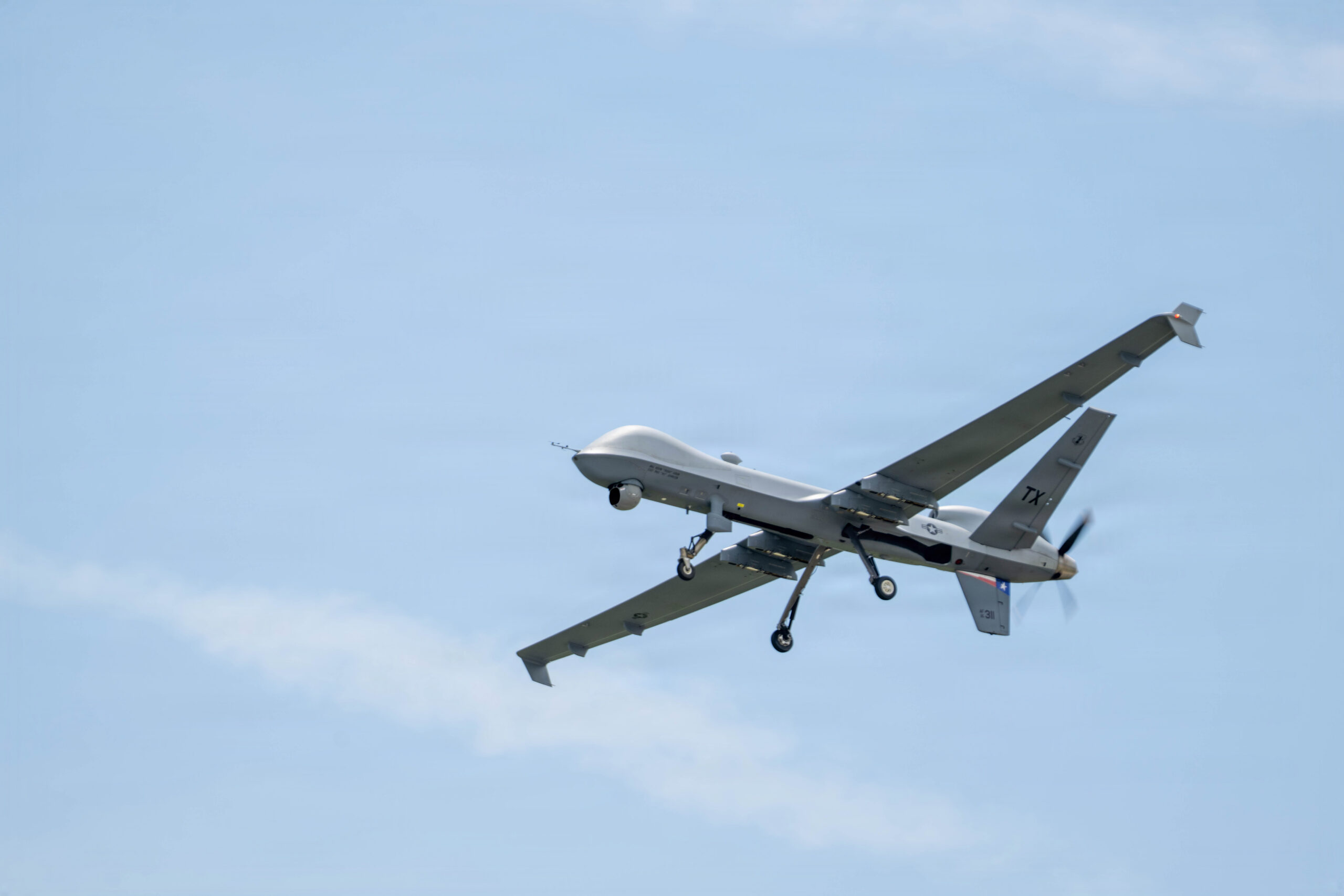
General Atomics aims Wildfire at the Air Force's $10 million cap for the Reaper's successor
The Massed Modular Aircraft solicitation pairs a roughly $10 million airframe price with an 8,000 nautical mile self-deploy and 2,800 pounds of payload. GA-ASI says its clean-sheet drone clears all of it years before fiscal 2031.
The Product Desk · Product desk
What happened
- General Atomics Aeronautical Systems unveiled Wildfire, a clean-sheet drone it calls a faster and more affordable successor to the MQ-9A Reaper, designed against the Pentagon's Massed Modular Aircraft requirements.
- The Air Force and Defense Innovation Unit launched that program in July, and Lt. Gen. Christopher Niemi said it was accelerated after "concerning" Reaper losses during combat operations against Iran.
- The solicitation asks for an aircraft that can self-deploy 8,000 nautical miles carrying at least 2,800 pounds of payload, at roughly $10 million each excluding mission equipment.
Compiled by The Product DeskSomething wrong?How this is made
Why it matters
- decision Because the price target stops at the airframe, the program office has to define mission equipment before any bid's $10 million figure can be compared to what a squadron actually fields.
- constraint With a hard price ceiling and demanding range and payload floors set together, there is little room to differentiate on the airframe, so delivery date and factory rate carry the bid.
- precedent If MMA copies the Collaborative Combat Aircraft model of open architectures and design increments, the two firms already holding CCA production deals, GA-ASI and Anduril, start this contest inside the tent.
An MQ-9 can cost as much as $50 million depending on its configuration, and production of the aircraft ended last year, though the upgraded MQ-9B SkyGuardian is still being built [5][6]. The Massed Modular Aircraft target of roughly $10 million an airframe is one fifth of that top-end Reaper figure [1]. Twenty aircraft at the target price is $200 million of airframes [2]. The target covers the aircraft and excludes the mission equipment it carries [7].
The buyer has already described the airframe it expects. Lt. Gen. Christopher Niemi said the MMA aircraft is unlikely to rely on "cutting-edge" technology, and that the design will "probably" use a turboprop engine paired with "a long aspect wing" [17]. GA-ASI President David Alexander said in a press release, "This is exactly the right design for high-demand missions and cost-conscious customers" [11]. Alexander also said: "Our tailor-designed, attrition-tolerant Wildfire balances the high capability our aircraft are known for with huge flexibility and great scalability. There's never been anything like it before." [12]
The price ceiling and the capability floors arrived together. Self-deploying 8,000 nautical miles while carrying at least 2,800 pounds is what the solicitation asks for [8]. GA-ASI says Wildfire exceeds that ferry range and carries two Long-Range Anti-Ship Missiles at the same time over what it calls meaningful combat distances [10]. The company puts no figure on that phrase.
The production claim is the load-bearing one, and it is about a factory. GA-ASI says it can produce more than twice as many aircraft within the same timeframe [14]. Measured against the program's benchmark of 20 mission-ready aircraft, more than twice is more than 40 by the same date [3]. The range, payload and rate figures are all the company's own.
Around the price cap sits a modularity pitch. GA-ASI says the aircraft accommodates different configurations of "munitions, launched effects, sensors or other payloads" [18], supports collaborative operations from the beginning [15], and could carry commercial cargo on what the company calls stronger hardpoints [19].
What matters on any attritable platform is what is inside the unit price, and what has to be bought again after each aircraft is lost. Attrition tolerance saves money only if the mission kit either survives the loss or costs less than the airframe, and a $10 million target written to exclude mission equipment settles neither [7].
What to watch
- Whether the Air Force and DIU publish what counts as mission equipment inside the roughly $10 million target.
- Whether MMA awards copy the Collaborative Combat Aircraft increment structure and go again to GA-ASI and Anduril.
- A flying Wildfire article demonstrating the claimed ferry range with two Long-Range Anti-Ship Missiles aboard.