Product3 publishersAlso reported elsewhere3 min readPublished
Alibaba's $25bn a year of e-commerce cash backs Joe Tsai's open-source pitch to Europe
Alibaba chairman Joe Tsai pitched open-source AI to Europe as its only path to independence while Alibaba funds AI with about $25bn a year of e-commerce cash. Three years of doubled compute spending make Alibaba's AI push a strategy buyers can plan around, and Tsai's own warning about trusting foreign technology covers Alibaba too.
The Product Desk
What happened
- In 2023 Alibaba cut itself down to two businesses, e-commerce and what Tsai called "full-stack" AI, running from computing infrastructure to models to applications.
- Tsai said Alibaba has doubled its capital spending on computing infrastructure every year for the past three years.
- Tsai said computing power is the piece Europe is missing and that it needs to "get serious" about building data centres to train and run models on its own infrastructure.
Compiled by The Product DeskSomething wrong?How this is made
Why it matters
- decision European procurement teams now have a stated reason, from a Chinese vendor's own chairman, to require a second model supplier whatever the first one's nationality.
- cost Independence on Tsai's terms turns the recurring access fee for a closed model into the capital cost of owning the data centres that run the open one.
- exposure A team that builds on Alibaba's continuing model work is exposed to its retail business, because the AI budget is drawn from e-commerce cash flow.
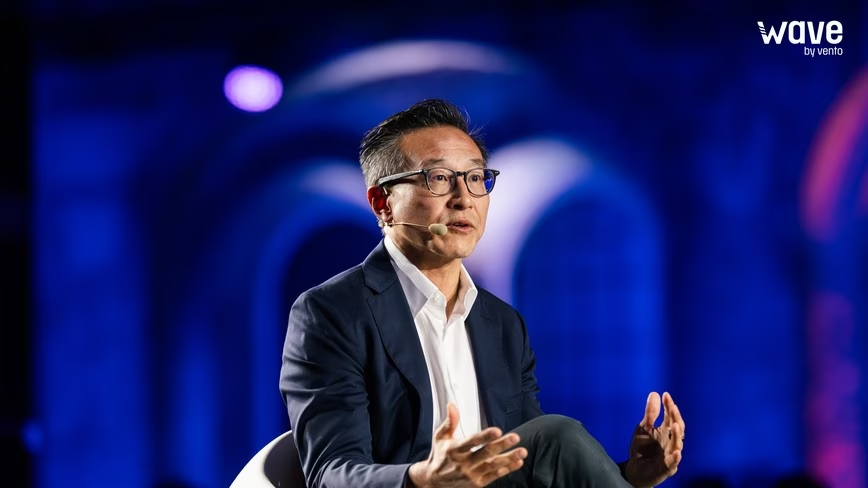
The person who has to act on Joe Tsai's advice is an IT lead at a European manufacturer. That person holds factory data and a vendor form asking where the model trained on it will run. Tsai said industrial companies around Turin hold data they would not want to send to a closed model. He said they could take open models, train them further on that data and run them themselves [7]. "I think the open source approach is the only way to go," Tsai said [2].
The thing being pitched is independence. Tsai compared open-weight models to a recipe that anyone can take and improve [8]. He said a company can run one in its own data centre, train it on its own data and stop depending on the original developer, and it avoids paying for access to closed models [8]. He also said no country should fully trust another country's technology, because a change of government or circumstances could see it switched off [9]. That goes for American and Chinese technology alike, he said [9].
The thing being done is spending. Three straight doublings leave Alibaba's compute capex at about eight times its level before the run began, on Tsai's account [15]. He put this year's combined US hyperscaler investment at around $1tn, a scale he said China does not match [14]. Still, a company that cut itself to two businesses in 2023 and then absorbed a profit hit of the size TNW reported has years of record behind its AI push [4] [6]. In my view, a team choosing a model supplier can treat that push as a standing Alibaba strategy. The account of the Turin session does not say which models, if any, Alibaba is offering European buyers [1].
"It is not a talent problem," Tsai said of Europe [13]. Alibaba Cloud opened data centres in France in June [11]. I'd expect Alibaba to make much of its money from the compute. Open weights spare a buyer the access fee [8], and someone still has to run them.
Any candidate supplier sorts on two lines: whether the buyer can take the weights, and whose hardware runs them. Running open weights on the buyer's own hardware is Tsai's version of independence [8]. With open weights on rented compute, a team can move the model, but the host can still cut it off. A closed model through an API means paying for access and depending on the developer and the government it answers to, by the test Tsai set [9]. For a European team that wants an open option from a home supplier, Paris-based Mistral released Large 4 with open weights on Tuesday [12].
What to watch
- Alibaba's next quarterly results, for whether AI spending keeps compressing profit after the cut TNW reported in August.
- Whether Alibaba Cloud's French data centres start hosting open-weight models for European industrial customers, which would show the sovereignty pitch being sold as cloud capacity.
- Whether European manufacturers fine-tune open-weight releases such as Mistral's Large 4 on hardware they own, or rent the compute.