Ng's new DeepLearning.ai spec is a reskilling checklist, not a hiring req
Built from 10,000-plus job postings and interviews with hiring managers, the four-skill list describes what buyers already want. Three of the four need no machine learning background.
The Engineer · Build desk
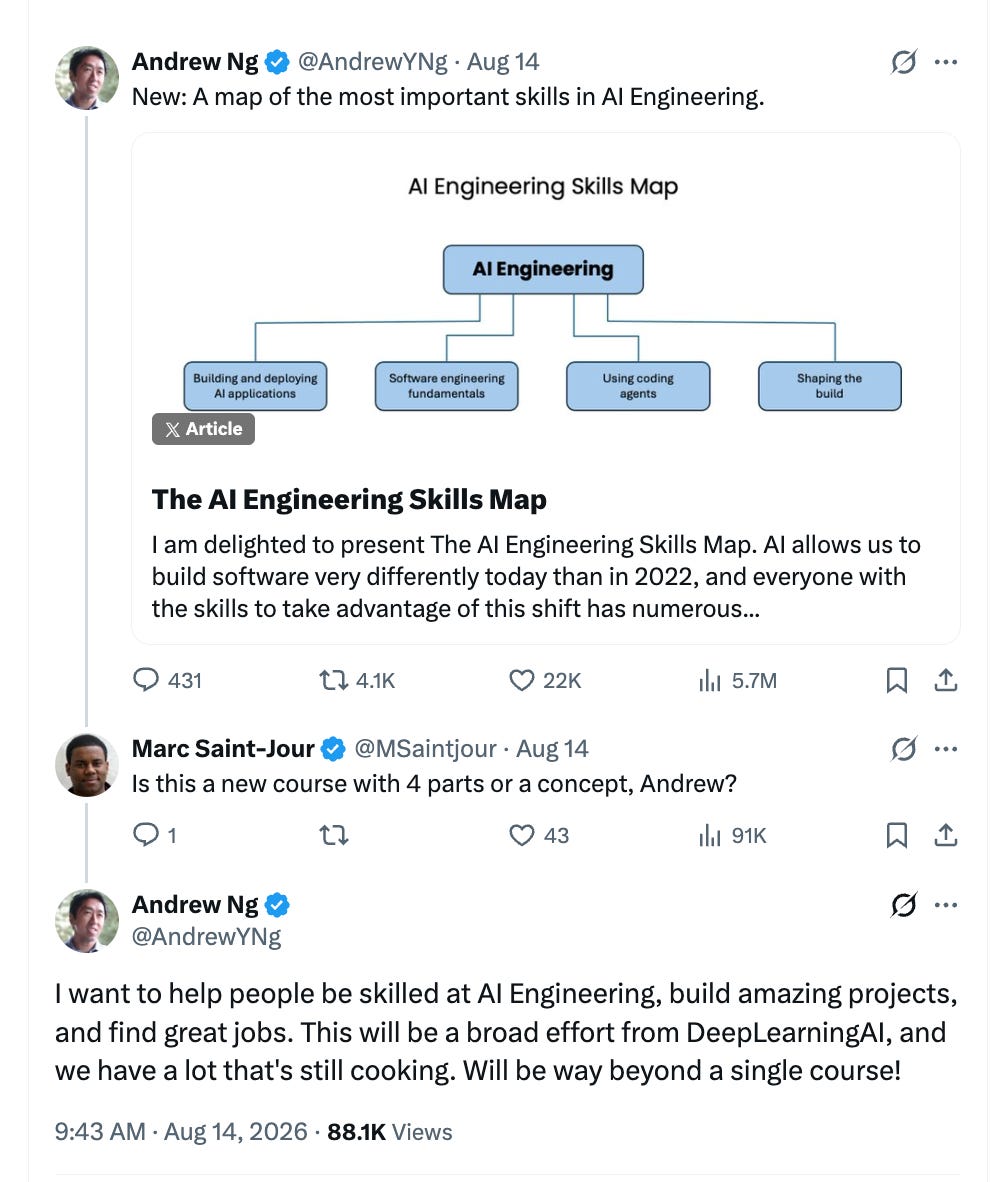
What happened
- Andrew Ng, cofounder of Google Brain and Coursera, is relaunching DeepLearning.ai around AI Engineering.
- Four skills are named: building and deploying AI applications, software engineering fundamentals, using coding agents, and shaping the build.
- Latent Space endorses Ng's framing that these skills apply well beyond people whose job title is AI Engineer.
Why it matters
- decision Managers weighing an AI specialist hire against retraining now have a demand-derived list where three of four items sit on ground their existing engineers already occupy.
- constraint One of the four competences is defined partly as keeping current with changing tools, so it cannot be discharged by a single training cycle and has to be funded as standing overhead.
- exposure Naming an agent damaging a production database as a skill failure moves that incident class from tool defect to operator error, which changes who answers for it internally.
- contradiction Latent Space's ceiling-over-floor claim cuts against the assumption that agent-fluent juniors substitute for experienced engineers, and the two readings imply opposite hiring budgets.
A syllabus assembled from job postings and recruiter interviews is not really a syllabus. It is a demand survey with homework attached. Andrew Ng's team says the four skills came out of over 10,000 postings, dozens of structured interviews with AI experts, hiring managers and recruiters, plus surveys and other online data [2]. That inverts the usual direction of educational content: instead of asserting what practitioners ought to know, it reports what people writing requisitions have been asking for.
Read that way, the useful signal is what the list leaves out. Only the first of the four items mentions models at all, and it frames LLMs, context engineering, RAG, agentic workflows, machine learning and deep learning as building blocks to be understood, alongside statistical techniques for measuring, steering and governing system behaviour [4]. The other three are software judgment [5], operating coding agents [6], and product involvement [8]. By the descriptions given, three of the four skills carry no requirement for machine learning or deep learning knowledge at all [15]. For a team deciding whether to open an AI specialist role, that is the number that matters: the distance a competent backend engineer has to travel is shorter than the job title suggests.
The genuinely scarce piece sits inside item one, and it is not model knowledge. It is the eval and error analysis loop [4]. That is closer to test discipline than to research, which is good news for transfer, and bad news for org charts where nobody owns it.
Item three has a shelf life written into its own definition. Ng's description asks not only for current practice but for routines to keep trying new tools as best practices change [7]. Latent Space's own account of the period supports the pace: agentic coding was barely visible in 2023 when Copilot was the only option, and the years to 2026 produced Cursor's run from zero to $60B and the rise of Claude Code, Codex, Cognition and Cline [12]. A competence defined as keeping up cannot be certified once.
There is a real disagreement in the material about who benefits. Ng contrasts the engineer who knows the tradeoffs with the inexperienced developer who vibe codes a solution without knowing what its coding agent is deciding [5]. Latent Space goes further, arguing LLMs reward expertise and raise the ceiling for strong developers much more than they raise the floor [10]. If that holds, the cheap-substitution plan runs backwards, and the highest-return spend is on the engineers already on staff.
The fourth item is the one no course fixes. Product sense, business context, customer goals, and the judgment of when to ship an MVP for user testing versus slowing down [8]: Latent Space calls this the only part of AI engineering its original essay missed, and says it responded by adding an AI PM track at its 2024 World's Fair [11]. Whether your engineers can acquire it is a question about access to customers, not about training budget.
One caveat on provenance: what is visible here is a newsletter's quotation of Ng's post, which it points readers to for the full argument [14]. The 10,000 postings themselves are not on the table.
What to watch
- Whether Ng publishes the underlying job posting analysis or its taxonomy, which would let teams check the four skills against their own requisitions.
- Whether the relaunched courses assess eval and error analysis work directly, or only teach it as material.
- Whether employer job ads begin quoting the four skill headings, which would turn a curriculum into a screening rubric.
Clarity's read
What the record supports and how the coverage leans. The claims behind it follow.
Reality
- Evidence38
- Adoption34
- Hype gap+22
- Incentives74
- Confidence41
Claim ledger
Ranked by verification strength, evidence, and original report placement.
- [1]
Andrew Ng, cofounder of Google Brain and Coursera, is relaunching DeepLearning.ai with a focus on AI Engineering.
- [2]
According to the announcement, the work was done via "an analysis of over 10,000 job postings; carrying out dozens of structured interviews with AI experts, hiring managers, and recruiters; gathering data through surveys; and synthesizing other online data".
- [3]
Ng names four most important AI engineering skills: building and deploying AI applications; software engineering fundamentals; using coding agents; and shaping the build.
- [4]
Ng on the first skill: people skilled at building and deploying AI applications understand the building blocks of AI (LLMs, context engineering, RAG, agentic workflows, machine learning and deep learning) and how to use statistical techniques to measure, steer and govern AI systems so they behave more predictably; a core skill is driving disciplined evals and error analysis loops.
- [5]
Ng on software engineering fundamentals: understanding them allows you to recognise what tradeoffs exist, leading to better decisions in choosing a software stack, designing system architecture, designing the data store and testing, and to better outcomes than an inexperienced developer who vibe codes a solution without knowing the tradeoffs their coding agent is making.
- [6]
Ng on using coding agents: the skill includes having a good mental model of how agents work, understanding their limitations and workarounds, knowing how much to intervene, working with a clear spec and knowing when not to bother, orchestrating multiple agents, and avoiding pitfalls such as an agent messing up your production database.
- [7]
Ng adds that because agentic coding is evolving quickly, using coding agents skilfully means not only knowing cutting-edge practices but having routines to keep trying new tools and evolve workflows as best practices change.
- [8]
Ng on shaping the build: effective AI engineering requires product sense and understanding of business context and customer goals so you can participate in shaping and driving the build, including knowing when to quickly build an MVP to take to users for testing and when to slow down and build more carefully.
- [9]
Latent Space says it agrees with Ng that "AI Engineering Skills" are broadly applicable to more than just those with the job title of "AI Engineer", and calls that an insightful focus.
- [10]
Latent Space argues that LLMs reward expertise, raising the ceiling for high-skill developers much more than they raise the floor for low-skill vibecoders, though both are improved.
- [11]
Latent Space says shaping the build is perhaps the only part of AI Engineering that was not foreseen in its original Rise of the AI Engineer essay, and that it added an AI PM track at World's Fair 2024, then Design Engineering and other adjacencies, as the lines blurred.
- [12]
Latent Space says that when it first wrote about the 1000x AI Engineer in 2023, Copilot was the only game in town and coding agents were the least evident part; coding then exploded in 2024-2026, culminating in Cursor's run from zero to $60B and the rise of Claude Code, Codex, Cognition and Cline.
- [13]
The item appeared in AI News covering 8/22/2026-8/24/2026, a section of Latent Space, which checked 12 subreddits and 544 Twitters for the issue.
- [14]
Latent Space quotes Ng's descriptions of the four skills and directs readers to his full post for more.
- [15]
Three of the four named skills, as described, contain no stated requirement for machine learning or deep learning knowledge.
Get this ledger inside ChatGPT. Ask about any of our stories and the answer brings its figure, each claim’s verdict and the sources. Free, no account.
Sources
1 independent publisher whose own reporting we read for this story.
- latent.space[AINews] Andrew Ng gets into AI Engineering
1 article · August 24, 2026
Topics and entities
Follow any of these and your For You feed starts watching them — no settings page required.
Topics
- AI Engineering SkillsFollow
- AI Education and CertificationFollow
- Developer Hiring and ReskillingFollow
- Coding AgentsFollow