Science1 publisher2 min readPublished
Planet Labs images show little sign of instability before the Langtang Lirung collapse
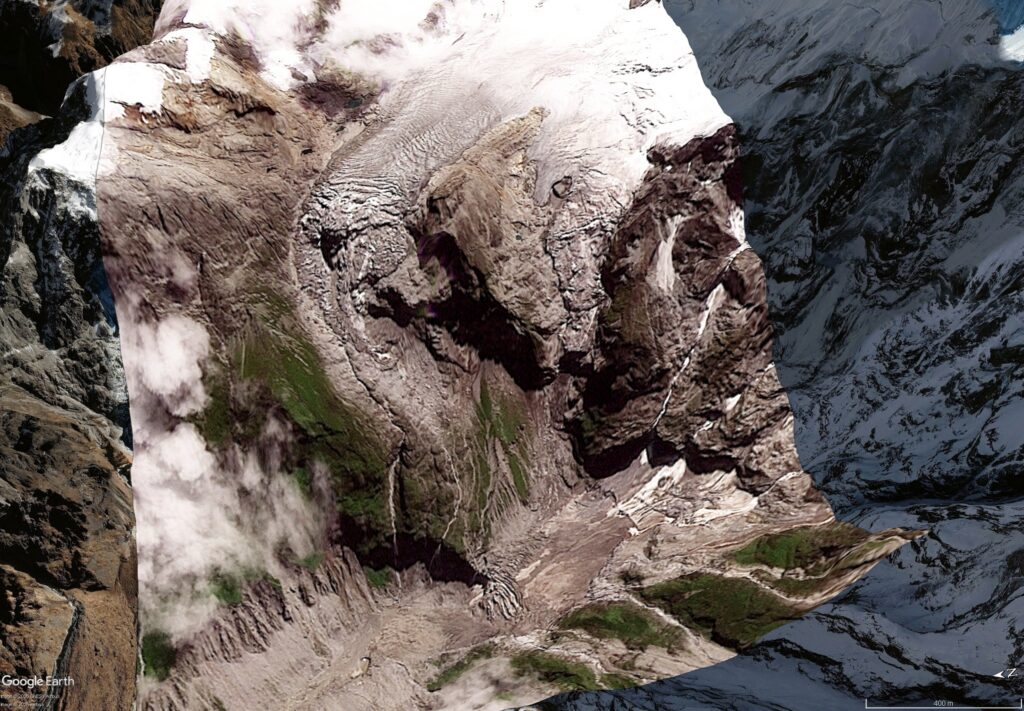
Eos's Landslide Blog compared Planet Labs images from 12 and 25 August and found little change on the Langtang Lirung slope that collapsed on 26 August. The few changes it found are hard to tell from background activity, a problem for optical warning systems that would rely on such imagery.
The Scientist · Science desk
What happened
- The disaster began as a very large rock slope failure on Langtang Lirung, in Nepal's Langtang National Park, and became a debris flow and flood that swept through Tibet and Nepal.
- The 25 August scene, collected the day before the failure, shows no obvious dust being generated and no obvious dust deposits around the slope that later failed.
- Ice near the landslide crown appears to have moved between the two dates, the same change earlier pixel-tracking research detected, though shadows make the reading uncertain.
- Several parts of the midslope rock face detached between 12 and 25 August, leaving large boulders collected just below them, still on the slope.
Compiled by The ScientistSomething wrong?How this is made
Why it matters
- constraint An alarm threshold low enough to catch rockfall and crown ice motion this small would, on the author's account, also be triggered by the slope's normal background activity.
- capability Pixel tracking registered the crown ice movement, so the case for optical warning on slopes like this one now depends on automated measurement of small displacements.
- exposure Communities below slopes that fail the way Langtang Lirung did gain little from systems calibrated on landslides with obvious precursors; the author says other large landslides behave very differently.
The Landslide Blog's author, writing on Eos, draped each Planet Labs scene onto the Google Earth elevation model and compared the two by eye, using a slider [8]. The scenes are of moderate spatial resolution. The author flags that as a caveat, then argues it is likely the imagery an optical early-warning system would be built on [3].
On first inspection the scenes differ mostly in shadows and cloud [4]. The changes that hold up under a closer look are midslope and at the crown. The author reads the detached rock and the boulders below it as debuttressing of the upper slope, probably part of how it failed [9]. "But these are really minor changes that are probably very difficult to differentiate from the background level of activity," the author wrote [10].
An alarm has to fire on a signal that stands out from what the slope does in an ordinary fortnight. On the author's account, a threshold set low enough to catch these changes would also catch routine activity [10].
Two scenes 13 days apart [1] cannot show how the slope moved in its final day, or whether its motion was speeding up. They give one before-and-after comparison and no rate. The only automated measurement in the record, earlier pixel-tracking research, did register the ice near the crown moving [6].
The author came to the images already doubtful about early warning: "loyal readers will know that I have my doubts about this," the post says [11]. "It is quite interesting that this slope generated so little obvious precursory signs of failure. Other large landslides behave very differently," the author wrote, adding that the case needs more detailed investigation [12][13].
I think the evidence supports a narrower verdict than a general one on optical warning. On this slope, comparing moderate-resolution scenes by eye would not have flagged the failure; the scene from the day before shows no dust and no fresh deposits [4][5]. One slope and two images cannot settle whether automated tracking of the same imagery could have caught it without false alarms from ordinary activity [6][10].
What to watch
- The more detailed investigation the author calls for, and whether it finds precursors the two optical scenes missed.
- Quantitative pixel-tracking results for the crown ice, showing whether its motion stood out from background before 26 August.
- Any imagery from between 12 and 26 August that could show whether movement on the slope was accelerating.