Science1 publisher3 min readPublished
A weaker AMOC does not just move heat around. It adds to the total
New work in Nature Geoscience finds past Atlantic slowdowns raised the heat stored by the global ocean, an effect the authors size at about 25 ppm of carbon dioxide.
The Scientist · Science desk
Drafted by a language model from the sources cited here and checked against its claim ledger before publication. How we use AISend a correction
What happened
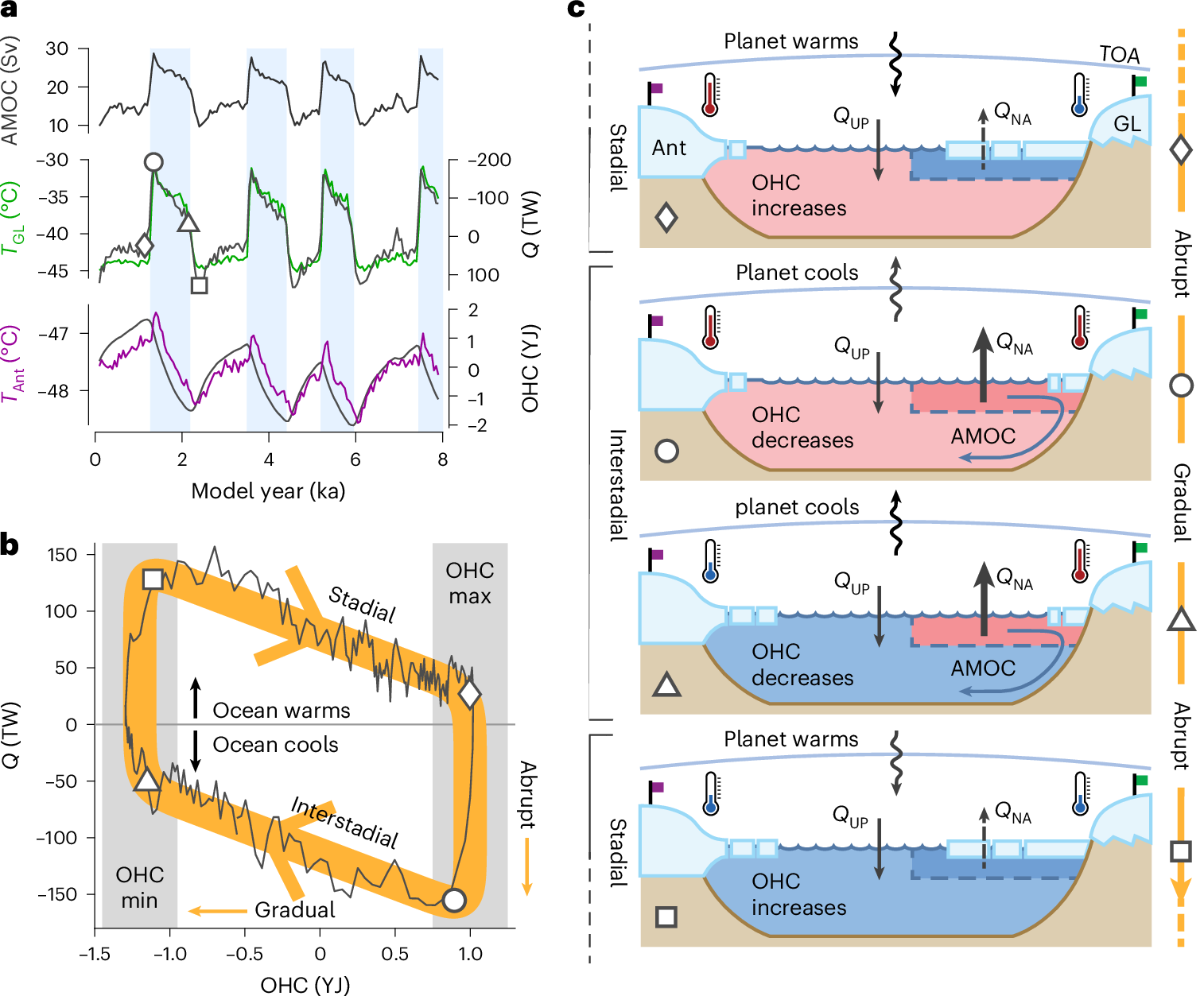
- An analysis of past natural oscillations in AMOC strength found that during periods with a strong AMOC the global ocean and planet lost heat, and when the AMOC was weak the global ocean and planet gained additional heat.
- Christo Buizert said, "The AMOC works like a heat valve that controls the energy budget of the planet." The study was published in Nature Geoscience.
- AMOC weakening would exacerbate warming across the planet, according to Buizert; its most direct impact is cooling in the North Atlantic and surrounding regions, including Greenland.
- Christo Buizert is a paleoclimatologist at Oregon State University, lead author of the study, and an associate professor in OSU's College of Earth, Ocean, and Atmospheric Sciences.
- Buizert said that when zooming out to the entire planet, the total amount of heat actually increases.
Compiled by The ScientistSomething wrong?How this is made
Why it matters
A study published in Nature Geoscience reports that the Atlantic Meridional Overturning Circulation acts as a control knob on the planet's energy budget, not just a conveyor that shuffles warmth between hemispheres [1][2]. That matters for anyone reading climate projections as a ledger: if AMOC decline is booked only as North Atlantic cooling, the global warming total is understated [3][5].
The analysis looked at past natural swings in AMOC strength and found a consistent sign. When the circulation was strong, the global ocean and the planet lost heat; when it was weak, both gained heat [1]. Christo Buizert, a paleoclimatologist at Oregon State University and the study's lead author, described the system as "a heat valve that controls the energy budget of the planet" [2][4].
The mechanism is plumbing rather than mystery. The ocean absorbs sunlight mostly in the tropics; a strong AMOC carries that heat to the North Atlantic, where deep ocean convection dumps it to the atmosphere [6]. When the circulation slows, the study finds, the heat instead accumulates in the ocean interior, including the North Atlantic itself, with only a thin surface layer cooling while the rest of the ocean warms [7]. Buizert's framing is that the ocean is a bucket of heat and the AMOC is the spigot [8].
This cuts against the standard interpretation of the abrupt AMOC changes recorded during the ice ages, the Dansgaard-Oeschger events, which are often cited as the clearest paleoclimate example of a tipping point [9][10]. Those weak-AMOC intervals plunged Europe, Greenland and the area of present-day New York into much colder conditions, and the prevailing explanation was a thermal bipolar seesaw moving heat to the Southern Hemisphere [11][12]. The new work says the books do not balance that way: there was a net increase in heat stored by the global ocean [13].
On magnitude, Buizert put the last Ice Age's AMOC weakening events at roughly the warming that 25 ppm of carbon dioxide would produce today, which he equated to about 10 years of human emissions [14]. Taken at face value, that implies an assumed emissions pace near 2.5 ppm per year [15]. It is not a large number against total anthropogenic forcing, but it is an additive term that regional-cooling framings drop entirely.
The result rests on a new accounting framework applied to simulations of abrupt AMOC change in three climate models, tracking where heat goes in the ocean and how much the planet loses or gains overall [16]. That is a model-based finding, not an observational one, and Buizert notes that natural past changes are an imperfect analogue for the modern shift [17]. The AMOC has been strong for the 11,700 years since the last Ice Age ended, while many models project weakening under human-driven warming [18].
Buizert also reports a stabilising result: in a warmer world the AMOC tends to be more stable, which suggests future weakening could recover rather than tip, and that irreversible collapse might not occur [19]. He is explicit that more work is needed on future stability [19].
Two things to watch. Whether independent groups reproduce the net-heat-gain sign outside these three models, and whether the planetary energy-budget term shows up in the next round of projections rather than only the regional cooling. The authors also flag that the global weather and climate consequences of a changing AMOC remain underexamined [20].