Science1 publisher3 min readPublished
A phage kinase with no target list: EMBL finds one enzyme that breaks several bacterial defences
EMBL Heidelberg reports in Nature that T7 phage phosphorylates nearly the whole E. coli proteome within minutes, disabling defence systems that work by different mechanisms.
The Scientist · Science desk
Drafted by a language model from the sources cited here and checked against its claim ledger before publication. How we use AISend a correction
What happened
- EMBL scientists and collaborators discovered a new paradigm by which phages can shut down bacterial defence systems; the findings were published in the journal Nature.
- The study demonstrates, for the first time, how a single phage protein can shut down multiple bacterial defences with different mechanisms of action.
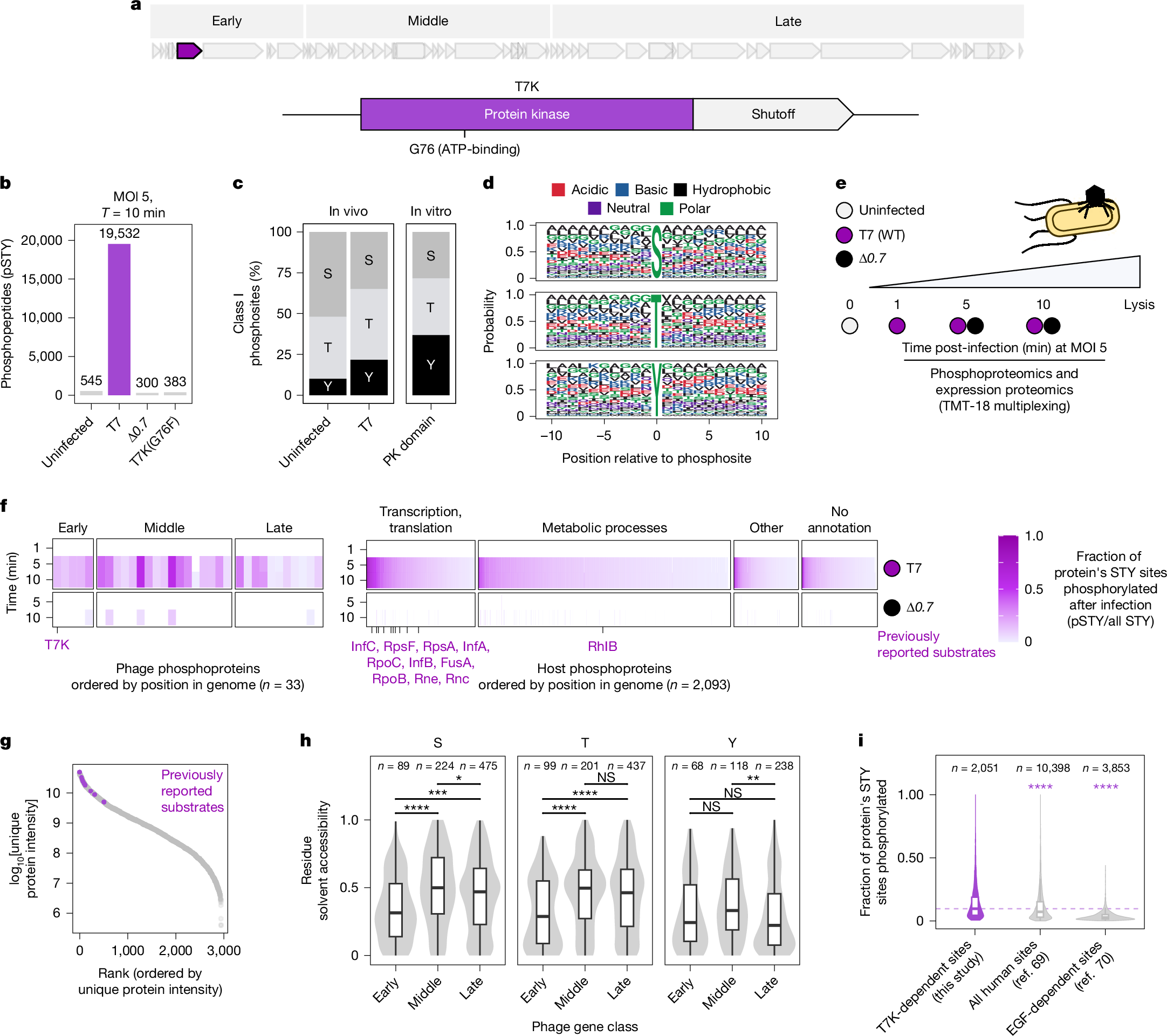
- Phage infection resulted in almost every bacterial protein becoming phosphorylated within minutes, at least in part of the protein pool in the cell.
- The findings resulted from a collaboration between two research groups at EMBL Heidelberg: the Typas Group, which specialises in systematic studies of bacterial interactions, and the Savitski Team, whose members are experts in proteomics technologies.
- The researchers used a model system of E. coli and T7 phage, a prototypical virus studied since the dawn of molecular biology that infects E. coli.
Compiled by The ScientistSomething wrong?How this is made
Why it matters
Researchers at EMBL Heidelberg and collaborators report in Nature that a single phage protein can shut down multiple bacterial defence systems that operate by different mechanisms, which they describe as a first [1][2]. The route is not a targeted inhibitor but an indiscriminate one: within minutes of infection, almost every bacterial protein becomes phosphorylated, at least in part of the cell's pool of that protein [3].
The work joined two groups at EMBL Heidelberg, the Typas Group, which does systematic studies of bacterial interactions, and the Savitski Team, which runs proteomics [4]. They used E. coli and T7, a phage studied since the early days of molecular biology, in which infection ends with the phage bursting out and killing the host in about 15 minutes [5][6]. Given that speed, the team looked at post-translational modifications rather than at changes in protein abundance [7].
The likely agent is T7 kinase, an enzyme first discovered in the 1970s [8]. Its list of phosphorylation targets exceeds what is known for any kinase in nature, which is why the authors call it a "loose cannon" [9]. According to Mikhail Savitski, head of the Proteomics Core Facility at EMBL Heidelberg, this was "a catastrophic phosphorylation across the entire proteome in a completely nonspecific manner," with no discernible pattern to it [10].
That creates a problem the paper has to solve rather than a result it can simply report. Earlier studies found that deleting T7 kinase from the phage genome does not really affect infection [11]. Nassos Typas, head of EMBL's Molecular Systems Biology Unit, put the other half of the puzzle plainly: if you uncontrollably phosphorylate every host protein, how does that help a phage that still depends on host machinery such as the ribosome [12]. Two features contain the damage. The kinase is short-lived and deactivates itself 5 to 6 minutes after infection [13], roughly a third of the 15-minute cycle [14], and its structure carries a shutoff domain sitting far from the enzyme domain [15].
For anyone building phage therapy, the useful part is the selection logic, not the enzymology. Phages offer a way to kill pathogenic bacteria selectively, including strains resistant to conventional antibiotics, but using them well depends on understanding how they interact with their hosts [16][17]. A gene whose deletion produces no obvious infection phenotype in the lab [11] is exactly the kind of thing a screen based on infection efficiency will discard, even if it is what lets a candidate phage get past a clinical isolate's defence repertoire. Breadth of anti-defence activity is a separate axis from host range and lysis speed, and this result suggests it can come from one promiscuous enzyme rather than a stack of specific inhibitors [2].
What to watch: which specific defence systems the kinase disables, and whether the effect holds in hosts other than laboratory E. coli. The material available here does not name them, nor does it settle how the shutoff domain terminates the reaction. Also worth tracking is whether developers begin genotyping candidate phages for kinases of this class, given that phage research has already produced tools of wide use, including CRISPR-Cas9 [18].