Science1 publisher3 min readPublished Updated
A squeeze on iron sulfide moves an altermagnet's two signals together
Rice researchers report that uniaxial strain shrinks both the residual moment and the anomalous Hall voltage in hexagonal FeS, while the underlying magnetic order sits still.
The Scientist · Science desk
Drafted by a language model from the sources cited here and checked against its claim ledger before publication. How we use AISend a correction
What happened
- Researchers at Rice University found that gently squeezing a crystal of iron sulfide can change two of its unusual properties at the same time: its tiny magnetic signal and the way electricity moves through it.
- The Rice team studied a hexagonal form of iron sulfide (FeS).
- Altermagnets combine features of two familiar magnet types: like antiferromagnets their internal magnetic moments mostly cancel, so they do not produce the strong external field of an ordinary magnet, yet they can still affect moving electrons in ways that could be useful for future electronic devices.
- Although most of the magnetism in the studied FeS cancels out, the material has a very small leftover magnetic moment.
- FeS produces an anomalous Hall effect: when current flows through the material, a small voltage appears sideways even when no external magnetic field is applied.
Compiled by The ScientistSomething wrong?How this is made
Why it matters
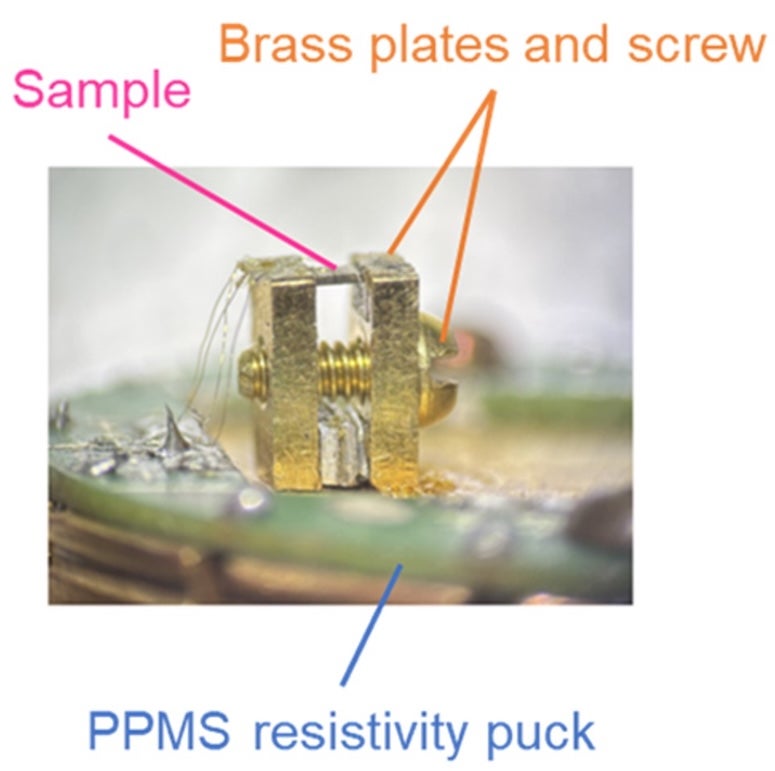
A team at Rice University reports that gently compressing a crystal of hexagonal iron sulfide along one direction reduces two things at once: the material's very small leftover magnetic moment and the sideways voltage it generates when current flows without any applied field [1][2][4][5][7]. That matters because it turns a property that has mostly been argued about in classification terms into something an experimenter can move with a clamp [7][13].
FeS belongs to the altermagnets, a recently recognized group in which internal moments largely cancel, so the material produces no strong external field, yet it can still act on moving electrons in ways that ordinary antiferromagnets do not [3]. In FeS that action shows up as an anomalous Hall effect, a transverse voltage with no external magnetic field present [5].
The experimental point is the simultaneity. Corresponding author Pengcheng Dai said the value of this material is that the tiny magnetic signal and the electrical signal can be watched at the same time, and that squeezing the crystal in one direction makes both smaller together, which indicates the two are closely connected [6][16]. Neutron measurements at Oak Ridge National Laboratory showed that the basic magnetic structure does not change under the squeeze; what changes is which magnetic orientations dominate inside the crystal [8]. The much larger underlying magnetic order was essentially unchanged [7].
That combination narrows the interpretation. Because the crystal has several nearly equivalent directions for its moments to point, separated by very small energies, modest pressure is enough to favor some over others [9]. Put together, the reported response looks like a redistribution among near-degenerate orientation states rather than a change in the size of the antiferromagnetic order parameter [17]. The team is not claiming the standard electronic explanation is wrong. First author Weiliang Yao said the measurements show the small moment and the anomalous Hall effect are strongly linked in this material, and that understanding why is now the open question [11]; the Rice work does not rule out the usual account based on Berry curvature in the electronic structure [10].
For operators, the interesting part is the knob, not the taxonomy. Mechanical strain is cheap, local, and already used in semiconductor manufacturing, and the Rice authors frame it as a route to control in spintronics, where the aim is to use electron magnetism for storage or processing with less stray magnetic interference and lower energy use than some conventional approaches [12]. Dai's framing is that control is essential for applications, and that a relatively simple mechanical squeeze changes important magnetic and electrical properties together [13].
The caveat is sizing. The public account gives no strain magnitude, no size for the residual moment or the Hall response, and no measurement temperature, so there is no way yet to judge whether the effect is usable at device scale or only visible in a laboratory press [18]. The paper is in Advanced Materials, and the work combined crystal growth, transport, magnetization and neutron scattering with the groups of Qimiao Si and Emilia Morosan at the Rice Laboratory for Emergent Magnetic Materials [14][15].
Watch for the numbers in the published version: strain per unit change in Hall signal, the temperature range over which the coupling holds, and whether the switching is reversible on repeated cycling. Watch also for whether the same trick works in altermagnet candidates with larger Hall signals, since FeS was chosen partly because its orientation states are unusually close in energy [9].