Science1 publisher3 min readPublished
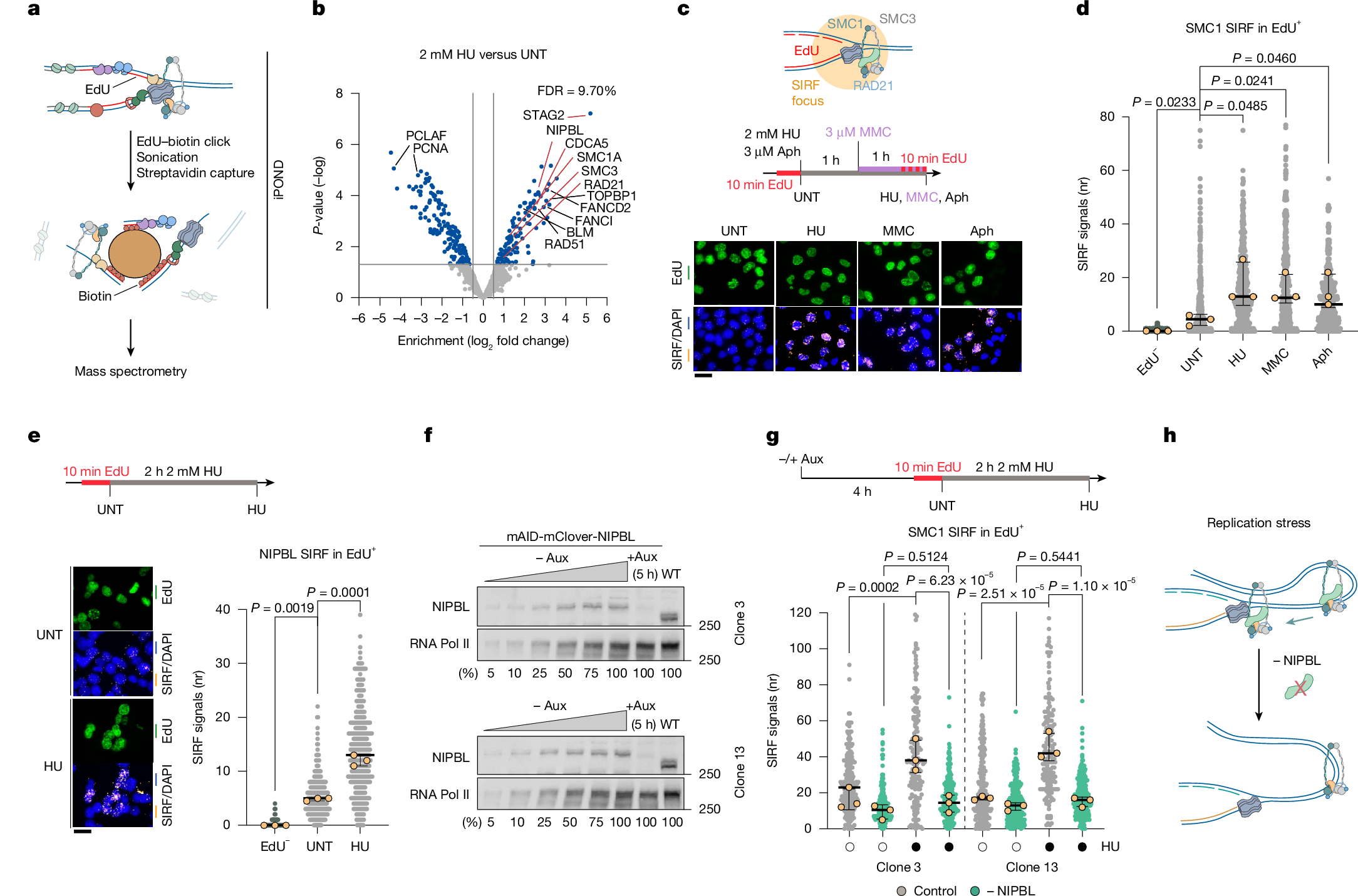
Cohesin reorganizes newly copied DNA where replication stalls
A Nature paper from the University of Zurich and the CNIO reports that cohesin is pulled to sites where DNA replication is disrupted, holds the new copy in a protective arrangement, and keeps the error-prone restart factor Primpol switched off.
The Scientist · Science desk
What happened
- An international team from the University of Zurich's Institute of Molecular Cancer Research and Spain's CNIO reported in Nature a process cells use during division to safeguard their genetic information.
- They describe cohesin, long studied as a chromosome-organizing protein, acting as a molecular anchor that reorganizes newly replicated DNA when replication runs into obstacles.
- Cohesin is rapidly recruited to the sites where replication has been disrupted, according to the researchers.
Compiled by The ScientistSomething wrong?How this is made
Why it matters
- capability A map that separates the new DNA copy from the parental one makes folding a measurable variable in replication-stress work, so other groups can ask whether their stressor also reshapes nascent DNA.
- constraint The size of the Primpol suppression cannot be worked out from the announcement. That limits how far the result can be pushed until the cell system and the loss-of-function numbers are read out of the paper itself.
- precedent If a structural step belongs in the stalled-fork response, work on fork protection now has to say where the new DNA sits, on top of which enzymes act on it.
The finding rested on a measurement that had to be built first. Daniel Gonzalez at the IMCR and Daniel Gimenez at the CNIO, the paper's co-first authors, developed a genomic approach that maps the three-dimensional organization of newly replicated DNA [14]. The restriction to the new copy is the point of the design, because the claim is about how freshly made DNA is arranged. The study pairs Massimo Lopes's replication-stress group at the IMCR with Ana Losada's cohesin group at the CNIO [12], and Gonzalez, a postdoctoral researcher, led the conception and much of the experimental work [13]. The genomic analysis was complemented by microscopy [15].
Losada said cohesin "moves quickly to the affected region, providing stability and promoting a protective DNA organization that preserves genome integrity" [9]. The first half of that sentence is a location, and the second is a function; establishing the function means taking cohesin away and watching what breaks. The phys.org account does not give the cell system used or the size of the Primpol effect [19].
Primpol can restart replication as an emergency response when a fork has stopped, and in doing so it may introduce a large number of genetic errors [10]. Cohesin, on this account, prevents Primpol from being activated [10]. That leaves the protein doing two things at a disrupted fork at once: holding the new DNA in a particular arrangement, and keeping the fast and error-prone rescue route shut [2].
Cohesin already had two credited jobs. It holds together the two copies of each chromosome before division so they are distributed correctly to daughter cells, and it helps newly replicated DNA adopt the right three-dimensional organization in the nucleus [3]. This is a third [4]. Losada, who was the first to identify cohesin in vertebrates in the late 1990s [7], said that "DNA folding by cohesin is not simply a way to make the molecule fit inside the nucleus. It brings together regions of the genome that may be far apart along the DNA sequence, allowing distant genes to coordinate their activity" [5].
The disease language in the framing is about origins. "If these interruptions are not properly managed, DNA can break or accumulate mutations that may contribute to diseases such as cancer," Losada said [6]. The quote is about where mutations come from. In my view no target follows from it yet: nothing in the account tries to manipulate cohesin or Primpol for therapeutic effect, and a structural step in fork protection is a long way from a drug. What it does change is the list of variables a replication-stress experiment has to control, since the folding of the new copy is now one of them [2].
What to watch
- The Nature paper itself: whether removing cohesin raises Primpol-dependent errors, in which cell system, and by how much.
- Whether other replication-stress labs adopt the nascent-DNA folding map and apply it to stressors other than nucleotide shortage.
- Whether the same structural response shows up in primary cells and in distant organisms, given how conserved cohesin is.