Science3 publishers3 min readPublished Updated
Researchers report in Nature that mouse skull bone marrow holds germinal-centre-like lymphoid structures that respond to CNS antigens and help drive anti-tumour immunity.
The Scientist · Science desk

Compiled by The ScientistSomething wrong?How this is made
A paper in Nature reports that the bone marrow of the mouse skull contains organised lymphoid structures, including germinal-centre-like formations, that surveil and respond to antigens derived from the central nervous system [1][5]. The consequence is a change of job description: the calvarium stops being a supply depot that ships immune cells toward the brain and becomes a place where antigen-specific decisions about the brain are partly taken [3][4].
The anatomy has been accumulating for a few years. Osseous channels connect skull marrow directly to the dura mater, letting cerebrospinal fluid and immune cells move between the CNS and skull marrow in mice under both homeostatic and disease conditions [2]. Skull marrow was already known as a primary lymphoid organ that supplies immune cells, including developing and immature B cells and myeloid cells, to the CNS and its border regions [3]. What was unclear, the authors write, is whether that traffic amounted to anything more than logistics [4].
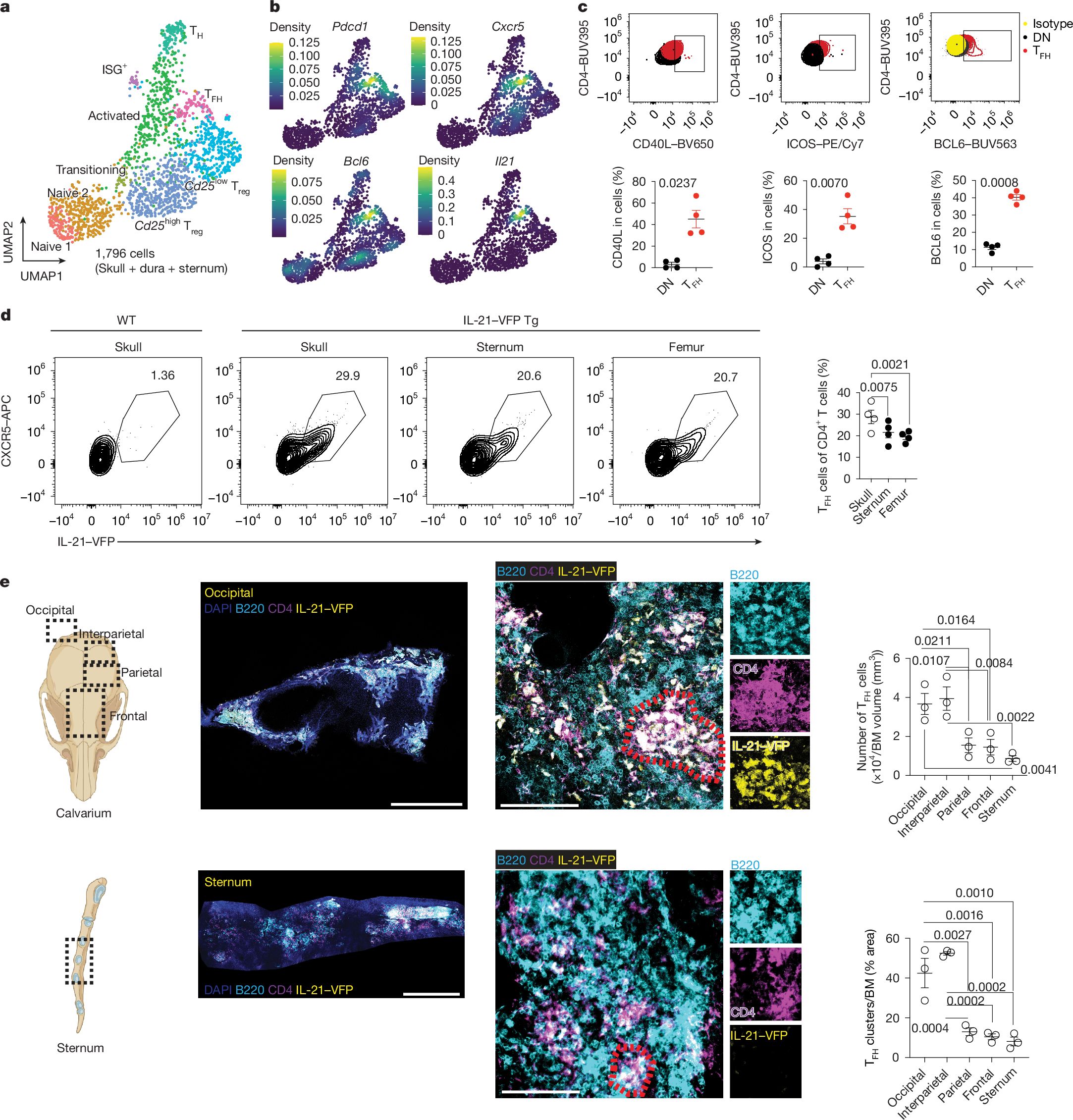
Their answer is that antigen-presenting cells, T cells and B cells form clusters with germinal-centre-like structures inside mouse skull marrow [5][6]. Within them sits a distinct population of follicular-helper-like T cells that promotes B cell activation and humoral immunity through CD40L, IL-21 and IFN-gamma signalling [1]. Single-cell RNA sequencing of T cells from mouse skull and sternum marrow turned up the expected CD4+ spread, from naive and activated through regulatory and differentiated helper subsets, plus follicular helper T cells marked by Pdcd1, Cxcr5, Bcl6 and Il21 [8]. Flow cytometry in IL-21-VFP reporter mice confirmed IL-21+CXCR5+ cells as a discrete subset, with CD4+ T cells the main source of IL-21 in marrow [9][10]. Skull marrow also carried a higher proportion of central memory T cells than other marrow sites, while overall T cell frequencies remained below those of secondary lymphoid organs [7][11].
The functional test is the part operators should care about. Modulating the presence and activity of these structures in vivo changed anti-tumour immunity in mouse brain cancer models, meaning the skull compartment is not merely correlated with the response but contributes to it [6][12]. That lines up with earlier reports of tumour-specific CD8+ T cells in the skull marrow of human glioblastoma patients and regulatory T cells in mouse tumour models [13]. If the skull is where anti-brain-tumour help gets licensed, it is a target in its own right, distinct from the tumour bed and from cervical lymph nodes.
Two cautions. Almost everything new here is mouse work; the human data point is prior literature, not this paper's own demonstration [14]. And the disease evidence presented is confined to brain cancer models, with the broader suggestion that skull marrow may influence responses across diverse neurological diseases stated as possibility rather than result [15]. Extending the mechanism to CNS autoimmunity is the obvious next hypothesis, and it is untested here.
Watch for whether calvarial marrow from human surgical samples shows the same clustered architecture, and whether blocking the named axis of CD40L, IL-21 and IFN-gamma degrades anti-tumour immunity or, in an autoimmune setting, protects [1][12].
Ranked by verification strength, evidence, and original report placement.
The authors identify lymphoid structures within skull bone marrow featuring germinal-centre-like formations and containing a distinct population of follicular-helper-like T cells that promote B cell activation and humoral immunity through CD40L, IL-21 and IFN-gamma signalling.
The authors state that whether and how skull bone marrow contributes to CNS antigen recognition and immunosurveillance had not previously been elucidated.
In mouse skull bone marrow, antigen-presenting cells, T cells and B cells form clusters with germinal centre-like structures, and these structures participate in CNS immune surveillance under homeostatic and brain cancer conditions.
Channels between the skull and the dura mater facilitate exchange of cerebrospinal fluid and immune cells between the CNS and skull bone marrow of mice under both homeostatic and disease conditions.
By modulating the presence and activity of the skull lymphoid structures in vivo, the authors show these structures contribute to anti-tumour immune responses in mouse brain cancer models.
Skull bone marrow is a primary lymphoid organ that supplies immune cells, including developing and immature B cells and myeloid cells, to the CNS and CNS border regions under homeostatic and neuroinflammatory or injurious conditions.
Follow any of these and your For You feed starts watching them — no settings page required.
Evidence-backed comparisons of source perspectives and observed adoption signals. Read the methodology
Which Builder, Operator, and Investor concerns the observed source mix emphasized—not a truth score.
Evidence, demonstrated adoption, hype gap, incentives, and confidence are assessed independently, each on its own current evidence. How these are measured.
Multi-modal, single lab
Four different assays converge on the central structural claim inside one paper: single-cell sequencing of skull and sternum marrow T cells, flow cytometry in IL-21 reporter mice, confocal imaging of whole calvaria, and in vivo perturbation run in both directions. The weakness is provenance rather than method, since every new result comes from one laboratory, and the human component is a reanalysis of a dataset published by others. Vesa Kiviniemi, quoted by New Scientist, endorses the work without having repeated any of it.
Preclinical, mouse only
Everything here is still in the animal room. The therapy is a gel on mouse scalps, the survival deltas are days in tumour-bearing mice, and the human presence of these hubs is inferred from low-abundance cells in a previously published skull marrow dataset. Kiviniemi's own condition for believing the human case, analysis of cadaver skulls, has not been met, and no clinical work, trial or commercial programme appears anywhere in this reporting.
Mouse data, human disease list
The abstract's reach is one hedged sentence about diverse neurological diseases. By the time Kipnis is quoted in GEN, that has become Alzheimer's, Parkinson's, schizophrenia and long COVID, plus the claim that the understanding of neuroimmunology has changed, none of which the experiments address. New Scientist's framing, that the hubs 'may' keep the brain healthy, sits much closer to what the survival curves actually show, and it is also the only outlet that lets an outsider name the missing human work.
A lab extending its own map
The Kipnis lab made its name on lymphatic vessels in the dura and on the skull-to-brain channels, and this result extends that same account of the brain's borders, so the group is adding to a story it owns. GEN's piece is assembled almost entirely from WashU Medicine quotes and excerpts of the paper. A therapeutic route is already in frame, and the first author is launching a laboratory at KAIST on the strength of the work. New Scientist at least called Oulu for an outside view.
Firm in mice, thin in people
The mouse anatomy and the two-way survival effect are well corroborated within the paper and unchallenged by the outside voice in our coverage, so that part holds. The human extension and the disease list beyond glioblastoma rest on a reanalysed dataset and on quotes, which is exactly where the coverage pushes hardest.
science
A pyridine reaction that moves the nitrogen instead of the substituents2 publishers
science
One enzyme sets the chromatin mark that links early stress to adult anxiety in mice1 publisher
science
A pole-on magnetar hands vacuum birefringence its first astrophysical candidate1 publisher
science
A phage kinase with no target list: EMBL finds one enzyme that breaks several bacterial defences1 publisher
Publishers with included, body-backed reporting in this cluster.
1 article · August 20, 2026
1 article · August 18, 2026
1 article · August 19, 2026