Invest1 publisher3 min readPublished
SaaStr books one sponsor meeting for every 28 conversations its inbound agent holds
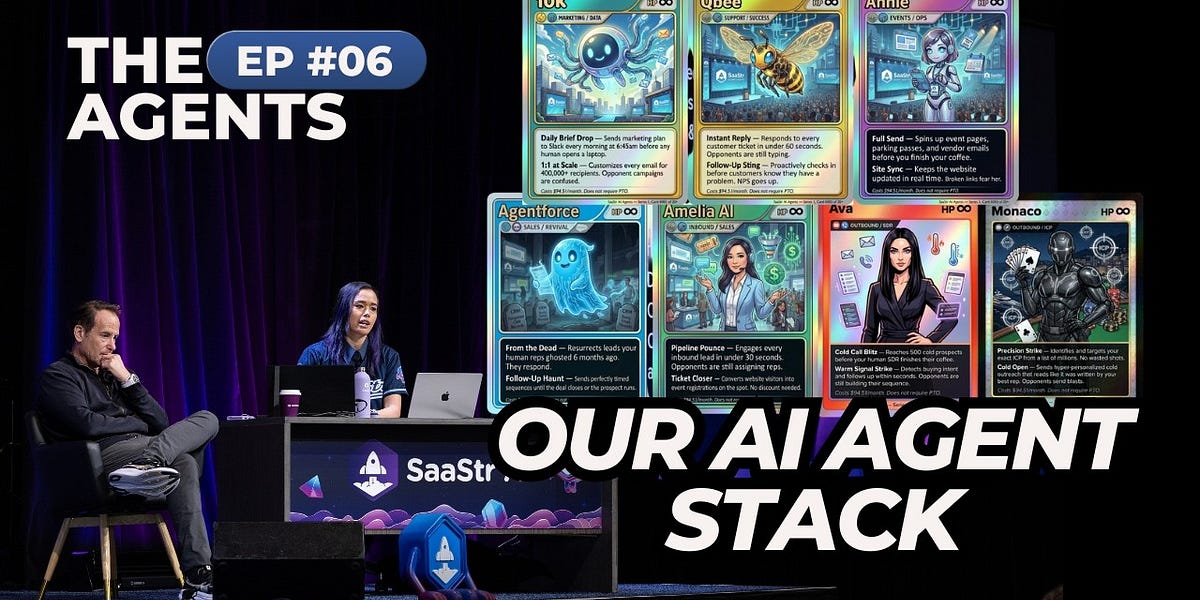
SaaStr published a screen-by-screen account of the agent stack behind its sponsorship business. Its own figures put three people and more than 21 agents against 3 million site sessions and about 600 booked meetings.
The Investor · Invest desk
What happened
- SaaStr published a screen-by-screen walkthrough of the agent stack running its sponsorship business, which it says three humans and more than 21 agents in production now operate.
- New business from inbound is up 60 per cent, a gain the company attributes directly to its inbound agents.
- Renewals are 60 per cent ahead year to date, and SaaStr says it has already passed all of last year's renewal total in roughly three months since its Annual event.
- Everything runs through an internal agent called 10K, built on Replit, which is the team's daily dashboard, queue, renewal tracker and AP tracker, and which writes to Salesforce.
Compiled by The InvestorSomething wrong?How this is made
Why it matters
- constraint Traffic no longer sets the size of the top of this funnel, so the binding limit is what a three-person team plus one full-time seller can convert.
- contradiction A trailing-12-month doubling and a 2.1x measured against a year just started are not the same claim, and with no dollar base disclosed a reader cannot size either one.
- decision Salesforce keeps the record and the renewal here while its interface goes largely unopened, so anyone repricing CRM seats has a public example of licence and usage coming apart.
- precedent Seven agents for every human is now a published staffing ratio, and it will be quoted at revenue teams that have not tried one.
One conversation for every 176 sessions, and one meeting for every 28 conversations [1] [2]. At roughly $90K of annual contract value each, the 600 meetings SaaStr booked for its AI Annual event come to about $54m if every one signed at that price [8] [3]. For the same agent over the same year, the write-up reports "a couple million in influenced and closed pipeline" [16]. Two million against fifty-four million is 3.7 per cent [4].
The write-up describes the inbound path in one line: "they do their own discovery, they talk to the agent, they book their own meeting, they close" [25]. The team also includes a full-time sales exec, who logs into Salesforce sometimes, while Amelia logs in to click a button when she has to and the post's author never logs in at all [12].
The plumbing is the more specific disclosure. Everything feeds an internal agent SaaStr calls 10K, built on Replit [10]. It started about six months ago as a basic Replit dashboard with Salesforce hooked into it, and became headless Salesforce almost by accident, the post says [11]. Salesforce is still the system of record, next to Momentum for call recording, Qualified, Marketing Cloud on Agentforce, Sales Cloud and Slack, with about 30 further integrations behind 10K [13]. The reason SaaStr gives for the headless setup: "the agent can pull from all of them at once, and the Salesforce UI only shows you Salesforce" [14].
The growth numbers come as multiples, and the post does not give a revenue base. Two framings of the same line sit close together: sponsorship revenue "has doubled in the last 12 months" [9], and sponsorship revenue at 2.1x year over year "with the year just started" [1]. The renewal claim has the same shape, since passing all of last year's renewal total in roughly three months since Annual compares a partial year against a whole one [4].
The front end changed in thirteen months. It was a page with a long contact form that round-robined to Amelia or David, with follow-up inside about a day [18]. The post gives Amelia's unedited view of the form letter that came back: "it's the worst email on planet Earth" [17]. Door one is now Amelia AI, an avatar on Qualified that qualifies for budget, for lead gen versus brand versus speaking, and for which competitors the buyer is watching, then books the meeting on the spot [15]. Door two survived a debate about killing self-serve entirely, kept because a real share of buyers will not talk to an avatar [19]. Its old version was a link to a Google Slides prospectus that converted worse than the avatar for a year [20]. The replacement issues a tokenized prospectus unique to each company and heat-maps it with Microsoft Clarity, which 10K picked itself, and the agent then waits ten minutes, because most self-serve visitors click off after five to seven [21].
SaaStr says the post will identify the one part of the funnel that still isn't solved, and the published account stops partway through that self-serve sequence without naming it [22]. I would treat the 3.7 per cent as the open question: booking is cheap at 28 conversations a meeting [2], and the closed dollars behind it are small next to what the meeting count implies [3] [4]. The counter-case is an accounting one. If "a couple million" counts only what the inbound agent is credited for, while the 2.1x is carried by renewals and by outbound revenue up 124 per cent [16] [1] [5], then the comparison sets a subset against a gross. Publishing the dollar base and the attribution window would settle it.
What to watch
- Whether SaaStr publishes the dollar base under the 2.1x and the attribution window behind "influenced and closed pipeline".
- Whether the tokenized self-serve prospectus out-converts the Amelia AI avatar, after losing to it for a year on the Google Slides version.
- Whether renewals stay 60 per cent ahead once the three-months-since-Annual window lapses and the comparison is year against year.