Invest1 publisher2 min readPublished
Bloomberg Aggregate posts its first negative five-year return since its 1976 inception
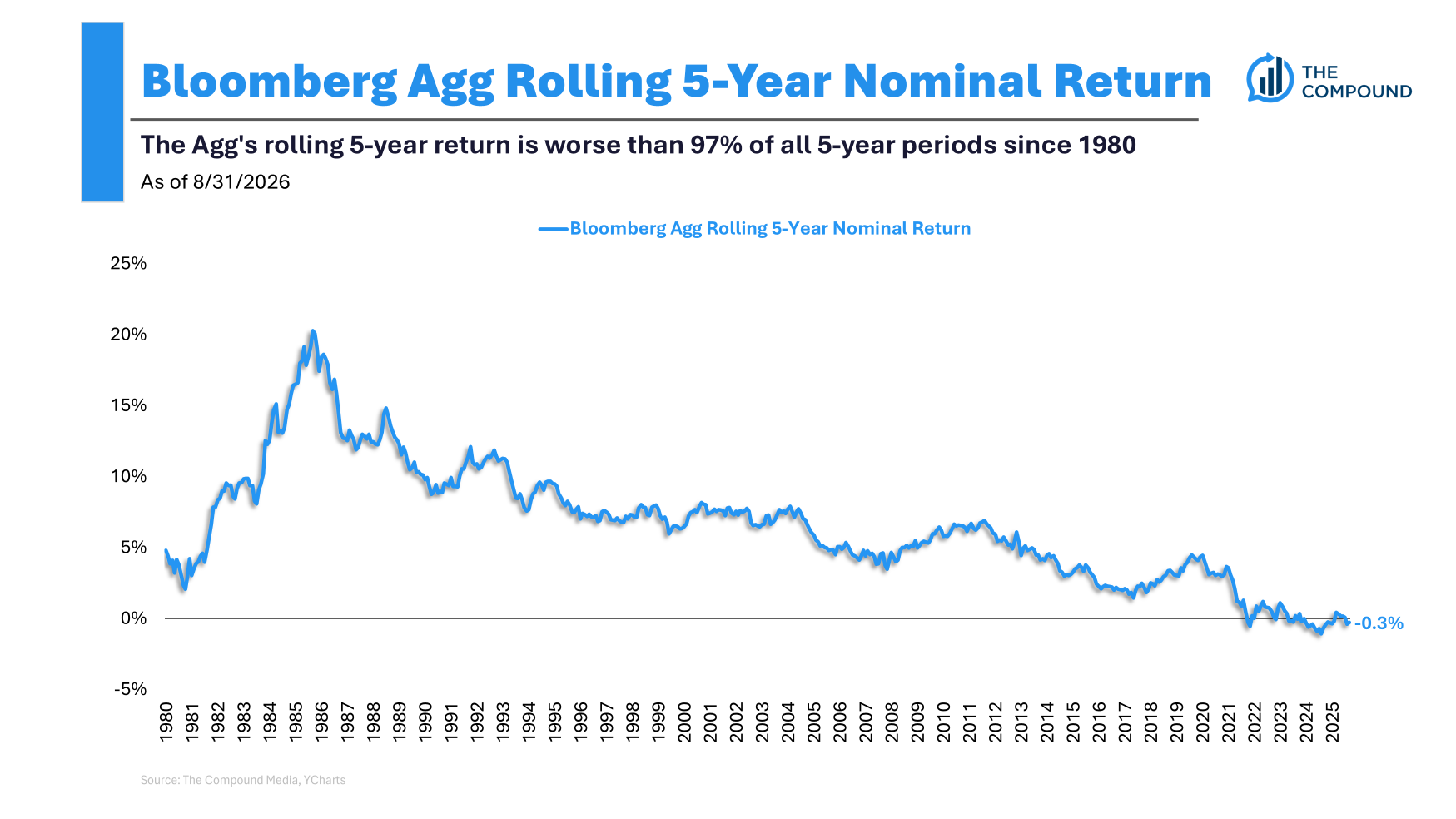
Bloomberg's Aggregate Bond Index has lost money over a rolling five-year stretch for the first time in records going back to 1976. Yields that bottomed in 2020 caused the damage, and today's higher starting yield gives holders income to set against further price losses.
The Investor · Invest desk
What happened
- After inflation, the Agg's five-year returns have been worse only once, in the early 1980s, when inflation ran in double digits.
- The index fell 1.5% in 2021 and 13% in 2022, its first back-to-back losing years and its first double-digit annual decline.
- The bear market that began when rates bottomed in 2020 produced a drawdown of nearly 20%, the worst in the index's history.
- The Agg's average yield to maturity is now 5.5%, while cash yields about 4% and corporate bonds more than 6%.
Compiled by The InvestorSomething wrong?How this is made
Why it matters
- exposure Passive investors could not have avoided this record by choosing a different core fund, because most total bond market index funds track the Agg.
- decision If today's 4% cash yield and 5.5% Agg yield both held for five years, cash would end about nine points behind, and that gap is the cost of sitting out further rate rises.
- contradiction The post puts the Agg's yield at 5.5% in one place and at close to 6% in another, so its premium over 4% cash is somewhere between 1.5 and nearly 2 points, depending on which figure is right.
Lehman Brothers built the index in the early 1980s and later backfilled its history to 1976, so the earliest stretch of the record was assembled after the fact [2]. It now covers more than 10,000 securities, mostly Treasuries, corporates, mortgage-backed and asset-backed bonds [3]. According to A Wealth of Common Sense, the index had no down year from 1976 to 1981 and none at all until 1994, when it fell almost 3% [9]. Counting 1976 through 1993, it went 18 calendar years without a loss [1]. Its weakest late-1970s year was 1978, a nominal gain of 1.4%, and while inflation was far higher then, so were yields [10].
This cycle started at the other end of the yield range [11]. The post blames starting yields that were too low, rates that rose in a hurry and high inflation [11]. Compounding the two losing years, the index kept 0.985 times 0.87 of its value, about 0.857, for a loss of roughly 14.3% [2]. Rolling 10-year returns stayed positive but came close to a lost decade during the 2022 bear market [20]. After inflation, the 10-year figure is as bad as it has ever been [6].
In my view the broken record is about the yield investors paid on the way in. An index bought near the 2020 yield low had little income to set against a rate shock [11]. At a 5.5% yield to maturity [12], the post argues, higher starting yields can now offset further price pain [17]. The post also carries the counter-case. This decade the link between starting yield and forward five-year returns broke down, and realized returns fell short of what the yield implied [13]. If the Agg's next five years again land well below 5.5% a year, that view is wrong.
Rates could fall if inflation eases, growth slows, a recession arrives, the AI trade falls apart or the war in Iran ends and energy prices drop [16]. They could keep rising if growth stays strong, AI spending gets bigger or the war drags on [16]. The author declined to pick a direction. "I've yet to encounter anyone in this field who has the ability to predict the direction or magnitude of interest rate moves. Even the Fed is not good at this," the author wrote [15].
The decade was lousy for fixed income investors unless they sat in cash or floating-rate debt, according to the post [21]. Yields are now at levels not seen in almost 20 years [19]. The same post calls bonds the most hated asset class in the world [18].
What to watch
- Whether the rolling five-year return turns positive once 2022's 13% loss drops out of the window.
- An end to the war in Iran and a fall in energy prices, one of the paths the post lists toward lower rates.
- Where cash yields go from 4%, since a falling cash rate widens the Agg's premium even if bond yields stay where they are.