ProductNot yet confirmed elsewhere1 publisher3 min readPublished
Apple takes the CPU upgrade option off the Mac Studio order page
The 2025 configurations are gone from the store rather than fading out, which turns a refresh most shops would have taken at renewal into a purchase they have to justify on this quarter's numbers.
The Product Desk
What happened
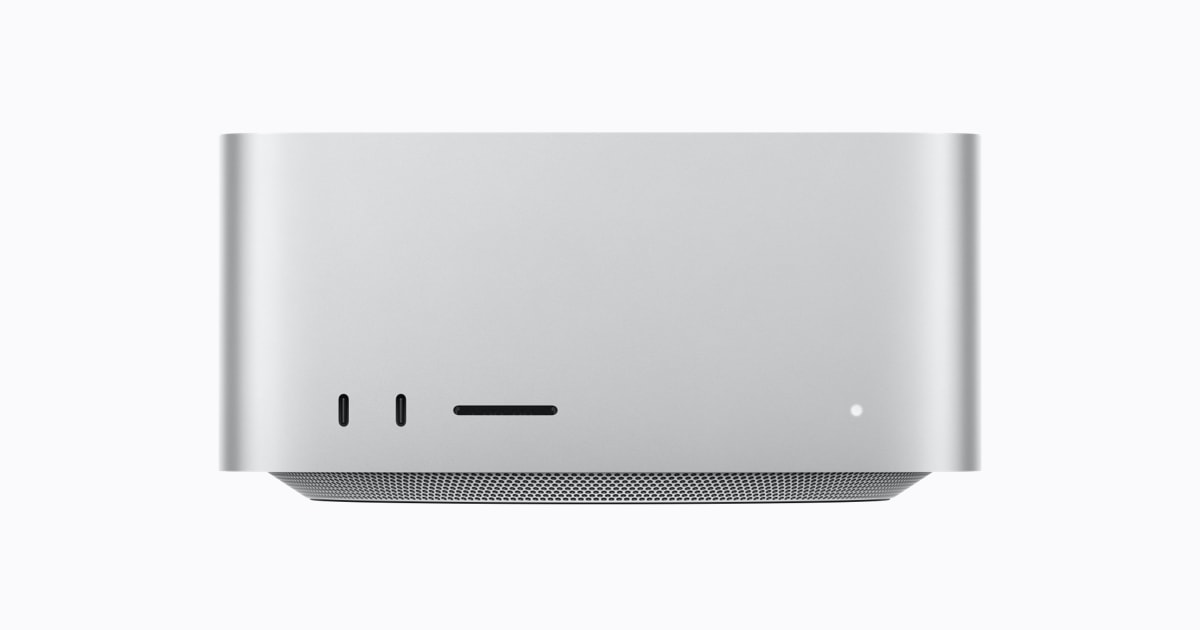
- Apple announced a Mac Studio with M5 Max and M5 Ultra chips and discontinued the M4 Max and M3 Ultra models that had been on sale since March 2025.
- The M5 Max ships with an 18-core CPU as standard and no CPU upgrade to buy, where the M4 Max began at 14 cores and could be configured up to 16.
- Wi-Fi 7 and Bluetooth 6 reach the Mac Studio for the first time, carried in by the same N1 chip Apple introduced in the iPhone 17 lineup.
- The maximum GPU stays at 80 cores, the Neural Engine at 32 cores, display support and the media engine are identical, storage still tops out at 16TB and unified memory at 512GB.
Why it matters
- decision Anyone whose standard build was the $2,499 14-core M4 Max has to rewrite the spec now, and the budget that used to buy a CPU upgrade has to be pointed at memory or storage instead.
- cost A 2025 launch buyer who swaps machines pays 25-38% more for an enclosure, port layout, Ultra core limits and Media Engine that did not change, which is a hard number to defend to a CFO after 17 months.
- capability Local-model work that the M3 Ultra's 96GB memory ceiling ruled out becomes buyable, since the M5 Ultra restores 256GB and 512GB options.
- constraint Shops that bought in 2025 precisely because they were pinned against the 512GB memory or 16TB storage limits gain nothing from a swap beyond bandwidth and the Neural Accelerators.
Somewhere there is an IT standards page that reads "Mac Studio, M4 Max, 14-core CPU, up to 64GB," priced at $2,499 [13], and this week it describes a machine Apple will not sell [1]. Old configurations do not linger on the price list while a purchasing cycle finishes. The person who owns that page now re-specs, and the new base build has no CPU line to fill in: 18 cores standard, four more than the old floor and two above the most you could previously order [3][21].
The Ultra tier shows the money more clearly. The M3 Ultra finished its run at $5,299 with a 96GB memory limit, and MacRumors puts the M5 Ultra $200 above that [5], so $5,499 [17]. March 2025 launch buyers paid $3,999 for the Ultra and $1,999 for the Max [8]. Replacing the Ultra now is a 37.5% increase [18]; replacing the Max at $2,499 is 25% [19].
Teams justify a workstation refresh with the work they actually push through it. Apple's own comparison sheet for the M5 Ultra measures something adjacent: up to 4.3x text-to-image, 4x LLM prompt processing in LM Studio, 3.3x CopyCat training in Foundry Nuke, and exactly one figure covering the whole CPU, 1.3x multithreaded [15]. Put that next to the 37.5% price move and the cost of a unit of Apple's claimed multithreaded throughput rises about 6% (1.375 divided by 1.30) [20]. The comparison is rough, since it sets a 2025 launch price against a 2026 price after Apple's June increase [9]. It is still the arithmetic a compile queue or a colour bay has to sign for. The core split changed too, from performance-and-efficiency to 6 super cores plus 12 performance cores [4], so per-core intuitions carried over from the 14-core part will not survive contact with the machine.
The buyer this refresh actually serves is visible in the same list. Matrix multiplication runs three to four times faster on the Neural Accelerators now sitting in each GPU core [7], and Apple says the M5 Max processes prompts up to 10.7x faster than the M1 Max while the M5 Ultra trains models up to 15.4x faster than the M1 Ultra, on machines that also lack Thunderbolt 5 and AV1 decoding [16]. That is a 2021 or 2022 owner, not a 17-month-old fleet.
For Monday, sort each seat by what its work waits on. If it waits on matrix multiplication or memory bandwidth, the case is already made in Apple's numbers: 1.2TB/s is 50% up, which implies roughly 800GB/s before [6][22], and the cores you used to pay extra for are now included [3]. If it waits on top-end core count, disk capacity or the media engine, the machine on the desk stays, because those ceilings did not move [12], and the budget line becomes refurbished 2025 stock, checked against the fact that lightly discounted older units often sit too close to new after the June rise [9].
What to watch
- Independent multithreaded benchmarks against Apple's 1.3x M5 Ultra claim, which is the figure CPU-bound buyers are signing for.
- Whether Apple ever restores a CPU configuration option on the Max tier or leaves 18 cores as the only choice.
- Whether the 3x Magic Mask and 3.3x CopyCat gains Apple cites show up in shops running mixed timelines rather than single effects.
Clarity's read
What the record supports and how the coverage leans. The claims behind it follow.
Reality
- Evidence46
- Adoption22
- Hype gap+24
- Incentives63
- Confidence52
Claim ledger
Ranked by verification strength, evidence, and original report placement.
- [1]
Apple announced a new Mac Studio with the M5 Max and M5 Ultra chips, discontinuing the M4 Max and M3 Ultra models that had been on sale since March 2025.
- [2]
The M4 Max started with a 14-core CPU and could be configured up to 16 cores.
- [3]
The M5 Max has an 18-core CPU as standard, with no CPU upgrade available to buy.
- [4]
Apple changed the core architecture, dropping the performance and efficiency split in favour of 6 super cores and 12 performance cores.
- [5]
The M3 Ultra ended at $5,299 with a 96GB memory limit; for $200 more the M5 Ultra brings back 256GB and 512GB options and adds 50% more memory bandwidth.
- [6]
The M5 Ultra's memory bandwidth is 1.2TB/s, which is 50% higher than before.
- [7]
On either chip, tasks that use matrix multiplication can run three to four times faster thanks to new Neural Accelerators in each GPU core.
- [8]
MacRumors says current M4 Max and M3 Ultra owners generally do not need to upgrade after only 17 months, because launch buyers paid $1,999 or $3,999 and replacing now costs 25-38% more for the same design, ports, Ultra core limits, storage limit and Media Engine.
- [9]
MacRumors says the 2025 models are mainly worth considering used or refurbished at a steep discount, because Apple raised prices in June and lightly discounted older stock is often too close in price.
- [10]
The Mac Studio design is unchanged for a fifth consecutive year, with all of the upgrades being internal.
- [11]
Wi-Fi 7 and Bluetooth 6 arrive on the Mac Studio for the first time, facilitated by the same N1 chip Apple introduced in the iPhone 17 lineup.
- [12]
Across both generations the maximum GPU still contains 80 cores, the Neural Engine still contains 32 cores, display support and media engine are identical, storage still maxes out at 16TB, and maximum unified memory is still 512GB.
- [13]
The M4 Max cost $2,499 with a 14-core CPU and up to 64GB of memory; for the same price the M5 Max has an 18-core CPU, 614GB/s memory bandwidth, up to 128GB of memory, twice-fast storage and Wi-Fi 7.
- [14]
Apple's claims for the M5 Max against the M4 Max include up to 3.9x faster LLM prompt processing in LM Studio, up to 3.5x faster text-to-image, up to 3x faster Magic Mask in DaVinci Resolve Studio, up to 1.9x faster basecalling in Oxford Nanopore MinKNOW, and up to 50% faster graphics.
- [15]
Apple's claims for the M5 Ultra against the M3 Ultra include up to 4.3x faster text-to-image, up to 4x faster LLM prompt processing in LM Studio, up to 3.3x faster CopyCat ML training in Foundry Nuke, up to 1.8x faster graphics, up to 1.7x faster scene rendering in Maxon Redshift, and up to 1.3x higher multithreaded CPU performance.
- [16]
Apple says the M5 Max can process prompts up to 10.7x faster than the M1 Max and the M5 Ultra can train ML models up to 15.4x faster than the M1 Ultra; older models also lack Thunderbolt 5, AV1 decoding and the newer Media Engine.
- [17]
Entry price of the M5 Ultra Mac Studio is $5,499.
- [18]
A March 2025 Ultra launch buyer replacing the machine at $5,499 pays 37.5% more than they paid.
- [19]
A March 2025 Max launch buyer replacing the machine at $2,499 pays 25% more than they paid.
- [20]
Measured against Apple's 1.3x multithreaded CPU claim, the price per unit of claimed multithreaded throughput on the Ultra rises about 6% for a 2025 launch buyer.
- [21]
The M5 Max entry CPU has 4 more cores than the M4 Max entry CPU, about 29% more, and 2 more than the highest M4 Max CPU configuration.
- [22]
A 1.2TB/s figure that is 50% higher than before implies roughly 800GB/s of memory bandwidth in the prior Ultra.
Sources
1 independent publisher whose own reporting we read for this story.
- macrumors.com2025 vs. 2026 Mac Studio Buyer's Guide: All Upgrades Compared
1 article · August 27, 2026
Topics and entities
Follow any of these and your For You feed starts watching them — no settings page required.
Topics
- Local AI inference hardware demandFollow
- Workstation Hardware RefreshFollow
- Apple SiliconFollow
- Hardware Pricing and ConfigurationFollow
Entities
- AppleFollow
- Mac StudioFollow
- Apple M5 MaxFollow
- M4 MaxFollow
- Apple M3 UltraFollow
- Apple N1Follow
- Wi-Fi 7Follow
- Bluetooth 6Follow
- Thunderbolt 5Follow
- AV1Follow
- LM StudioFollow
- DaVinci Resolve StudioFollow
- Foundry NukeFollow
- Maxon RedshiftFollow
- Oxford Nanopore MinKNOWFollow
- Mac ProFollow
- MacRumorsFollow
- Apple M5 UltraFollow