Science1 publisher3 min readPublished
Soil sliding from hillside graves may explain some of Göbeklitepe's scattered bones
Bones from Göbeklitepe's only two intact graves show the same damage as many of its 928 loose fragments, German Archaeological Institute researchers report. Ground slipping off the slope may account for part of the scatter, the team argues, while carved grooves on several skulls still point to deliberate handling.
The Scientist · Science desk
What happened
- The first grave, found in 2012 and reopened in 2022, held a woman in her 20s laid on her side on a bed of fist-sized stones more than 10,000 years ago.
- Her grave was mostly undisturbed, yet her arm and leg bones had broken into pieces, gathered a mineral crust and in places carry what may be rodent tooth marks.
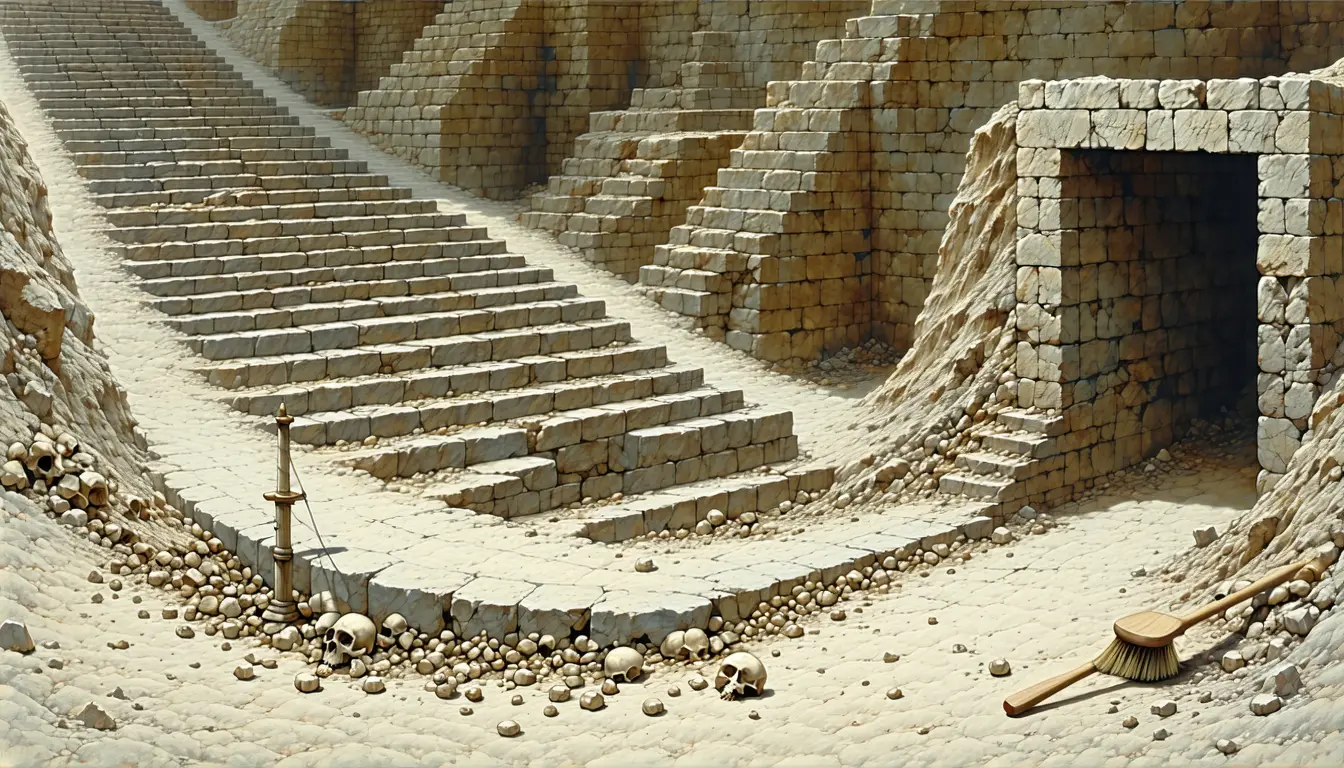
- Her room sat on a slope above a stone enclosure in a hollow, and the authors think heavy rain or earthquakes may have sent the unstable ground sliding into it.
- Loose fragments turn up across roughly 32,000 square feet and in places many feet down, with skull pieces mixed among bones from the rest of the body.
- The team cannot trace any single loose fragment back to a particular grave.
Compiled by The ScientistSomething wrong?How this is made
Why it matters
- constraint Broken, mineral-crusted bone at Göbeklitepe can no longer be read as a sign of ritual by itself, because an undisturbed burial shows the same damage.
- capability Excavators now have a site-specific reference for what burial does to bone, so each new fragment pulled from the rubble can be checked against it.
- constraint The skull-cult hypothesis now depends on the carved grooves, the one kind of damage that moving soil cannot produce.
The young woman's grave is the closest thing this study has to a control. It was left mostly undisturbed, so the damage to her bones shows what burial alone can do at this site [6]. That gave Julia Gresky and Lee Clare of the German Archaeological Institute a baseline for the loose material, and in their PLOS One paper many of the fragments fit it [1][7]. According to Discover's account of the study, they conclude only that at least some fragments came downhill from graves higher on the mound [2].
The comparison set is small. The two graves hold at least four people between them [2]. Against them sit 928 fragments recovered from the rubble that buried the buildings [3]. Four skeletons are enough to show that this kind of damage is ordinary here. They are not enough to say what share of the scatter came from graves.
The woman's own room shows the proposed mixing inside a single grave. Skull fragments found above her in 2012 look like a man's, while her jaw and the rest of her skeleton are a woman's [11]. They may belong to someone else whose remains mixed into the soil of her room [11].
The spread of fragments is the weaker half of the argument. The authors say that if people had placed the bones on purpose, they would more likely have clustered in particular spots [9]. A scatter without clusters fits ground sliding off the slope. It would also fit other ways of churning a buried site, so it supports the slope account without singling it out.
The grooves are a different matter. Sliding soil cannot account for grooves carved into skull fragments [13]. Gresky proposed a skull cult in 2017 on the strength of three individuals with deeply grooved skulls [12]. Grooves now appear on remains from five people, two more than when she made the proposal [13][1]. At nearby Sefertepe, archaeologists found at least 21 skulls arranged in a small chamber, so people in the region did handle skulls on purpose [14]. Without distinct dates for Göbeklitepe's bones, researchers cannot yet say when its practices took place or whether they overlapped with Sefertepe's [15].
In my view the study's effect on the skull-cult case is specific. It takes the broken, scattered bones out of the ritual evidence and leaves the grooved skulls carrying the weight they carried before. It is also Gresky testing her own 2017 hypothesis against better material [12][1].
The graves also say something about what Göbeklitepe was. For its first two decades of excavation, researchers described it as a sanctuary for ceremonies, and more recent work has turned up houses and everyday activity [16]. The second grave, exposed in 2017, was dug through a building floor and held at least three people: a woman over 35, a man in his 20s and a girl between 11 and 14 [5]. Earlier remains there appear to have been shifted aside with each new burial, and the skulls were gathered in one corner [5][18].
What to watch
- Distinct dates for Göbeklitepe's bone fragments, needed to tell whether the burials, the slides and the skull grooving belong to the same period.
- More grooved skull fragments: the count has gone from three people in 2017 to five, and each new case adds to the deliberate-handling evidence whatever the slope did.
- A grave found higher on the mound whose bones can be tied to specific fragments in the enclosures below, the link this study could not make.