Science1 publisher2 min readPublished
Curiosity's layered sulfate bedrock gives way to blocks covered in disc-shaped lumps
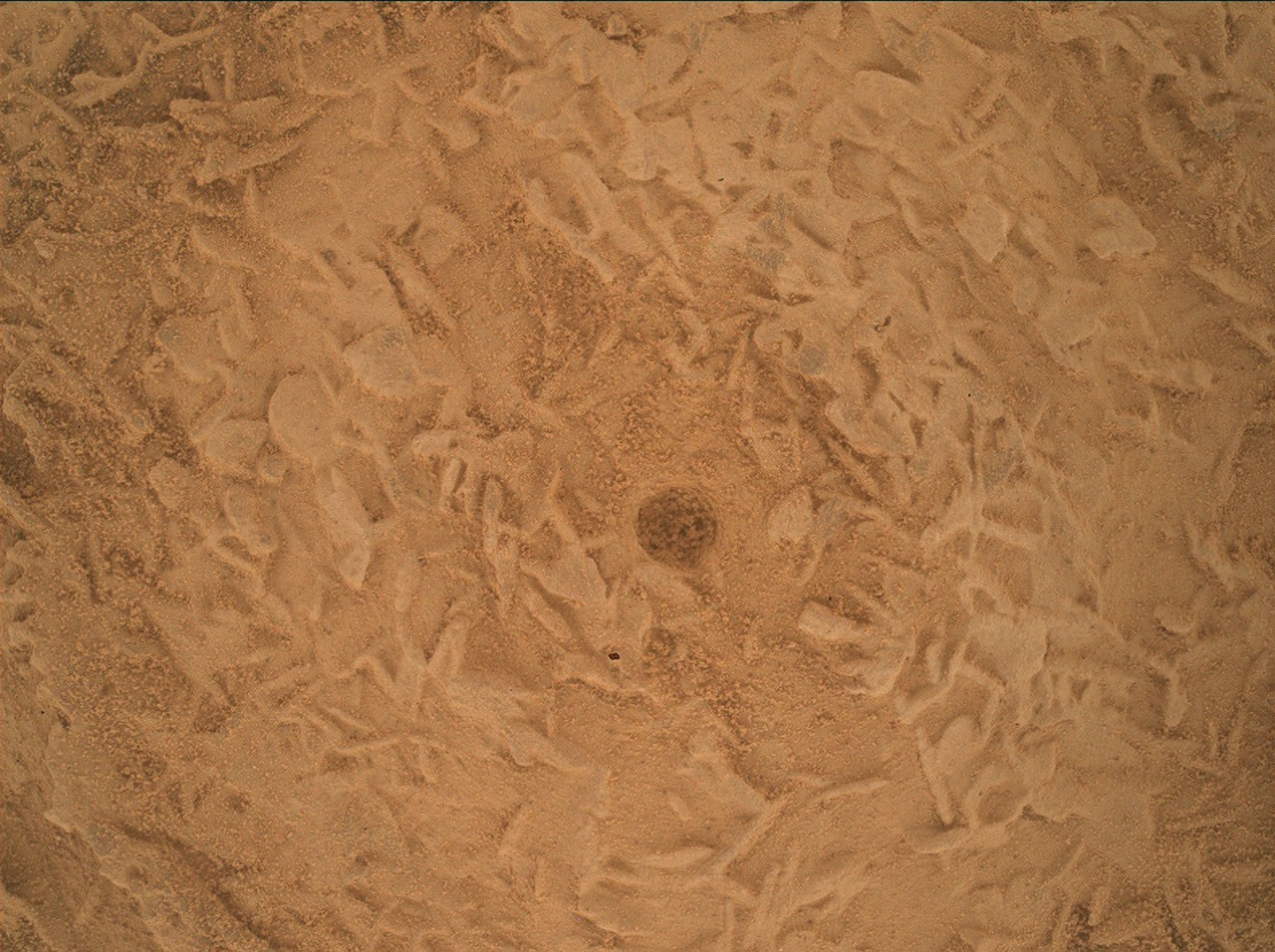
Curiosity's team planned four chemistry readings on blocks covered in disc-shaped lumps, a texture Earth rocks can show where evaporating fluid left minerals. Settling whether that happened on Mars will likely take the rover's next drill sample and its CheMin instrument.
The Scientist · Science desk
What happened
- The new texture appeared at the start of the week, after recent sulfate-unit workspaces had shown finely layered bedrock blocks.
- Curiosity saw somewhat similar features much earlier in the mission, near the Pahrump Hills in the Murray mudstones.
- The rover has driven more than a kilometer since its last drill site, Campo Marte.
- The team picked a drill target and planned a very short drive to reach it, for contact science first and then, if all goes well, a preload test and drilling.
Compiled by The ScientistSomething wrong?How this is made
Why it matters
- constraint A broken-up harder layer would also leave disc shapes, so the resemblance to Earth rocks cannot by itself put evaporating fluid at this site.
- constraint The chosen drill workspace lies a little beyond the disc blocks, so CheMin's result will speak to the discs only if the drilled rock shares their texture.
- capability The hole will be the first drilled above the erosional supersurface, so its CheMin result will be the team's first mineral identification from these upper rocks.
Lucy Lim, a planetary scientist at NASA Goddard Space Flight Center, wrote the team's update for sols 5016 to 5021, with Earth planning running through Friday, Sept. 18 [12]. "Curiosity surprised us at the beginning of the week with a change in rock texture," she wrote [13]. The plan that followed moved from shape to chemistry. The team set Mastcam and MAHLI imaging on two of the blocks, "Yungay" and "Chiu Chiu," for finer morphological detail [5]. Three LIBS targets and one APXS target, "Salar de Vacas," were assigned to investigate composition [5]. That makes four chemistry readings in all [1].
Lim offered two explanations for the lumps. "The disc-like shapes could be created by the growth habits of a specific crystalline mineral that is known to grow into similar shapes, or they could be bits of a harder rock layer that broke up and collected here," she wrote [4]. Only the first involves a crystal growing into the disc shape. It is the explanation that fits the Earth settings she described, where minerals came out of an evaporating fluid [3]. The blog does not say which chemical result would favour either explanation.
Composition data also stops short of a mineral name. "In order to identify minerals, Curiosity needs data from the CheMin X-ray diffraction instrument, which means a drill campaign," Lim wrote [6]. By that standard, the four LIBS and APXS readings can describe what the disc blocks are made of. Naming a crystal that might have shaped them needs a drill sample [d1, c6]. Friday's plan began characterizing the drill site, with the arm instruments on "Alberta Wild Rose" and "Moonraker Mountain," a LIBS target called "Osoyoos," and Mastcam images [9].
Long-distance imaging continued alongside. The ChemCam remote imager and Mastcam built mosaics of the buttes on either side of Valle Grande [11]. Lim wrote that these cutaway views of the strata above the rover will help the team map sedimentary structures in the units ahead and work out how Valle Grande itself formed [11]. She will be back on planning on Monday as Geology and Mineralogy Science Theme Lead for Drill Sol 1, given over to triage contact science [15].
What to watch
- Results from the three LIBS targets and the APXS target Salar de Vacas, and whether the team reports the disc blocks differ in composition from the layered bedrock.
- Whether the preload test passes and drilling goes ahead, and whether the drilled rock carries any of the disc texture.
- CheMin's mineral list from the first sample above the erosional supersurface.