Science1 publisher3 min readPublished
NOAA puts the odds of a record-strength El Nino at 69%
The probability describes a ranking of Pacific ocean temperature, and the December peak it points to arrives for Southeast Asian governments that have already been drawing down reserves to cover energy and fertilizer.
The Scientist · Science desk
What happened
- The UK's national weather and climate service says this El Nino may be the strongest in living memory, and NOAA has put its assessment as a probability of outranking every event since record-keeping began in 1950.
- Asian governments have been drawing on financial reserves to absorb the higher energy costs and scarce fertilizer supplies that followed the war in Iran, leaving less capacity for the El Nino.
- In Indonesia, wildfires are burning forests and peatlands while the reservoir supplying Jakarta has dropped far enough to expose the ruins of a village it flooded.
Compiled by The ScientistSomething wrong?How this is made
Why it matters
- constraint Food support in December would be funded from the same reserves already covering imported energy and fertilizer. That narrows what a finance ministry can offer farmers before the next planting.
- exposure Mekong households that time fishing and farming to predictable water levels take the drought on top of changes dams and mining have already made to the river, so a poor catch will have two plausible causes.
- decision Jakarta's water managers have to line up alternative supplies for 42 million people while the reservoir is still falling, ahead of the forecast December peak.
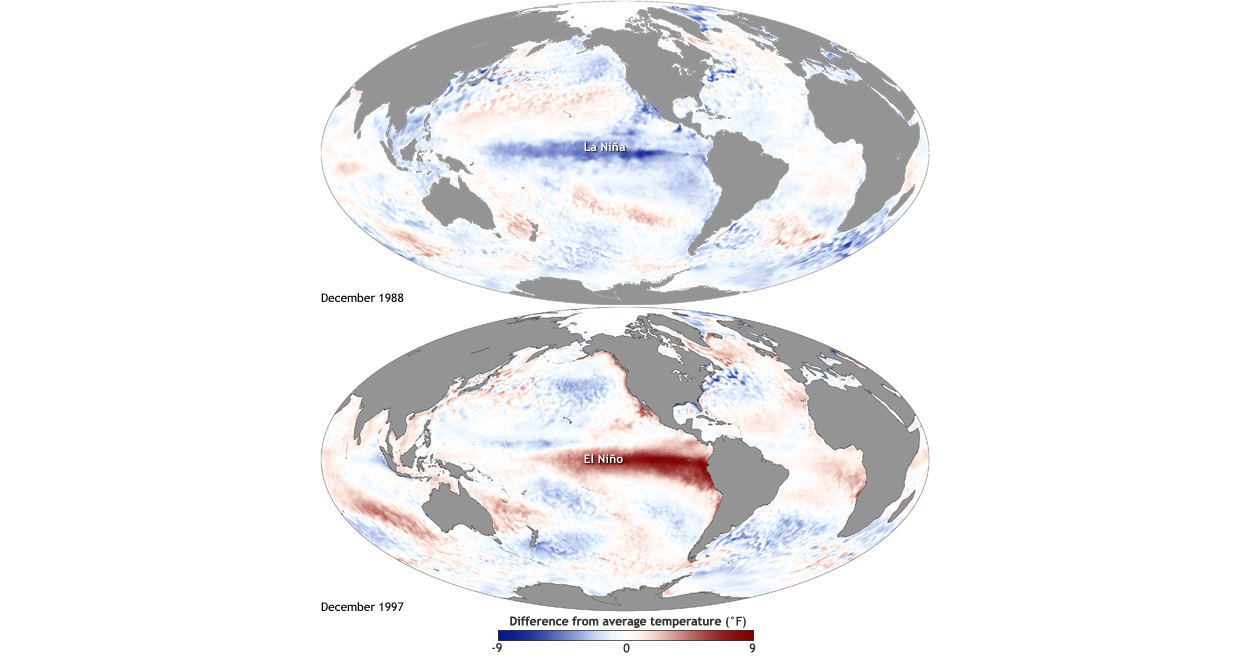
NOAA's number is a probability about rank. It says this event is more likely than not to outrank every El Nino in a record that begins in 1950, and that record is built from ocean temperature [1]. By the same figure there is roughly a 31% chance it falls short of the top spot [1].
El Nino is the warm phase of a Pacific cycle that recurs every few years and often shifts weather patterns worldwide [4]. Its effects differ from region to region [21]. Kareff Rafisura, who heads the Disaster Risk Reduction Division at the U.N. Economic and Social Commission for Asia and the Pacific, said the seas are already hotter than average and that global oceans set new temperature records in August [5].
Paul Teng of Singapore's ISEAS-Yusof Ishak Institute said El Nino is only compounding the other problems already in view [10]. That compounding shows up in the Mekong, which flows through six countries and whose flows are already disrupted by mining and hydropower dam construction [16]. Zeb Hogan of the University of Nevada, Reno, who runs the Wonders of the Mekong research and conservation project, said, "It's one punch after another," and added, "If the river doesn't catch a break, we will reach a point where it's no longer going to sustain people in the way that it always has" [17][18]. Kongmeng Ly of the Mekong River Commission said lower flows are especially hard on communities that depend on predictable water levels for fishing and farming [19].
Phys.org reports that Asian governments have been drawing on financial reserves to soften the higher energy costs and scarce fertilizer supplies that followed the war in Iran, and that they have less capacity to cope with an El Nino forecast to peak in December [9][3]. The article does not put a figure on the drawdown or forecast a food price. The World Food Program's 49 million is a count of people expected in acute food insecurity by the end of 2027, with the worst effects anticipated in parts of Central America and southern Africa [6][7].
In Indonesia, wildfires are burning forests and peatlands and sending up plumes of toxic haze [12]. Erma Yulihastin of Indonesia's Research Center for Climate and Atmosphere said El Nino has only just begun its "super phase" [15]. At the reservoir supplying Jakarta, the ruins of one of 11 villages flooded when it was filled have come back above the water, and the city it serves holds 42 million people [13]. "I would have rather not moved. There were plenty of livelihood opportunities here," said Hussen, who uses only one name and ferries people across the receding reservoir [14].
Southeast Asia's wet season runs from about June to October, when rain refills reservoirs, cools overheated cities and supplies irrigation water ahead of the next planting [20]. El Nino is forecast to peak in December, after that window closes [2].
What to watch
- Whether NOAA's odds on beating the 1950-onward record rise or fall in its updates before December.
- Whether reservoir levels show the June-to-October rains refilled enough storage to carry irrigation into the next planting.
- Whether any Southeast Asian government publishes the size of the reserve drawdown it has already made on energy and fertilizer support.