Product1 publisher3 min readPublished
Wooden turbine blades get a factory, and a 2031 start date
Voodin's 100 million euro plant in Navarra is the first serious attempt to industrialise a recyclable wind blade. Commercial output is five years away.
The Product Desk · Product desk
Drafted by a language model from the sources cited here and checked against its claim ledger before publication. How we use AISend a correction
What happened
- A German startup, Voodin Blade Technology, is leading the VB1F project with European partners to build what is described as the world's first large-scale factory for wooden wind turbine blades, making blades from wood-based materials.
- The VB1F project will cost over 100 million euros (115 million dollars), was announced in 2026, will be located in Navarra, Spain, and is expected to begin commercial operations in 2031.
- Most modern wind turbine blades are made from fiberglass composites combining glass fibers with epoxy resin, and once made they are hard to break down or recycle.
- About 78 percent of old wind turbine blades end up in landfills or are burned.
- By 2050, wind turbine blade waste could reach 43 million metric tons.
Compiled by The Product DeskSomething wrong?How this is made
Why it matters
Voodin Blade Technology, a German startup, and its European partners are putting more than 100 million euros (115 million dollars) into VB1F, a plant in Navarra, Spain, described as the world's first large-scale factory for wooden wind turbine blades [1][2]. The project was announced in 2026 and is expected to begin commercial operations in 2031 [2], and that gap is the most informative number in the announcement.
The problem it addresses is real and already priced into landfill contracts. Most modern blades are fiberglass composites, glass fibers set in epoxy resin, which is difficult to break down or recycle once cured [3]. About 78 percent of decommissioned blades are landfilled or burned [4], leaving at most 22 percent going anywhere else [1]. Cumulative blade waste could reach 43 million metric tons by 2050 [5].
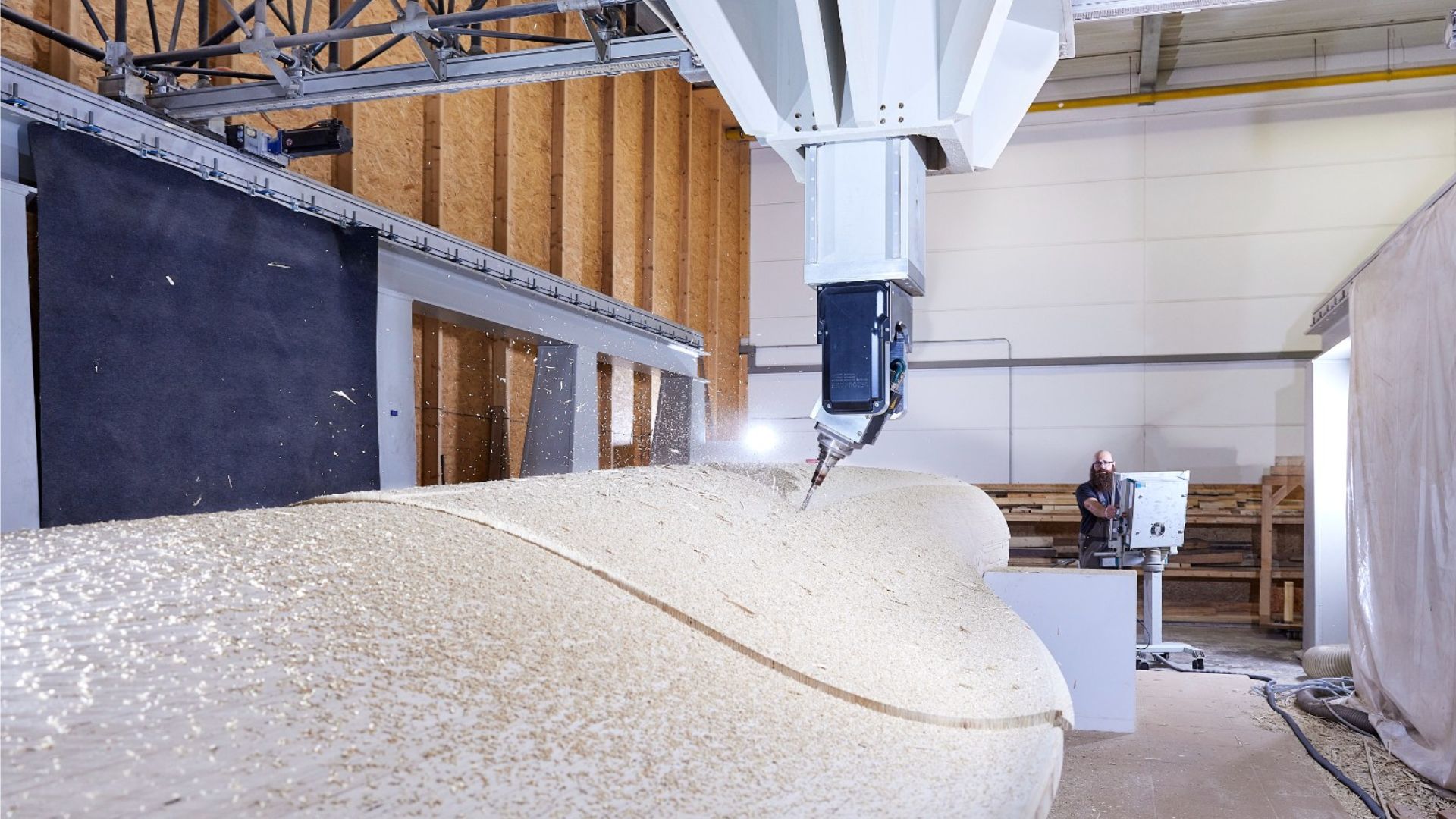
Voodin's answer is engineered timber. Nordic spruce fir from certified European forests is peeled into thin veneers and glued into Laminated Veneer Lumber, retaining the biogenic carbon captured during growth [6][7]. The company says LVL offers the strength, dimensional stability and fatigue resistance that turbine loads demand [8], and blocks of it will be cut into aerodynamic profiles by CNC milling driven by CAD files [9]. At end of life, according to the developers, LVL can be recycled into other organic or industrial uses rather than discarded [10].
The scale numbers are where enthusiasm should meet arithmetic. At full production the Navarra site is expected to make up to 160 blade sets a year, employ about 450 people locally, and, on the developers' own estimate, avoid more than 2.4 million metric tons of emissions in its first decade [11][12][13]. That works out to roughly 222,000 euros of capital per job [2], which is ordinary for heavy manufacturing and worth noting only because the plant is being sold partly as regional industrial policy [12].
Set 160 sets a year against the installed base. Global wind capacity has passed 1,000 GW [14], and meeting climate targets implies more than 3,000 GW by 2030 [15], with each megawatt requiring roughly 10 metric tons of blade material [16]. Closing that 2,000 GW gap therefore calls for about 20 million metric tons of new blade material [3], equivalent to close to half the blade waste projected to have accumulated by 2050 [4]. Almost all of that material will be composite, because VB1F does not produce anything until 2031 [2], a year after the 2030 milestone it is meant to help clean up [5].
That is not an argument against the plant. It is the honest measure of how early this technology is: five years from announcement to first commercial blade [6], with the recyclability claim still to be demonstrated at industrial volume, and with the wooden blade competing on cost and fatigue life against a composite supply chain that has decades of tooling behind it. The reported plan does not disclose turbine rating, blade length, or cost per blade [17], so 160 sets cannot yet be converted into gigawatts served or into a price comparison.
Watch three things: whether Voodin secures firm orders from a tier-one turbine maker before construction, whether the LVL blades accumulate certified fatigue test hours on a full-length article, and whether the 2031 date holds through permitting and financing. Composite blade plants that slipped two years were common in the last build cycle, and a wood plant has no reason to be immune.