Product1 publisher3 min readPublished
Penn State tunes a perovskite film to LED light with 35 percent bromine
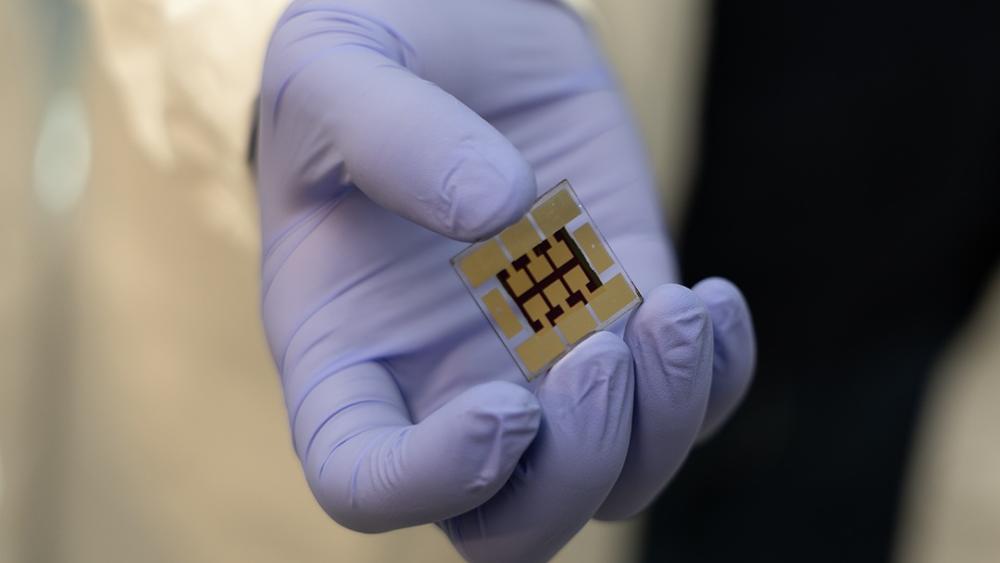
Penn State walked the bromine-to-iodide ratio across six metal-halide films to aim the bandgap at indoor wavelengths. The stability run that followed was done under light many times brighter than an office ceiling.
The Product Desk · Product desk
What happened
- Penn State researchers built a perovskite-based thin film designed specifically for indoor lighting and published the results in the journal APL Energy.
- They changed the bromine-to-iodide ratio across six metal-halide compositions to move the optical properties toward indoor wavelengths, and the film with 35% bromine performed best.
- In testing, the device showed no decline in performance over 240 hours at high light intensities, and the researchers project stability for thousands of hours from that trend.
- A 2026 Penn State review found reported indoor photovoltaic efficiencies above 44% in some devices, with relatively few studies systematically reporting long-term stability under standardized protocols.
Compiled by The Product DeskSomething wrong?How this is made
Why it matters
- constraint A bandgap aimed at the narrow spectrum of artificial light is aimed away from the broad solar one, so an indoor harvester is a separate part number from an outdoor cell and cannot be pulled from the same bin.
- cost Taking the cell out of a thermostat or a remote moves the saving to whoever services the installed fleet, and that saving only arrives if the harvester outlives the device it powers.
- exposure Durability is the named obstacle to commercialisation, so the first team to ship a battery-free product on this class of film carries the field-warranty risk while the question is still open.
Installed sensors do not sit under a light meter. They end up in a corridor where the lights run on occupancy sensors, or on the shaded side of a room, and the deployed light level is a fraction of the one the design assumed.
That gap is why the test conditions are the most useful part of the Penn State account. The stability run was not done at office levels. The tests ran at roughly 10 to 50 times the intensity a recently proposed consensus framework for indoor photovoltaics calls for, which the account puts at about 8% to 50% of full sunlight [9]. Divide the two ranges through and the framework's own level sits near 0.8% to 1% of sunlight [17]. The film was stressed well past what a ceiling fixture would do to it, so flat output over that period is a better result than the hours alone suggest.
The hours are worth converting. The measured run works out to ten days [15]. The researchers project thousands of hours from the observed trend and say plainly that the figure is a projection, not a demonstrated operating lifetime [8]. Two thousand hours of continuous illumination is about 83 days [16]. A smart thermostat, one of the applications named in the write-up [12], is bought on a horizon of years.
The recipe logic is the part that transfers to other groups. Outdoor cells are built to absorb across the broad solar spectrum, while artificial light is weaker and narrower [4], so instead of maximising absorption across the whole solar range the team aimed the semiconductor's bandgap at the narrower spectrum of indoor sources [14]. The durability work was in fabrication: dichlorobenzene in place of chlorobenzene as the antisolvent, for a uniform film with compact grains and fewer voids [5], then a phenethylammonium bromide layer on the surface to passivate defects that would otherwise impede charge movement [6][13].
The authors of the 2026 review argued that better stability testing will be essential for determining how laboratory results translate into real-world lifetimes [11]. The account of the new device does not include an efficiency figure for it [19].
So the question to put to any indoor harvester, in a paper or on a datasheet, is whether the efficiency number and the stability number were taken under the same light. Same lux, same source spectrum, both stated. Where the efficiency comes from one condition and the hours from another, you have two experiments and no product spec. And the part either covers the device's whole duty cycle at the lux where it will actually be installed, or it tops up a cell. Someone still has to change that cell.
What to watch
- Whether a follow-up paper reports efficiency and stability for the same film under the same lux and source spectrum.
- Whether other labs adopt the proposed consensus framework for indoor photovoltaic testing, which would make results comparable across papers.
- Whether any supplier of indoor photovoltaic parts publishes hours-at-lux retention data on a datasheet rather than a peak efficiency.