LeadershipReports disagree2 publishers3 min readPublished
At Ramp, 75% of merged PRs come from a harness no vendor sold it
Block, Stripe and Shopify run in-house coding agents too. What Ramp built is not a model but a credentialed development box, and that is the part procurement cannot order.
The Board Room · Leadership desk
What happened
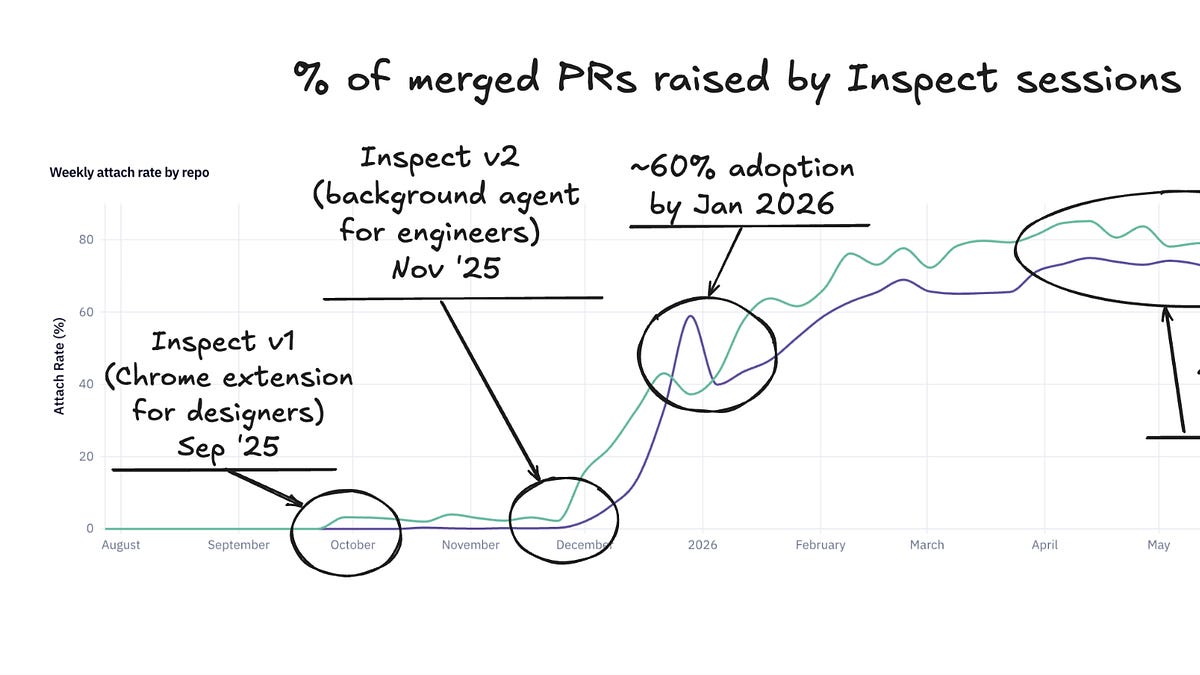
- Ramp says 75% of its merged pull requests are now raised by Inspect, its own coding agent, even though engineers are free to use any tool.
- Block runs Goose, Stripe runs Minions and Shopify runs River, each an internally built alternative to commercial harnesses.
- Ramp's engineers and designers wanted more parallel agents than a local machine allows, better frontend tooling and remote development environments.
- Inspect closes its own loop: tests, telemetry and feature flag checks for backend work, screenshots and live previews for frontend work.
Why it matters
- constraint A verification loop that reads telemetry and feature flags runs on systems behind a company's own authentication, so a seat licence alone does not buy it.
- cost More than 150 internal contributors is a payroll line rather than a procurement line, which moves the spend from vendor invoices to engineering time nobody itemises.
- decision The decision in front of engineering leaders is narrower than writing an agent: it is whether to fund sandboxes and integration work around a third-party agent loop.
- precedent With four named companies on this path, proposing an in-house harness now survives a review board instead of looking like an expensive hobby.
What Ramp built is a development machine with credentials attached. The agent doing the typing inside the sandbox is OpenCode, which Ramp did not write, sitting alongside Postgres, Redis, RabbitMQ, Temporal, Chromium and a VS Code Server [7]. The differences Ramp cites against Claude Code or Cursor are the remote sandbox and the internal integrations, with model intelligence named as the only remaining limit on what agents can do [5]. The buy-versus-build question, then, is not whether to write an agent. It is whether to own the box the agent runs in and the access that box carries [14].
That box has an unglamorous property: it starts in five seconds or less [7]. Near-free session startup is the mechanic under running many agents at once, which is the request local laptops could not serve.
The adoption figure deserves reading carefully. Using Inspect is optional, so 75% is a preference signal rather than a mandate, and a quarter of merged pull requests still arrive some other way [16]. That residual is the honest scale of the win.
The timing claim is where the strategy gets fragile. Ramp says it shipped screenshot verification almost a year ago, before third-party vendors supported it, and puts itself months ahead of nearly all harnesses [18]. Months is the unit. Each capability Ramp built that vendors later shipped stops being a reason to have built it and becomes something to keep maintaining. What does not commoditise is the integration surface, because one company's telemetry and feature flag systems are not a product anyone can sell.
The scope crept the way internal tools do. Inspect began as a Chrome extension for designers prompting minor website changes [12] and now covers bugfixing in Slack, debugging, and internal agents for code review and incident management built on the same platform [13]. Every session is public and open to collaboration, with no opt-outs permitted [c11b]. That is a rule an internal tool can impose on its own engineers and a vendor agreement generally cannot.
All of this is one company's account, given to the Pragmatic Engineer newsletter by CTO Rahul Sengottuvelu, head of engineering Hamid Dadkhah, and Zach Bruggeman, the founding engineer on Inspect [11]. No build cost, dedicated headcount, revert rate or defect rate is published next to the 75%. The named stack is React/Vite, Cloudflare Durable Objects, SQLite, the Cloudflare Agents SDK and Modal sandboxes [8], which sketches the shape of the bill without giving its size.
For anyone smaller, the case here rests on two preconditions: internal systems worth wiring an agent into, and enough engineers to keep that wiring current. Without both, an off-the-shelf harness remains the cheaper answer, and the live question is how long the access gap stays open.
What to watch
- Whether vendors ship telemetry and feature-flag integrations that close the verification gap Ramp currently claims for itself.
- Whether Ramp ever publishes Inspect's running cost or dedicated headcount, or open-sources it as Block did with Goose.
- Whether the 75% share holds, and whether revert or defect rates are ever reported next to it.
Clarity's read
What the record supports and how the coverage leans. The claims behind it follow.
Reality
- Evidence68
- Adoption74
- Hype gap+18
- Incentives76
- Confidence66
Claim ledger
Ranked by verification strength, evidence, and original report placement.
- [1]
At a select few tech companies, most code is written with custom-built internal AI coding agents, in contrast to most of the industry, which uses agents and harnesses such as Codex, Claude Code, Cursor, OpenCode and GitHub Copilot.
- [2]
Ramp's internal coding agent is called Inspect, Block's is Goose (open source), Stripe's is Minions and Shopify's is River.
- [3]
Inspect was shipped and opened internally at Ramp last November.
- [4]
Engineers and designers at Ramp were dissatisfied with third-party harnesses: they wanted to run more than a few agents in parallel, which local machines do not support, wanted better frontend tooling, and there was demand for remote development environments.
- [5]
What makes Inspect different from Claude Code and Cursor, per Ramp: remote sandboxes giving unlimited session concurrency, centralised setup configuration and cross-functional session collaboration; and internal integrations that give agents the same tools and context as a Ramp engineer, so the only constraint on the agent is model intelligence rather than missing tools or access.
- [6]
Inspect verifies its own changes: for backend work it runs tests, reviews telemetry and queries feature flags; for frontend work it visually verifies by providing screenshots and live previews to users.
- [7]
Inside the Inspect sandbox: OpenCode, development services including Postgres, Redis, RabbitMQ and Temporal, Chromium and VS Code Server, with tricks that make sandboxes spin up in five seconds or less.
- [8]
Inspect's tech stack: React/Vite, Cloudflare Durable Objects, SQLite, Cloudflare Agents SDK and Modal sandboxes.
- [9]
More than 150 people at Ramp have contributed to the Inspect project.
- [10]
All Inspect sessions are public and open to collaboration, with no opt-outs allowed.
- [11]
The Pragmatic Engineer newsletter interviewed Ramp CTO Rahul Sengottuvelu, head of engineering Hamid Dadkhah, and Zach Bruggeman, principal engineer and founding engineer of Inspect.
- [12]
The v1 of Inspect was a Chrome extension for designers to prompt AI to make minor website changes.
- [13]
Ramp uses Inspect for coding, bugfixing in Slack and debugging, and builds internal agents such as code review and incident management on top of the Inspect platform.
- [14]
The in-house element at Ramp is the environment and access layer rather than the agent itself: the agent running inside the sandbox is OpenCode, a third-party harness, while the stated differentiators are the remote sandbox and internal integrations.
- [15]
Engineers at Ramp can use any tool they want, but 75% of merged pull requests are now raised by Inspect.
- [16]
About 25% of merged pull requests at Ramp are raised by something other than Inspect.
- [17]
Most third-party AI harnesses cannot do these kinds of verifications out of the box because they lack internal integrations with systems such as telemetry and feature flags.
- [18]
Ramp built screenshot verification almost a year ago, before it was supported by third-party vendors, which placed Ramp months ahead of nearly all AI coding harnesses.
Sources
2 independent publishers whose own reporting we read for this story.
- How Ramp built a full context background coding agent on Modal
modal.com
1 article · August 26, 2026
- newsletter.pragmaticengineer.comWhy Ramp built its own in-house coding agent, Inspect
1 article · August 26, 2026
Topics and entities
Follow any of these and your For You feed starts watching them — no settings page required.
Topics
- Internal Developer PlatformsFollow
- AI Coding AgentsFollow
- Build versus buy for AI toolingFollow
- Agent Verification LoopsFollow
- Engineering Productivity MetricsFollow
- Remote sandboxed dev environmentsFollow
Entities
- SentryFollow
- The Pragmatic EngineerFollow
- DatadogFollow
- Hamid DadkhahFollow
- gooseFollow
- InspectFollow
- RampFollow
- ModalFollow
- CloudflareFollow
- StripeFollow
- OpenCodeFollow
- Claude CodeFollow
- ShopifyFollow
- GitHub CopilotFollow
- Zach BruggemanFollow
- TemporalFollow
- LaunchDarklyFollow
- BlockFollow
- CursorFollow
- Rahul SengottuveluFollow