Science1 publisher2 min readPublished
Indonesia's cross-border haze case rests on two health numbers without a baseline
An eruption and a cross-border haze episode hit Indonesia in the same week. The aviation disruption came with counts. The health figures quoted for Sarawak and Manila arrive as associations.
The Scientist · Science desk
What happened
- Mount Anak Krakatau erupted on September 15, pushing volcanic ash as high as 15,000 meters and producing rumbling that was heard 700 kilometers away.
- Eight airports suspended operations, thousands of flights were disrupted and more than 270,000 passengers were left stranded.
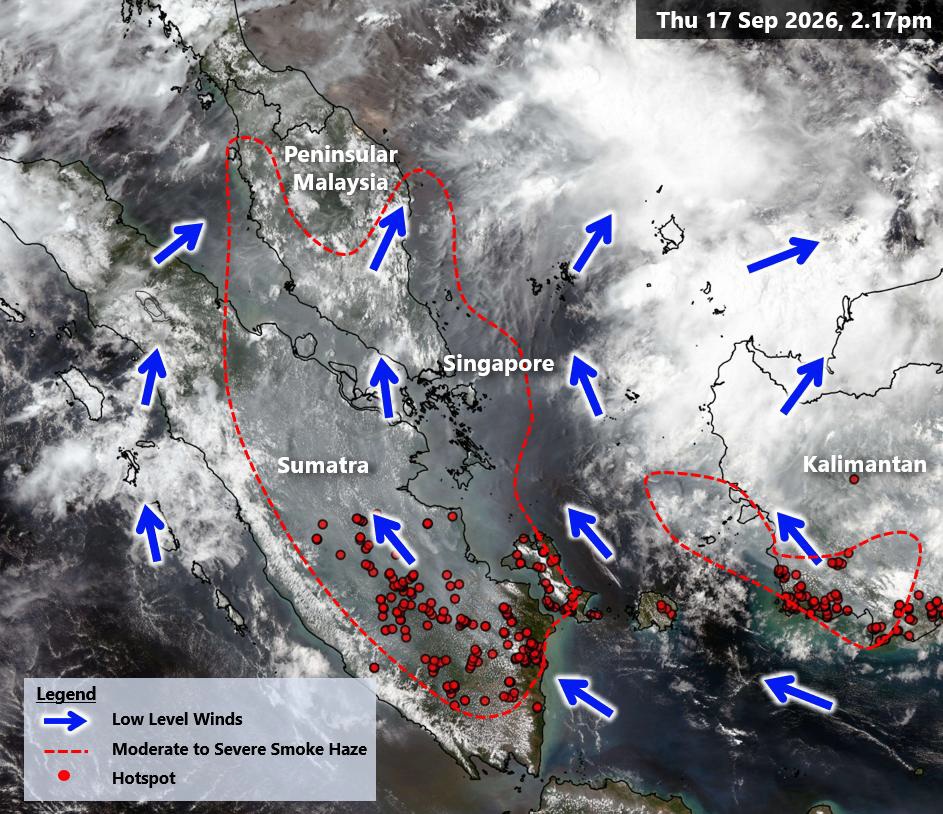
- Smoke from forest fires in Indonesian Borneo crossed national borders at almost the same time, and Manila reportedly recorded pollution levels more than four times the WHO's safe limit.
- Inside Indonesia the ash caused eye irritation and forced schools into distance learning.
- The disaster agency BNPB and the meteorological agency BMKG said the eruption carried no tsunami risk, a message for communities that remember the 2018 Sunda Strait tsunami, which killed more than 400 people.
Compiled by The ScientistSomething wrong?How this is made
Why it matters
- constraint The Sarawak asthma figure cannot be set against last year's haze season, because the baseline count and the counting window were not reported, so it cannot be used to fix a threshold at which neighbouring health systems escalate.
- decision Aviation and health agencies outside Indonesia have to time their own closures and advisories off Indonesian bulletins, so the release schedule of BNPB and BMKG shapes decisions taken in other jurisdictions.
- exposure Some burned concessions are held by companies linked to Singapore, Japan and Malaysia, so records held in those three countries bear on who is accountable for the haze.
A 259 percent rise in asthma cases is roughly 3.6 times the earlier rate [6][16]. The phys.org commentary reports the Sarawak figure as an association with deteriorating air quality, and association is the right word for what a percentage like that can carry [6][20]. Whether 3.6x means a regional health emergency depends on the baseline it multiplies.
The commentary did not disclose the baseline count, the population behind it, the counting window, or the pollutant and averaging period for the Manila reading [19]. A clinic that normally logs a handful of asthma visits a week gets to 259 percent on small absolute numbers. A rise in presentations can also mean more people presenting who would otherwise have stayed home during a haze episode everyone is reading about [6].
The aviation half of the same week has denominators built in. Tickets are sold and departures are scheduled before anything erupts, so the stranded total divided across the eight closures comes to about 34,000 passengers per airport [17].
Ingrid d'Hooghe, a senior research associate and former head of the Clingendael China Centre, sorts crisis communication into physical coping, psychological coping and reputational repair [11]. The two agencies' tsunami message belongs to the second category, and it is the kind of statement that can be checked, with an author, a date and a content that events can contradict [12]. The third category the commentary defines as strategic communication meant to restore a damaged image, particularly where a crisis involves imputable acts, a lack of prevention or inadequate handling [18].
The reputational layer carries the argument that Indonesia's response is being judged abroad. The support offered for it in the text is the ASEAN Disaster Risk Communication Framework's expectation of timely, accurate and trustworthy information-sharing, d'Hooghe's categories, and the point that silence or delay forces neighbouring governments to decide on incomplete information [10][15][23]. The accountability described does not stop at Indonesian firms. Some concessions affected by the fires belong to companies linked to Singapore, Japan and Malaysia [9], and the commentary says recurring crises may reinforce perceptions of Indonesia and of the neighbours whose companies hold concessions there as sources of regional environmental risk [22].
Indonesia is highly exposed to climate hazards and has seen more wildfires in recent years [14]. The commentary puts its test as a question: can Indonesia demonstrate that it is capable of managing risks whose consequences extend beyond its own territory [21].
What to watch
- Whether Sarawak health authorities publish asthma presentation counts with a baseline and a population, which would make the 259 percent figure comparable across haze seasons.
- Whether Philippine monitoring data attributes Manila's pollution readings to the Borneo fires or to local sources.
- Whether ASEAN centres publish a timestamped record of what Indonesian agencies sent partner governments during the September episode.