Product1 publisher2 min readPublished
Huang replaces his pacing advice with a flat 0% on AI extinction risk
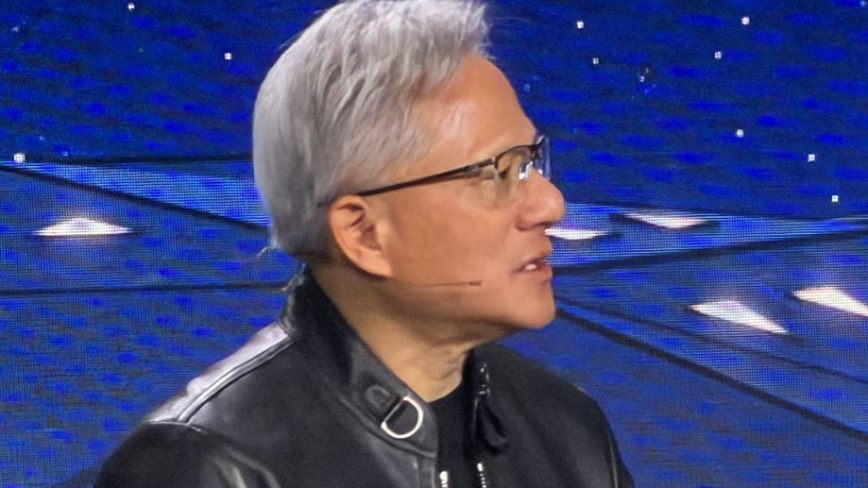
Weeks ago Nvidia's chief executive told companies to pause or pace their work if they felt out of control. On a CBS excerpt he puts the chance of AI ending the world by 2030 at zero and tells the industry to go as fast as it can.
The Product Desk · Product desk
What happened
- Jensen Huang told CBS News's Jo Ling Kent that 2030 is not going to be the end of the world, put the chance at zero, and said the industry should go as fast as it can irrespective of anyone else.
- Weeks earlier he said companies should pause or pace their work if they felt their company was out of control, which TNW takes to be close to what the pacing proposals ask for.
- In the same interview he said the industry would never ship products before they are ready or deliver products that are unsafe.
- Only an excerpt has been released so far, with the full interview airing on Sunday.
Compiled by The Product DeskSomething wrong?How this is made
Why it matters
- constraint A release gate that leaned on the supplier's own pacing language has lost its outside citation, so the team defending the gate has to carry it on numbers it measured itself.
- decision Anyone who quoted Huang in a launch review now chooses between re-arguing the gate from internal evidence and accepting that readiness is whatever the shipping team says it is.
- exposure The most quotable number in the pace argument now comes from the party whose sales a slowdown would hit, so a deck that reuses it inherits that conflict.
- contradiction TNW takes both CBS sentences as sincerely held and holds that they cannot both bind. That is what makes the excerpt hard to cite either way.
The earlier line was useful to somebody. A product manager writing the release gate on an agent feature needed a reason from outside the safety team, and a chip vendor conceding a brake was the most quotable reason available, since of everyone arguing about pace Huang has the most direct financial exposure to the answer [7]. That citation is spent.
Two sentences in the excerpt now have to live together. If pace is set irrespective of anyone else, readiness is judged by the shipper, and the only check on release is the releasing company's own assessment. TNW notes the pacing proposals were written to change that arrangement [6].
An outside quote wins a scheduling meeting; it does not set a threshold or write an eval. The gate underneath rests on numbers a team measured itself, like the eval a build failed before launch and the time a rollback actually took. Those numbers are unchanged, and the only thing lost is a sentence a PM could read aloud when the launch date was under pressure.
Zero is also a number that only Huang brings to this argument. The labs publish safety frameworks, capability thresholds and risk estimates. Those are instruments for operating under uncertainty [17]. The pacing case is explicitly a bet about unknown probabilities, which is why it asks for evaluators and tripwires instead of a halt [18]. Huang's zero is the only point probability on the table [19]. His earlier answer was narrower: he called apocalyptic predictions not grounded in science, which is a claim about evidence [4]. Andrew Ng has made that narrower case without any inventory to clear, calling the extinction warnings science fiction [9]. The people being dismissed include a DeepMind AGI safety researcher who left this month and published his warning [14].
Trump has spent the month attacking AI safety warnings and calling them a hoax, repeatedly and at length [10], and CBS trailed the interview on Huang agreeing with him [11]. Huang has been publicly resisting proposals to sanction Chinese AI [12]. He is expected at the state dinner for Xi Jinping next week [13].
The cheap test for anyone defending a gate is to cover the outside name on each line of the checklist. The lines that still give a reason point at something the team owns, like the threshold agreed before the build or a rollback time someone measured. The rest were borrowed from a supplier whose answer changed between two interviews [3].
What to watch
- Whether Huang repeats the 0% unprompted in the unedited interview or narrows it back to the not-grounded-in-science formulation.
- Whether any lab answers a point estimate of zero with a published number of its own, instead of a threshold.
- Whether Nvidia's export-policy position advances after the Xi Jinping state dinner.