Science1 publisher3 min readPublished
White dwarf RXJ0528+2838 has driven a bow shock for at least 1,000 years without a disc
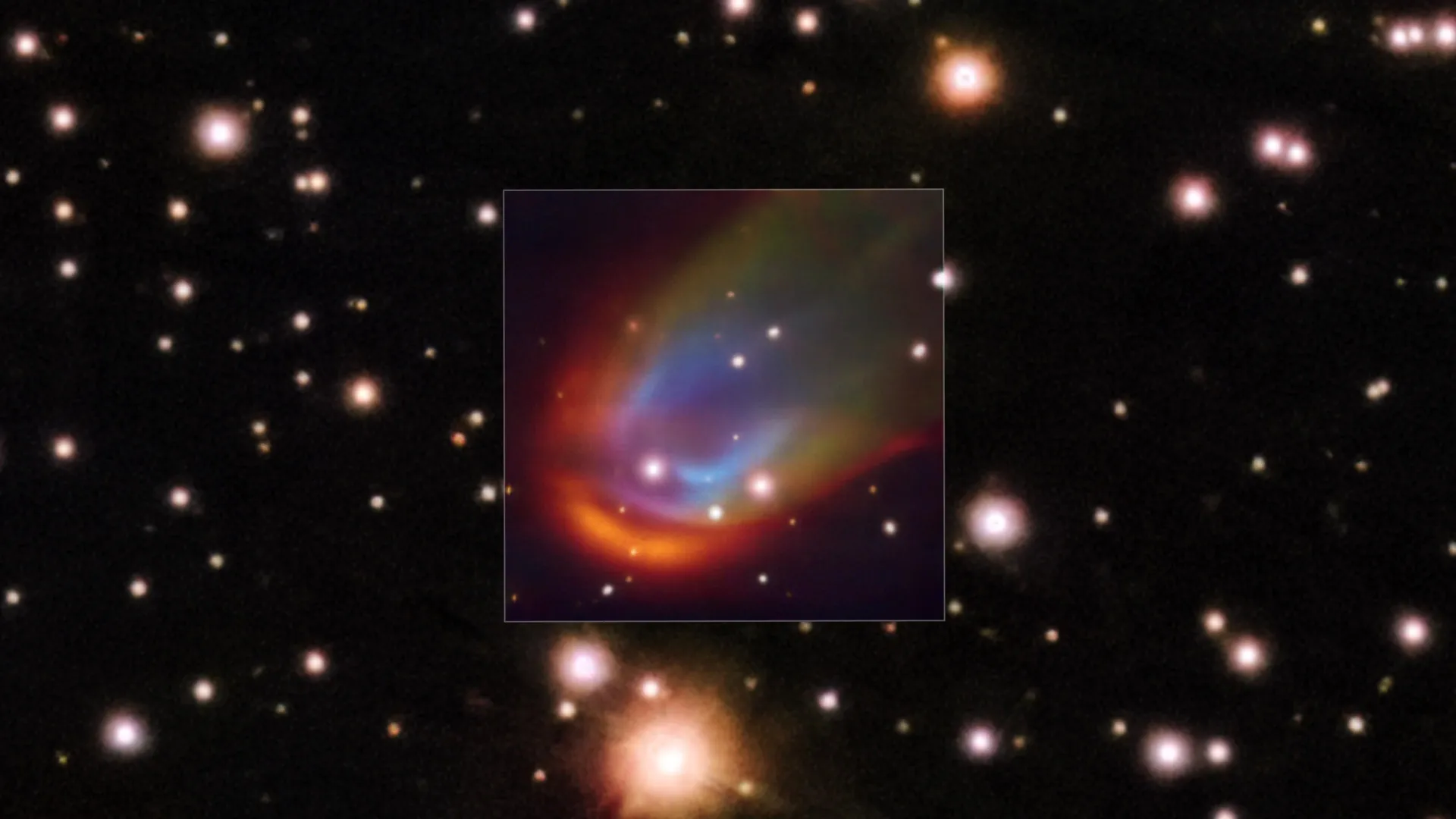
Astronomers find white dwarf RXJ0528+2838 has sustained a bow shock for at least 1,000 years with no disc to power it. Its strong magnetic field may account for part of that, and the team says an unexplained energy source may supply the rest.
The Scientist · Science desk
What happened
- RXJ0528+2838, a white dwarf about 730 light-years away with a Sun-like companion, pushes a bow shock ahead of it as it moves through interstellar gas.
- Astronomers see no evidence of the accretion disc that usually launches outflows in binaries like this one.
- The size and shape of the bow shock imply the star has been driving a powerful outflow for at least 1,000 years.
- MUSE also confirmed a strong magnetic field that appears to channel the companion's gas straight onto the white dwarf, so no disc forms.
Compiled by The ScientistSomething wrong?How this is made
Why it matters
- constraint Models that explain white dwarf outflows through an accretion disc cannot cover this system, so magnetic binaries without discs need their own account of how they eject matter.
- constraint Any proposed energy source now has to keep a disc-free star's outflow running for at least a thousand years, and the release says no one can yet explain how that happens.
- contradiction The 'shouldn't exist' framing is stronger than the team's own wording: no known process fully accounts for the shock and the field may cover part of it, so what is missing is a share of the power.
In a binary like this one, the outflow normally starts at the disc. Gas pulled off the companion collects in a disc that feeds the white dwarf, and some of that matter is flung back into space [4]. Remove the disc and the usual launch site goes with it. Yet something is still pushing out enough material to build what Noel Castro Segura, a University of Warwick research fellow who collaborated on the study, said is "a curved arc of material, similar to the wave that builds up in front of a ship." [14]
With any nebula seen near a star, the first question is whether the two are related at all. An interstellar cloud sitting on the same line of sight could look much the same in a single image. The arc first turned up in images from the Isaac Newton Telescope in Spain, and the team then pointed ESO's Very Large Telescope at it [5]. "Observations with the ESO MUSE instrument allowed us to map the bow shock in detail and analyse its composition. This was crucial to confirm that the structure really originates from the binary system and not from an unrelated nebula or interstellar cloud," said Krystian Ilkiewicz of the Nicolaus Copernicus Astronomical Center in Warsaw, who co-led the study published in Nature Astronomy [6][12].
The 1,000-year figure is a lower bound inferred from geometry [7]. The release does not give the outflow's speed or power, or how fast the star moves through the surrounding gas.
The team's main lead is the magnetic field. A field that steers gas straight onto the star explains why there is no disc [8]. How a star with no disc keeps an outflow going for a millennium is still unknown, though the release says the field may be an important clue [9]. "Our finding shows that even without a disc, these systems can drive powerful outflows, revealing a mechanism we do not yet understand," Ilkiewicz said [11].
In the team's account, the field and an unknown engine are not competing explanations. The release says the field may be partly responsible and that an unexplained "mystery engine" may also be at work [10]. It also says no known process fully accounts for the observations [16]. On that wording, the field could supply some of the power, with the remainder unexplained. Ilkiewicz's own statement keeps its qualifier: the outflow, he said, "according to our current understanding, shouldn't be there." [15]
The result rests on a single binary, about 730 light-years from Earth, whose companion is a Sun-like star [1]. "We found something never seen before and, more importantly, entirely unexpected," said Simone Scaringi of Durham University, the study's other co-lead [13][12].
What to watch
- A published outflow speed or energy budget for the bow shock, which would show how much power the magnetic field would have to supply.
- Searches of other magnetic white dwarf binaries without discs for similar bow shocks; a second example would show whether RXJ0528+2838 belongs to a class or stands alone.
- A physical model linking the white dwarf's field to a sustained outflow, the connection the team suspects but has not demonstrated.