Science1 publisher2 min readPublished
Three JWST sightlines put carbon and oxygen outside galaxies 500 million years after the Big Bang
A hand search of public JWST spectra turned up three galaxies whose outflowing gas carried carbon, oxygen and silicon 500 million years after the Big Bang. The search was done by eye, so the three cases show that enrichment happened while leaving its frequency open.
The Scientist · Science desk
What happened
- Astronomers at the University of Arizona report in Nature Astronomy that galaxies seen 500 million years after the Big Bang were already dispersing oxygen and carbon into the gas around them.
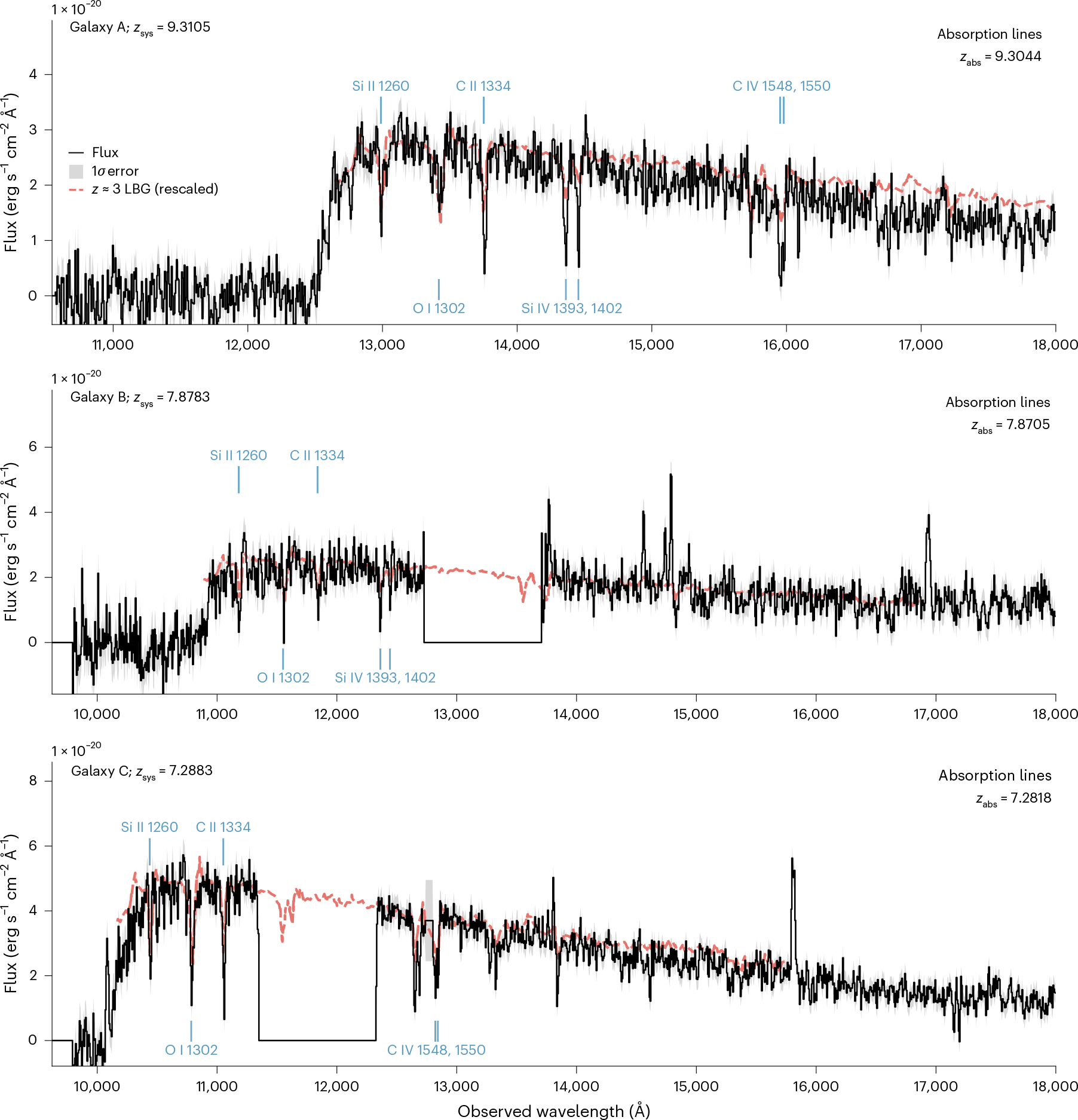
- The team used each galaxy as its own background light source and read the heavy elements off absorption imprinted on its spectrum, with nearly 30 hours of JWST exposure supplying the signal.
- The absorption lines were blueshifted against the galaxies' redshift, the signature the authors attribute to gas flowing outward and carrying oxygen, carbon and silicon away.
- Yongda Zhu found the three cases by hand over a single night, searching publicly available JWST spectra from hundreds of galaxies for absorption patterns.
Compiled by The ScientistSomething wrong?How this is made
Why it matters
- constraint The absorbing gas sits on the sightline to the galaxy that lights it, so the measurement constrains a galaxy's own surroundings; the metal content of gas far from any galaxy is not what these spectra test.
- capability Absorption chemistry at cosmic dawn can be done on archived JWST spectra, so anyone wanting to check the result needs analysis time rather than a new observing allocation.
- precedent Because the evidence is three by-eye detections out of hundreds of spectra, the next dispute about early enrichment timelines will be about how complete the archive search was.
- contradiction The study's framing treats the pristine-gas expectation as likely wrong, while its first author keeps the seeding of neighbouring galaxies conditional.
Metals seen in a galaxy's own spectrum could be metals still inside the galaxy. The blueshift is how the team addressed that: the absorption sits at a velocity offset from the galaxy itself, which the authors attribute to gas moving outward and carrying heavy elements away [11].
The design is simple. "We used the galaxies themselves as background light sources," said Yongda Zhu, first author and a postdoctoral researcher at the University of Arizona's Department of Astronomy and Steward Observatory [7][18]. "As light from the galaxies traveled toward Earth, it passed through surrounding gas, and we were able to look at the light's absorption patterns to detect specific elements," he said [8]. Only JWST's infrared capability made the observation possible [17], for light that has been traveling more than 13 billion years [3].
Three detections make up the sample. "Hundreds" of spectra means at least two hundred examined, which puts the detections at no more than about 1.5 percent of what was inspected [15]. That figure measures the search. The search kept the sightlines where the absorption was strong enough for one person to notice over one night of reading public spectra [10].
Because each galaxy lights its own sightline, the gas doing the absorbing lies in that galaxy's surroundings [8]. The claim that the metals reach intergalactic space rests on the outward motion of that gas [11]. The report lists carbon, oxygen and silicon and gives no abundances for the three systems [19].
The chemistry looked mature. The fingerprints of the three closely resembled those of evolved galaxies billions of years later [12], at a moment about 3 percent of the universe's current age [2], during the Epoch of Reionization [4]. The expectation had run the other way: much of the gas around the first galaxies should have stayed relatively pristine, mostly hydrogen and helium [5]. The Arizona account of the Nature Astronomy paper says that picture is likely wrong [6].
Zhu's own wording keeps the seeding of neighbours conditional. "Not only were the galaxies producing these elements, but they were also dispersing them, possibly seeding other galaxies," he said [14]. The exchange of material between galaxies and their surroundings is called baryon cycling [16]. "We observed that heavy elements escaped from galaxies very, very early in cosmic time," said Zhu [13].
What to watch
- An automated search of the same JWST archive with measured completeness would turn three detections into a detection fraction.