Science1 publisher2 min readPublished
Iron meteorite chemistry puts the earliest planetesimals at 8 to 17 percent icy dust
Yale researchers read the original makeup of planetesimals that melted so thoroughly their textures vanished, and place the Solar System's preference for heat-formed rock beads inside the first million years.
The Scientist · Science desk
What happened
- A Yale-led team reported in Nature Astronomy on September 18 the first geochemical evidence that bodies forming in the Solar System's first million years were built mostly from high-temperature chondrules.
- Until this work, the preference for chondrules over icy dust had only been documented in objects that formed two to four million years after the Solar System began.
- No undifferentiated body survives from that first million years, so the team worked from iron meteorites whose parent bodies melted completely on the heat of radioactive aluminum-26.
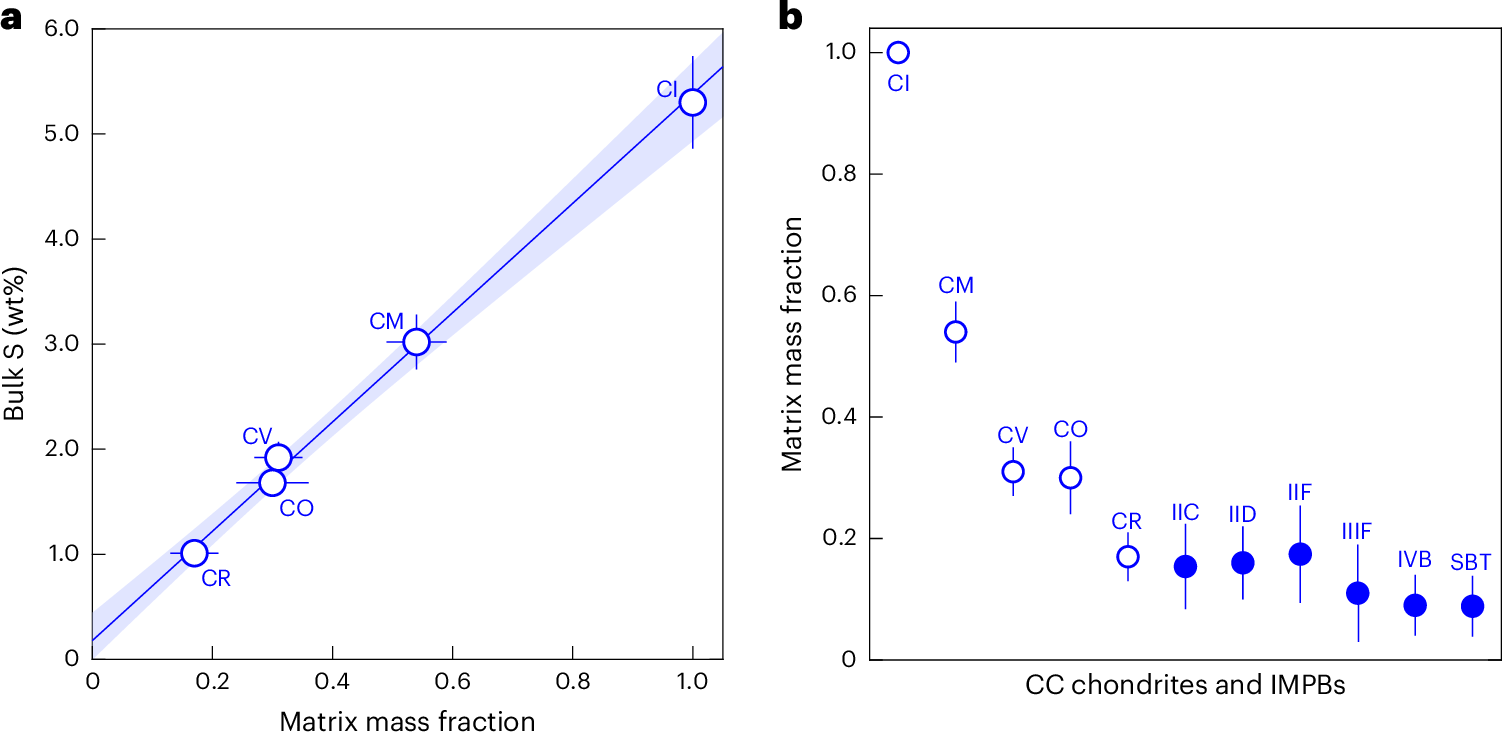
- Their reconstruction put matrix, the cold fine-grained dust rich in water ice and organics, at 8 to 17 percent of those bodies' original material, below any known chondrite.
Compiled by The ScientistSomething wrong?How this is made
Why it matters
- constraint If water ice and organics travelled in the matrix, the first outer Solar System planetesimals assembled dry, and the volatile inventory of later planets has to be carried by the generation of bodies that accreted after them.
- capability Fully melted bodies can now be interrogated about what they originally accreted, which widens the usable sample well beyond the small set of intact primitive meteorites.
- decision Anyone modelling how the protoplanetary disk separated millimeter rock beads from micron ice dust now has to make that separation work inside the first million years of disk history.
The two tracers rest on different chemistry. Sulfur is highly concentrated in matrix, so a planetesimal that swept up a lot of cold dust should have inherited a lot of sulfur. Iron's oxidation state records how much water ice and oxidized dust went into the body [8]. "Both tracers independently tell the same story: these early planetesimals were remarkably matrix-poor," said Damanveer Grewal, the Yale assistant professor of Earth and planetary sciences who is first author of the study. "That convergence is what makes the result robust" [12][13].
The indirect route is necessary because the rocks lost the direct evidence. Chondrules are small rocky spheres visible inside chondrites, among the most primitive meteorites in collections, and counting those spheres is how the sorting has been documented before [15]. The iron meteorite parent bodies held enough radioactive aluminum-26 to melt all the way through. Melting erased the structures [7].
Grewal described the result from the chondrule side: the earliest bodies in the outer Solar System, he said, were "built from 83% to 92% chondrules, with very little of the icy, volatile-rich dust that dominates later-forming objects" [11]. That range is the complement of the measured matrix fraction, 100 minus 17 and 100 minus 8 [16]. The tracers constrain matrix; the chondrule figure follows by subtraction, so the reconstruction counts everything that is not fine dust as a chondrule.
Matrix is where the water ice and the organic material sit [5]. A body that accreted that little of it started out drier than any chondrite yet measured [9]. The direction of the trend was already known from carbonaceous chondrites out of the outer Solar System, where older examples hold more chondrules and less matrix and younger ones hold more of the cold volatile-rich material [14]. "Our work shows that this assembly process was remarkably selective from the very beginning," Grewal said [10].
What the tracers constrain is the matrix content of outer Solar System planetesimals in the first million years [19]. Getting from there to the water on any planet requires knowing how much of the later, matrix-rich generation was moved inward, which is a transport question these melted bodies do not answer. The Yale announcement does not name the physical process that separated millimeter beads from micron dust [1].
What to watch
- Whether the uncertainties stated in the Nature Astronomy paper allow matrix fractions above 17 percent for any of the parent bodies.
- A disk model that reproduces an 8 to 17 percent matrix fraction inside one million years and identifies the sorting mechanism.
- The same sulfur and iron-oxidation treatment applied to inner Solar System iron meteorites, for comparison with the outer-system range.