Science1 publisher3 min readPublished
ALMA images a planet five times Jupiter's mass interacting with the gas it formed in
MPIA astronomers used ALMA to image WISPIT 2b, a gas giant five times Jupiter's mass, interacting with the gas it formed in. Formation models have rested on simulations and indirect evidence, so a planet still feeding on its birth gas gives them a direct check.
The Scientist · Science desk
What happened
- A team led by Myriam Benisty at the Max Planck Institute for Astronomy used ALMA to image WISPIT 2b, a five-Jupiter-mass gas giant, interacting with the gas around it.
- WISPIT 2, announced in August 2025 and about 430 light-years away, is only the second disk in which a protoplanet can clearly be seen.
- An MPIA study published in August 2026 found two stars in a very close orbit at the center of the WISPIT 2 disk.
Compiled by The ScientistSomething wrong?How this is made
Why it matters
- capability Simulated planet-disk gas flows can now be checked against an observed accreting planet, where earlier checks leaned on inferred planets behind disk rings.
- constraint A central binary and a second planet mean single-star, single-planet models are a poor fit, so agreement or disagreement with them will be hard to attribute to WISPIT 2b alone.
- constraint With only two disks showing a clear protoplanet, any result from WISPIT 2 can test a formation mechanism in one system but cannot establish how common it is.
- precedent The quick move from discovery to ALMA follow-up suggests newly imaged protoplanets will go straight into gas and dust observations.
Astronomers can clearly see a protoplanet in exactly two protoplanetary disks, according to the phys.org report on the work [6]. The first was PDS 70. There, Miriam Keppler, then a doctoral student at the Max Planck Institute for Astronomy (MPIA), led the 2018 SPHERE observations at ESO's Very Large Telescope that produced the first confirmed image of a protoplanet inside a disk [4]. The PDS 70 planets appear to have cleared the gas from their close surroundings, so the interaction between a young planet and nearby gas cannot currently be studied in that system [5].
WISPIT 2 is the second case. It lies about 430 light-years away [6], some 60 light-years farther than PDS 70 [1]. Its planet is also still growing: WISPIT 2b's emission in the hydrogen-alpha line indicates it is accreting gas from its surroundings [7].
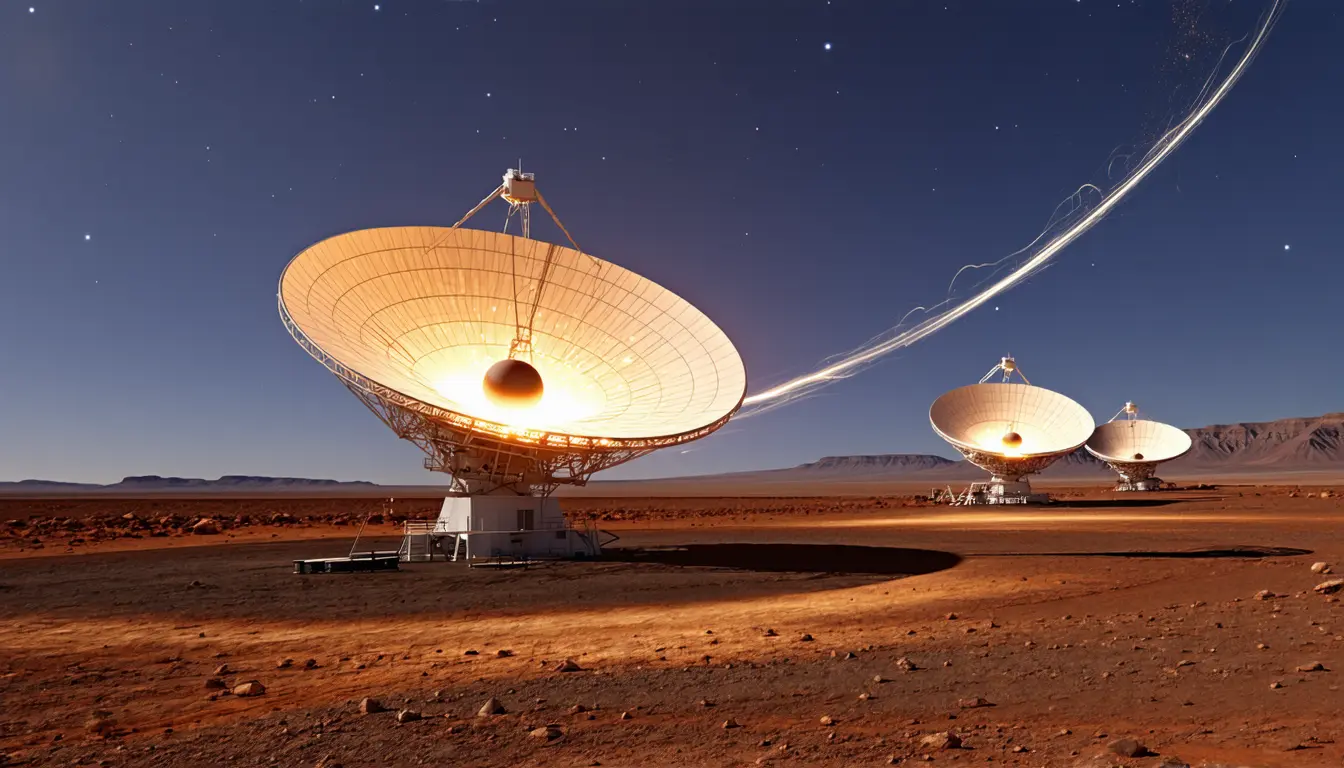
Distance is the practical obstacle. At WISPIT 2's range, the report says, imaging a structure the size of the Earth-sun distance is as hard as reading an ordinary book from 5 kilometers away [10]. ALMA's 66 dishes on the Chajnantor plateau in Chile can be combined to act like a single telescope up to 16 kilometers across. The report calls it the only facility that reaches that level of detail for disk gas and dust [11]. Once WISPIT 2b's discovery was announced, pointing ALMA at it was, in the report's words, "the logical next step" [13].
The theory under test starts with dust clumping into pebbles, then into planetesimals a few to a hundred kilometers across, then into rocky bodies that, in gas-rich parts of a disk, pull in enough gas to become the cores of giants [12]. Key parts of that account rest on simulations and measurements, and the report describes direct observations as "notoriously absent" [2]. Most of the observational support has been inferential. ALMA's 2014 images of ring-like disk structures, for example, were thought to be caused by young planets [3]. An image of a planet five times Jupiter's mass interacting with the gas of its birthplace is the direct observation that account has lacked [1].
The report does not describe the measurements behind the image, such as how fast or in which direction gas moves near the planet, or how closely the result matches any specific simulation. Those details are in two preprints posted to arXiv [1].
Any comparison with models will also have to handle a crowded system. A second planet, WISPIT 2c, was announced in March 2026 from SPHERE and GRAVITY+ data [8]. Work by MPIA doctoral student Cade Bürgy, published in August 2026, found that the disk's center holds two stars in a very close orbit [9].
I think the result deserves attention as a second data point with the property the first one lacked: gas still present around a planet that is still accreting [5][7]. It can test how one giant planet acts on its disk. With two systems in the sample, it cannot show how typical that behaviour is [6].
What to watch
- Whether the two arXiv preprints report gas motions near WISPIT 2b that match, or depart from, published planet-disk simulations.
- How modelling groups account for the close central binary and WISPIT 2c when fitting the ALMA data.
- Journal publication of the two papers, and any change to the results through review.