Build1 publisher2 min readPublished
Warp's LTL schedules become the test for a supervised Volvo-Waabi truck in Texas
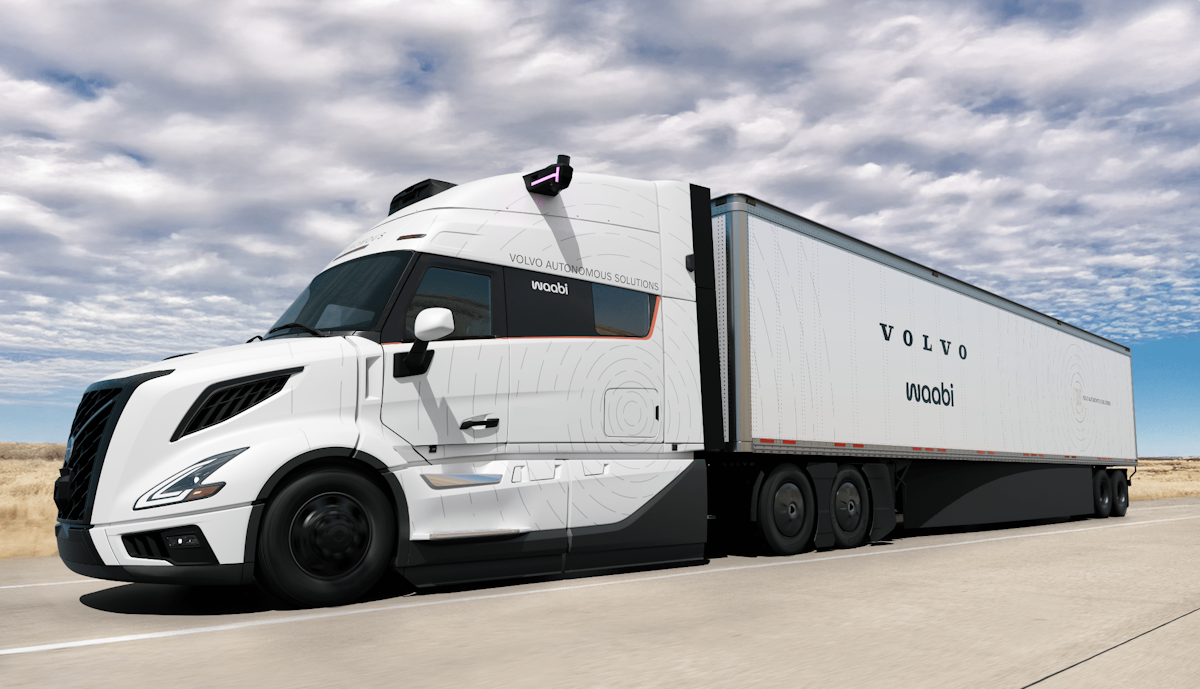
Volvo Autonomous Solutions and Waabi are hauling Warp customer freight on the Dallas-Houston corridor with an observer in the driver's seat. The measure now is whether the truck keeps to the pickup and delivery schedules of a shared-load network.
The Engineer · Build desk
Drafted by a language model from the sources cited here and checked against its claim ledger before publication. How we use AISend a correction
What happened
- The October 5 announcement describes the partnership's first customer operation, with freight going to third-party facilities outside a closed test site.
- The truck is a Volvo VNL Autonomous running Waabi Driver, on a platform Volvo says has redundancies for six safety-critical systems.
- Warp says the network the truck now feeds includes more than 38,000 carriers and 70-plus warehouses.
- Waabi announced a $750 million Series C in January 2026, alongside a separate milestone-based $250 million Uber commitment tied to robotaxis.
Compiled by The EngineerSomething wrong?How this is made
Why it matters
- constraint With a person aboard every autonomous haul, this lane can show whether the truck keeps a network's timetable, while the economics of driver-out trucking stay untested.
- exposure Each LTL trailer mixes several customers' freight, so a late autonomous run on this lane delays multiple Warp shippers at once.
- decision Volvo and Waabi will plan further routes from what this lane teaches them, so its reliability record sets the pace of any expansion.
A less-than-truckload lane asks more of an autonomous truck than a point-to-point haul does. Freight from several customers is combined, then consolidated and distributed through a network of facilities on scheduled routes [7]. That takes more coordination than moving one full trailer between two points [7]. Warp's software coordinates the shipments, capacity, routes and timing [8]. The truck is one leg in that plan [6]. As the RuntimeWire report puts it, "an autonomous truck is useful to a logistics provider when it fits existing pickup, consolidation and delivery schedules and completes the highway run" [16].
Waabi describes its approach as an AI driving system combined with simulation [13]. Raquel Urtasun, Waabi's founder and CEO, has argued that simulation lets autonomous vehicles face hard scenarios that are rare on public roads or unsafe to stage there [14]. That covers the hard edge case. Arriving when Warp's plan expects the truck is a different property. It can only be measured on ordinary runs inside the live network [8].
The observer keeps this deployment distinct from driver-out trucking [3]. I think that ordering suits an LTL network. Customer freight can test the timetable now, with a person aboard, before anyone has to settle the driverless question [3].
The vehicle side is cleanly divided. Volvo designed its platform to integrate partners' driving systems [5]. The three companies connected the truck to Volvo Autonomous Solutions' Autona freight ecosystem and to Warp's network, which handles both LTL and full-truckload freight [6]. Volvo owns the redundant vehicle, Waabi owns the driving system, and Warp owns the schedule [4][5][8]. I'd expect that split to make a late run easier to trace to a single layer.
Daniel Sokolovsky, Warp's CEO and co-founder, said the partnership puts advanced technology into everyday freight movement [9]. He also said that coordinating multiple customers' shipments lets improvements on one lane benefit a broader network [9]. Before starting Warp, he built AxleHire, a last-mile delivery company. In his telling, the middle mile, where goods move between regions and facilities, is a constraint on delivery networks [15].
The announcement does not say how many trucks, loads, miles or customer facilities the initial service covers [10]. It does report that Waabi has raised more than $1.3 billion to date, a cumulative figure that is the company's own claim [12].
What to watch
- Any load count, mileage or on-time figure from Volvo, Waabi or Warp for the Dallas-Houston service.
- A date or condition for taking the observer out of the driver's seat on Warp freight.