Build2 publishers2 min readPublished
Proton carries the x86 catalog onto Arm inside Valve's $1,059 Steam Frame
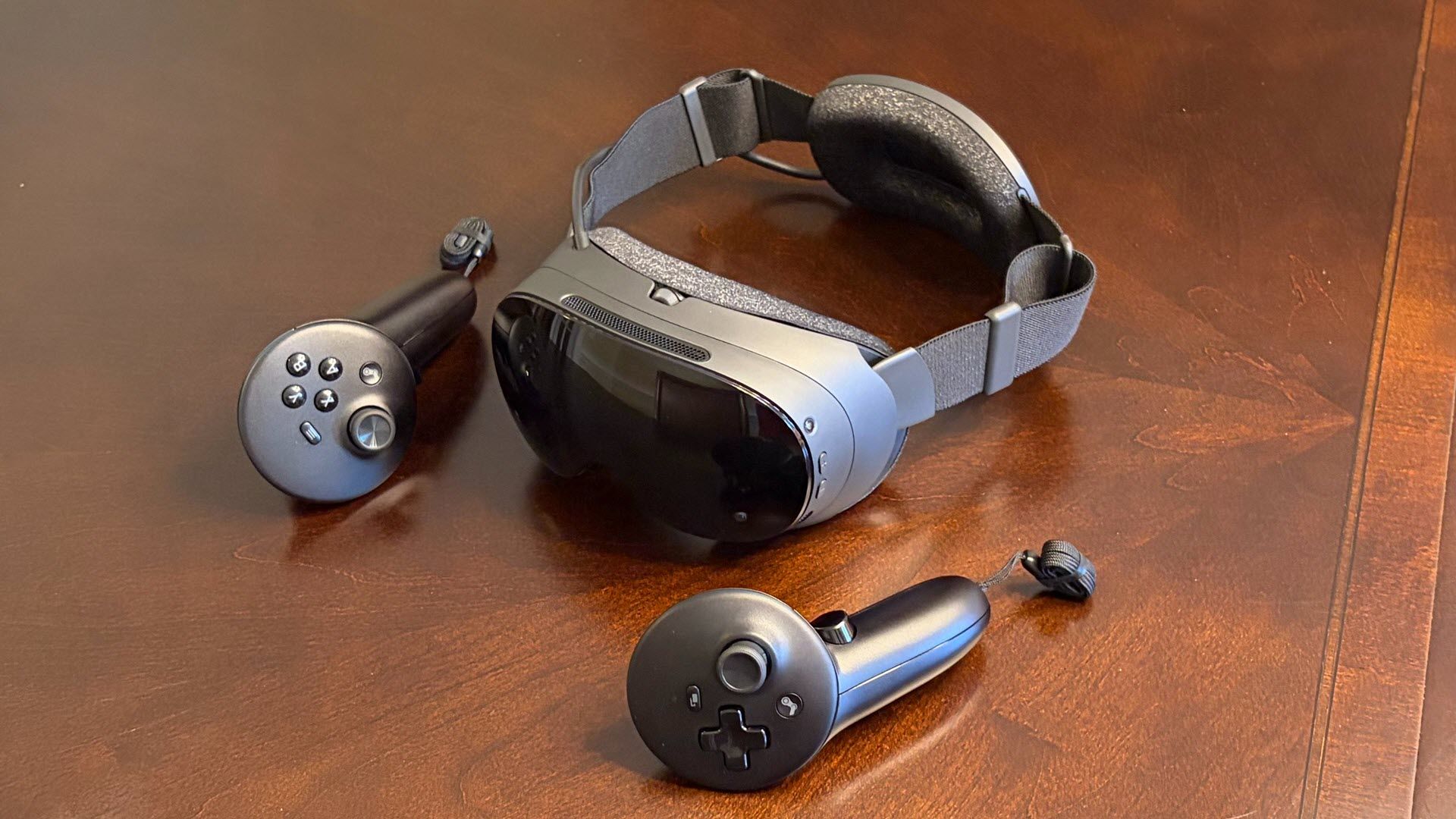
Valve opened Steam Frame reservations at $1,059, and its engineers say standalone play runs the same SteamOS as the Deck on a Snapdragon 8 Gen 3, with Proton and PC streaming absorbing the compatibility work.
The Engineer · Build desk
What happened
- Valve opened reservations on Monday for Steam Frame, its first new VR headset since the Index, at $1,059 for the 256GB model and $1,299 for the 1TB version.
- Tom's Hardware reports that standalone play uses the same SteamOS Valve ships on Steam Deck and Steam Machine, now on Arm hardware, with Proton handling emulation.
- Launch units are allocated by a randomized reservation: sign-ups close September 17 at 10 a.m. Pacific, with purchase emails expected to go out from September 18.
- Two 2,160-by-2,160 LCD panels, eye tracking and foveated streaming keep the highest-quality video where the wearer is looking and cut bandwidth around the edges.
Compiled by The EngineerSomething wrong?How this is made
Why it matters
- constraint Anything too heavy for the on-board chip has to arrive over the bundled Wi-Fi 6E adapter, so the quality of a buyer's wireless link sets the ceiling on what the headset plays.
- decision A studio shipping to this device now picks a lane: trust the existing x86 Windows build to the compatibility layer, or build the native Arm64 or Android package the documentation already supports.
- cost The 1TB upgrade works out at about 31 cents per extra gigabyte, and since both configurations take microSD cards, that $240 buys convenience.
- capability Because Steam Input can present the bundled controllers as a gamepad or a keyboard-and-mouse, a buyer's non-VR Steam catalog is playable on a virtual display without a second controller.
Running an x86 Windows game on a Snapdragon touches two problems at once: the platform the binary expects, and the instruction set the chip actually executes. "And then from there, we kind of tied that into a lot of the work that we did for Steam Deck and Steam Machine running Steam OS now on ARM, but it's the same Steam OS," Valve engineer Jeff Leinbaugh told Tom's Hardware [6]. Valve's developer documentation says the headset can also run Linux titles locally, along with native Arm64 software and Android packages [7]. Of those four local formats, a Windows x86 build has the longest path to the silicon [20].
What that costs shows up when the game is heavy. Asked what performance to expect in standalone mode, Valve's Pierre-Loup Griffais said: "Sure, games that are trying to push the boundaries on the AAA stuff that's very graphically intensive. Most of those recent ones won't run very well because it's a smaller compute envelope, right?" [8] His example of what does work was a re-release, the Metal Gear Solid Collection Part 2: "MGS4 is a game that I haven't played in, I don't know, 20 years at this point, but it's great from there," he said [9]. The same documentation describes Steam Frame as a standalone headset designed primarily for low-latency streaming from a PC [7].
The hard engineering is in the power budget. "So we picked the Qualcomm 8650 chip. It had a lot of capability, but in order to make use of that, we had to solve a lot of engineering challenges around thermal management and power delivery," Leinbaugh said [10]. Away from a PC, the headset runs on a Snapdragon 8 Gen 3 with 16GB of memory [4].
The Index's complete kit launched in 2019 at $999, so the entry Steam Frame is $60 dearer seven years on [11][21]. Meta lists the Quest 3 from $599.99 and the Quest 3S from $349.99 on its US comparison page, which puts Valve's entry model $459.01 above the Quest 3 [12][22]. Tom's Hardware attributes part of the pricing to higher costs across PC hardware, memory and storage in particular [16].
For a studio, the porting ask is one set of interfaces: SteamVR, OpenXR and Steam Input [15]. The performance question is separate, and the published interview does not include frame rates [23]. I would expect the practical gate for most titles to be Proton behaviour first and thermals second, which means the standalone claim transfers to a given game only if it already runs clean under Proton on the Deck and fits the smaller compute envelope Griffais described [8].
What to watch
- Whether the first allocation clears the September 17 sign-up window, and what Valve tells waitlisted applicants that day.
- Whether Valve publishes per-title standalone guidance for Steam Frame, in the way the Deck has verified tiers.
- Whether memory and storage costs, which Tom's Hardware ties to the $1,059 starting price, move that price after the first allocation.