Loading today’s stories
Product1 distinct publisher3 min readUpdated
Six months from concept to a missile off a robot boat: arming USVs is an integration job now
Lockheed Martin and Saildrone put an existing launcher and fire-control box on a commercial hull and shot at a target off Hawaii. The hard part left is not the hardware.
The Product Desk · Product desk
What happened
- Lockheed Martin and USV manufacturer Saildrone demonstrated the ability to launch missiles from an unmanned surface vessel during the RIMPAC 2026 exercise near Hawaii.
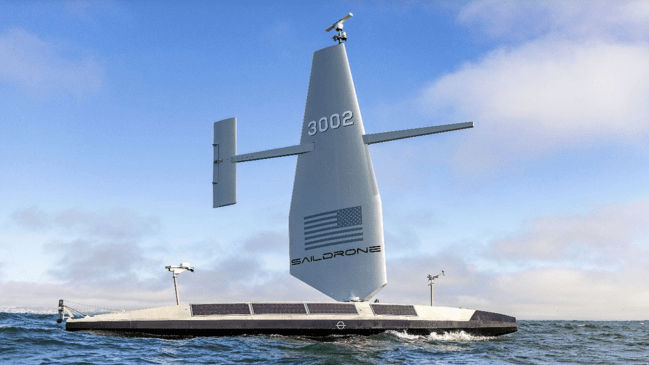
- A Surveyor-class Saildrone was integrated with Lockheed Martin's Joint-Air-to-Ground Missile (JAGM) Dual Launcher and an Adjunct Remote Engagement System (ARES) fire-control system.
- During the demonstration the vessel responded to targeting data and engaged a surrogate high-speed surface craft while operating alongside the USS Theodore Roosevelt Carrier Strike Group.
- The companies said the system went from concept to live demonstration in six months.
- The demonstration was conducted under the US Navy's Fleet Experimentation Program during RIMPAC, described as the world's largest international naval exercise.
Compiled by The Product DeskSomething wrong?How this is made
Why it matters
Read the parts list and the six-month figure stops being remarkable. The round is an existing one, and its designation says air-to-ground, yet here it went off a boat at a boat [16]. ARES is not a new invention either: it is a combat system built for exactly this task, letting a remote platform take target data and shoot [6]. The hull came from a company that has been running unmanned vessels since 2013, roughly thirteen years of sea time before anyone bolted a rail to one [9][15]. What the two companies integrated was a mount and a data path, not a weapon and not a ship.
The calendar supports the same reading. Six months before any date in 2026 lands no earlier than July 2025, which puts the start of work close to October 2025, when Lockheed Martin put $50 million into Saildrone [14][8]. The stake and the schedule are one decision: buy a route onto a deck you do not have to design, then ship your own launcher on it. That is more or less the pitch the companies make, which is that established defence kit reaches the water faster on a commercially developed autonomous platform than on a purpose-built naval one [13].
Worth being precise about what six months bought. The account describes one engagement, against one surrogate high-speed craft, with a carrier strike group in company [3]. It carries no magazine depth, no reload story, no cost per hull, no sortie rate. And the six-month number is the companies' own, not the Navy's; the Navy's contribution named in the account is the Fleet Experimentation Program slot at RIMPAC [4][5].
Saildrone chief executive Richard Jenkins was blunter about the purpose than the demonstration itself was. He described it as pairing one of the most tried and trusted munitions with the most operationally deployed class of USV on the planet [11], and said it reduced the technical risk of putting more advanced weapons on larger autonomous ships [12]. That is the tell. The next hull on the list, Spectre-class, is meant to carry containerised systems including the Mk 70 launcher and SURTASS towed-array gear [10]. Measured against a containerised launcher, a two-rail missile kit on a Surveyor is the cheap rehearsal that proves the fire-control chain works before anyone risks the expensive payload.
Which leaves the useful benchmark. Six months, concept to live fire, for a munition and a hull that both already existed, is now the number any competing team gets compared against, and it is the number the Navy will quote back at anyone proposing a clean-sheet armed vessel. The honest test at the next exercise is not whether a Saildrone can shoot again. It is how many rounds it carries, how long it stays out there, and what a shot costs when the boat is not sitting next to an aircraft carrier.
Loading topic controls
Loading related stories