Science2 publishers2 min readPublished
Seventeen NISAR radar frames trace Krasheninnikov's lava as it overflows its crater
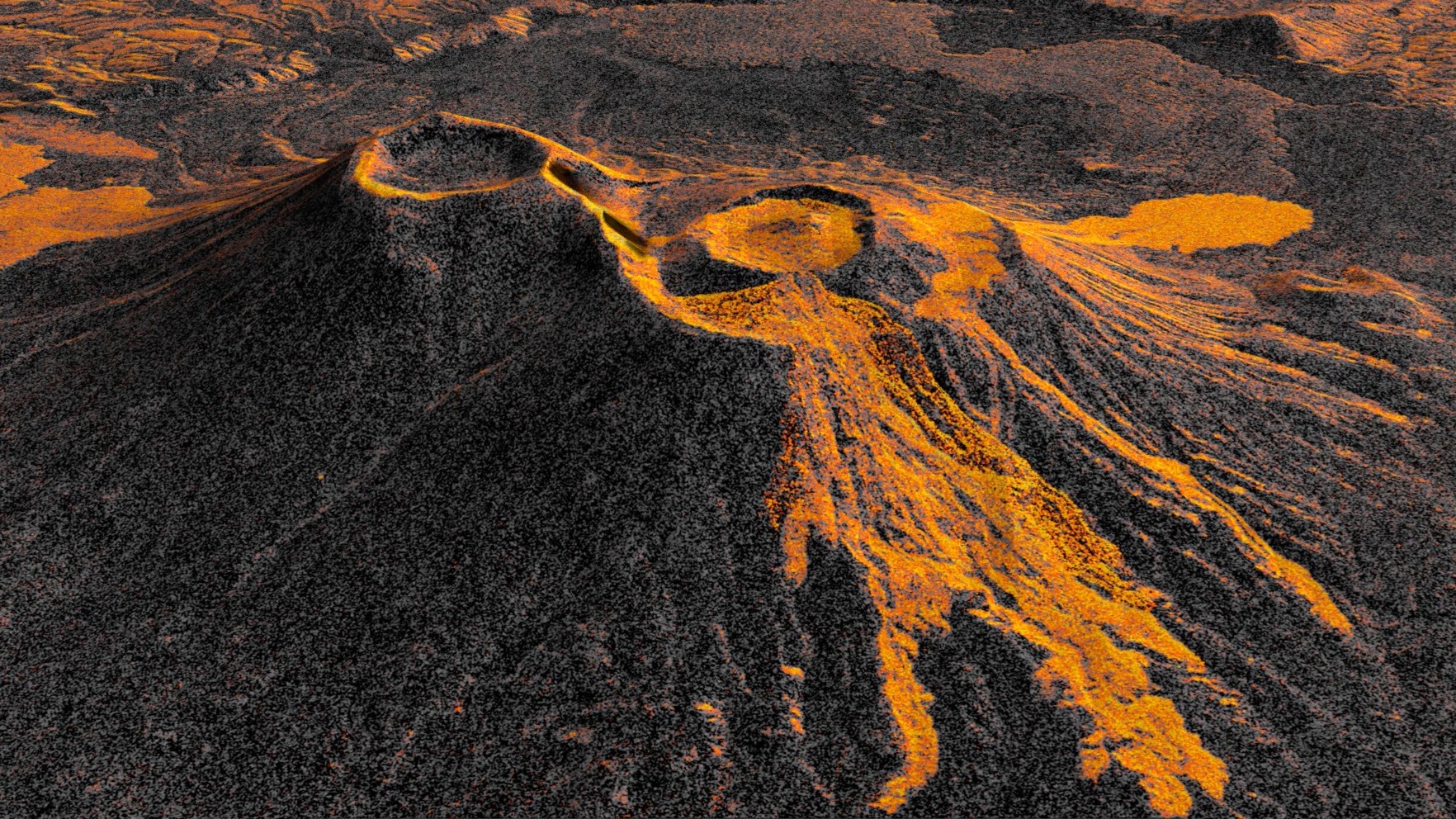
NISAR scientists turned 17 radar frames of Kamchatka's Krasheninnikov volcano into a time-lapse of lava filling and overflowing its crater. Two looks every 12 days are enough to follow a lava field that grows over months, though the satellite began imaging about five months into the eruption.
The Scientist · Science desk
What happened
- Krasheninnikov, a volcano pair on Kamchatka's Pacific coast, began erupting days after an 8.8-magnitude offshore earthquake on July 30, 2025, its first eruption in nearly five centuries.
- NISAR, orbiting 747 kilometers up, first imaged the volcano on Dec. 25, 2025, as the satellite was finishing post-launch checks and becoming operational.
- Since then it has returned to the same orbital spot twice every 12 days, once heading north and once heading south, taking a radar snapshot each time.
- Researchers sequenced 17 frames captured through mid-August into a time-lapse of lava filling an inner caldera, overflowing into a wider crater and spreading into a fan.
Compiled by The ScientistSomething wrong?How this is made
Why it matters
- constraint The eruption's opening months are missing from the radar record: NISAR began imaging about five months in, and a northwest flow in the video likely formed before its first frame.
- decision Two looks per 12-day cycle average one every six days, enough for lava that spreads over months; an agency weighing NISAR for response has to plan for changes that happen between passes.
- capability With L-band products posted at the Alaska Satellite Facility, groups outside the mission team can build comparable sequences for other volcanoes that lack ground networks.
Running two passes every 12 days from the first image on Dec. 25 to mid-August gives roughly 38 acquisitions over about 233 days [3]. The time-lapse uses 17 of them [6]. Matthew Pritchard, a NISAR science team member and geophysicist at Cornell University, analyzed the data behind the animation [13].
Each frame begins as thousands of microwave pulses per second sent down from orbit. Processing then combines the returns from the same patch of ground to sharpen the view [20]. The Krasheninnikov frames come from NISAR's L-band radar [19]. Lava shows up lighter because it reflects microwaves more strongly than the snow or bare ground around it [8]. Each pixel covers about 10 by 10 meters, roughly half a tennis court [7]. At that scale the sequence can follow the edge of the flow as the northern volcano feeds a field moving east [21]. The thing this doesn't tell you is how much lava there is, because brightness shows where the flow has reached and how wide it has spread.
NASA says that capturing the eruption over time shows the precision and reliability of NISAR's measurements [11]. Many of Kamchatka's dozens of volcanoes are closely monitored with ground instruments because they erupt often, but Krasheninnikov, quiet since about 1550, is not one of them [10][3]. So at this volcano, the precision claim rests mostly on the frames agreeing with one another [4]. Pritchard also put the weight on repeatability. "The consistency is crucial. Twice every 12 days, acquiring in this high-resolution mode and in two observation directions, this shows the promise of NISAR to closely monitor natural hazards," he said [12].
When Pritchard did his doctoral research on Kamchatka volcanoes more than 20 years ago, analysis-ready radar data were hard to come by [15]. Satellites revisited less often, and resolution was low [15]. NISAR now covers virtually all of the planet's roughly 1,300 active volcanoes above sea level, and its images can be reached through the cloud [16]. "We're seeing volcanoes around the world that we've never really had eyes on like this before," Pritchard said [14].
For science, nearly eight months of images taken on a fixed schedule is a clean record [3]. NASA also lists emergency response as a potential use [18]. A responder would need to know how long after a pass an analysis-ready image arrives. The release does not say.
What to watch
- NISAR frames after mid-August showing whether Krasheninnikov's eastward fan is still widening or the flow has stalled.
- A volcano observatory or emergency agency acting on NISAR imagery during an active eruption.