Product1 publisher3 min readPublished
Qnetic's flywheel enters EPRI's deRISKED programme, with SMUD paying for the scrutiny
The Pulsar system's non-lithium pitch for data centres now goes through an independent evaluation whose findings land in front of utility participants rather than in a vendor deck.
The Product Desk · Product desk
Drafted by a language model from the sources cited here and checked against its claim ledger before publication. How we use AISend a correction
What happened
- Qnetic announced on August 18 that its grid-scale Pulsar flywheel system has entered the Electric Power Research Institute's deRISKED program.
- Qnetic is a New York-based company.
- The evaluation is sponsored by the Sacramento Municipal Utility District (SMUD).
- The evaluation will combine prototype data, performance modelling and pilot-scale testing to help utilities assess the technology using independently reviewed evidence.
- The independent technical assessment covers performance, safety, reliability and commercial readiness.
Compiled by The Product DeskSomething wrong?How this is made
Why it matters
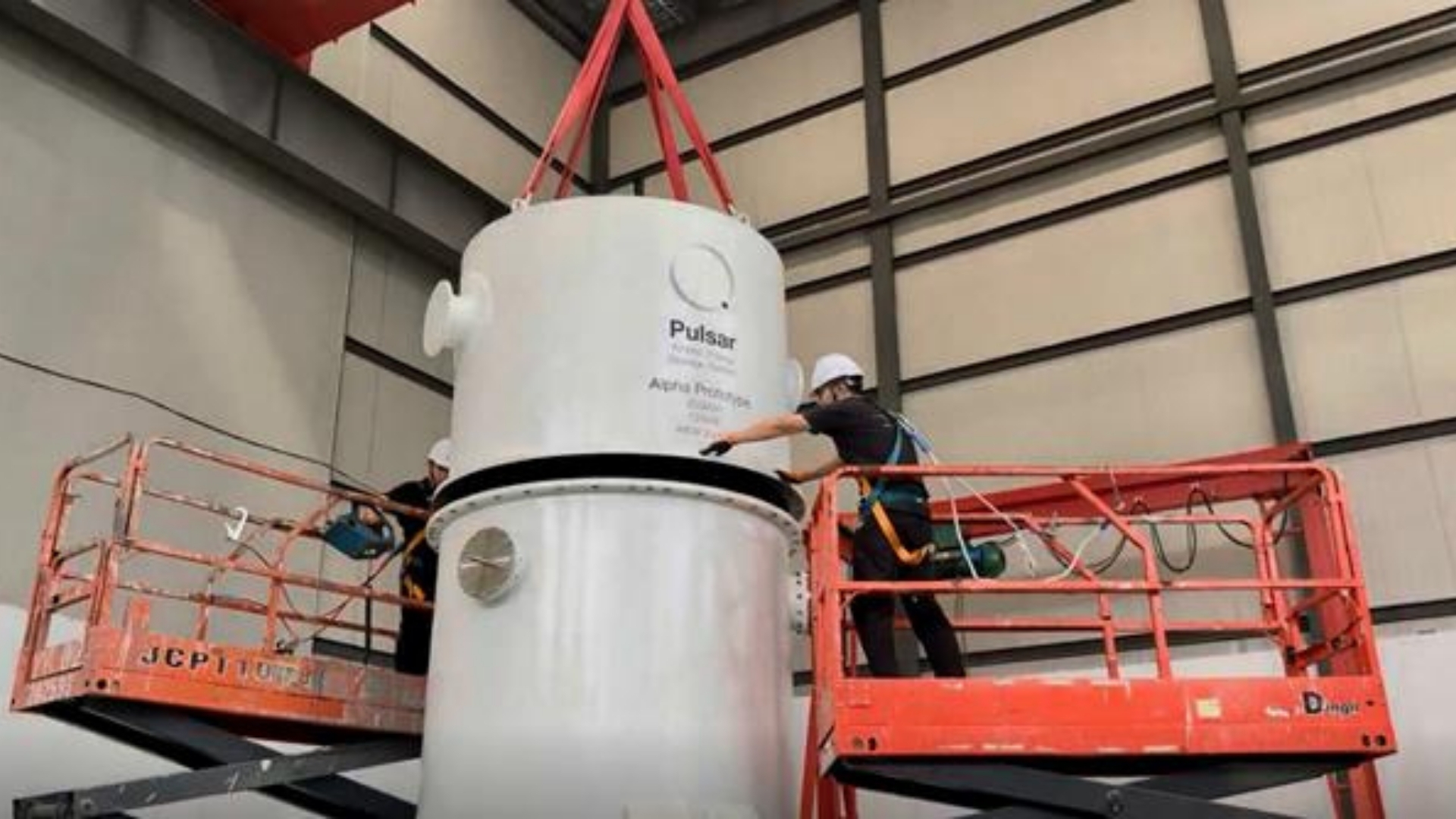
Qnetic said on 18 August that its grid-scale Pulsar flywheel has entered the Electric Power Research Institute's deRISKED programme, an independent assessment covering performance, safety, reliability and commercial readiness [1][5]. The evaluation is sponsored by the Sacramento Municipal Utility District, which matters more than the technology description: it moves a set of durability claims out of the New York company's marketing and into a file a utility procurement team can reference [3][2].
The mechanics are unremarkable and that is part of the appeal. Pulsar stores electricity as mechanical energy in a high-speed composite rotor suspended inside a vacuum enclosure, with no lithium-ion chemistry in the loop [6][17]. Qnetic says the system is designed to run for decades with minimal performance degradation, and claims virtually unlimited cycling, rapid response times and predictable lifetime economics relative to conventional battery systems [19][20]. Those are exactly the claims that are hardest for a buyer to verify from a datasheet, because they are assertions about year fifteen, not year one.
That is the problem the programme is built to address. According to the source account, deRISKED stands for Readiness Informed by Shared Knowhow, Evaluation, and Data, and was set up to assess pre-commercial storage technologies on a consistent basis, combining laboratory tests, field demonstrations and data analysis [11][12]. Qnetic will hand over its prototype testing records and a complete set of pilot-system performance data, which will be used alongside standardised testing, technical assessment and performance modelling [10][4]. The stated point is that the characteristics above get examined through EPRI's process rather than solely through information supplied by the developer [7].
Both sides are explicit about the commercial function of this. "Utilities need objective evidence when evaluating emerging energy storage technologies. Independent validation has become just as important as technical innovation," said Michael Pratt, chief executive of Qnetic, adding that sharing prototype and pilot data gives utilities the transparency to evaluate the technology on technical merits and to understand where flywheel storage delivers the greatest value [13]. Taylor Kelly, principal technical leader at EPRI, said independent evaluations using consistent methodologies help stakeholders objectively contextualise the pre-commercial storage landscape, and that the programme shares information supporting informed decisions as those technologies move toward commercialisation [14]. Findings go to the utilities participating in deRISKED, and are intended to reduce uncertainty about systems that have not yet reached broad commercial deployment [15][16].
The application list is broad: renewable integration, grid balancing, microgrids, industrial sites and energy-intensive data centres, aimed at markets that need long-duration storage plus frequent charge and discharge [8][9]. Data centres are the loudest of those markets, and the reason a non-lithium option gets a hearing at all.
What to watch is what the announcement does not contain. As reported, there is no power rating, no energy capacity, no duration in hours, no cost figure, and no date by which the evaluation concludes or its findings reach participants [18]. Until a duration number and a cost per cycle appear, "long duration" is a category label rather than a specification. The second thing to watch is whether SMUD's sponsorship converts into a project on SMUD's own system; a sponsoring utility that evaluates and then does not buy is its own kind of result.