Product1 publisher3 min readPublished
Celanese and Vigor bet the humanoid bottleneck is plastic, not planning
A US materials firm and a Chinese gear maker are targeting a 30-percent-plus weight cut in humanoid joints. The spec sheet they published is a list of endurance problems, not intelligence problems.
The Product Desk · Product desk
Drafted by a language model from the sources cited here and checked against its claim ledger before publication. How we use AISend a correction
What happened
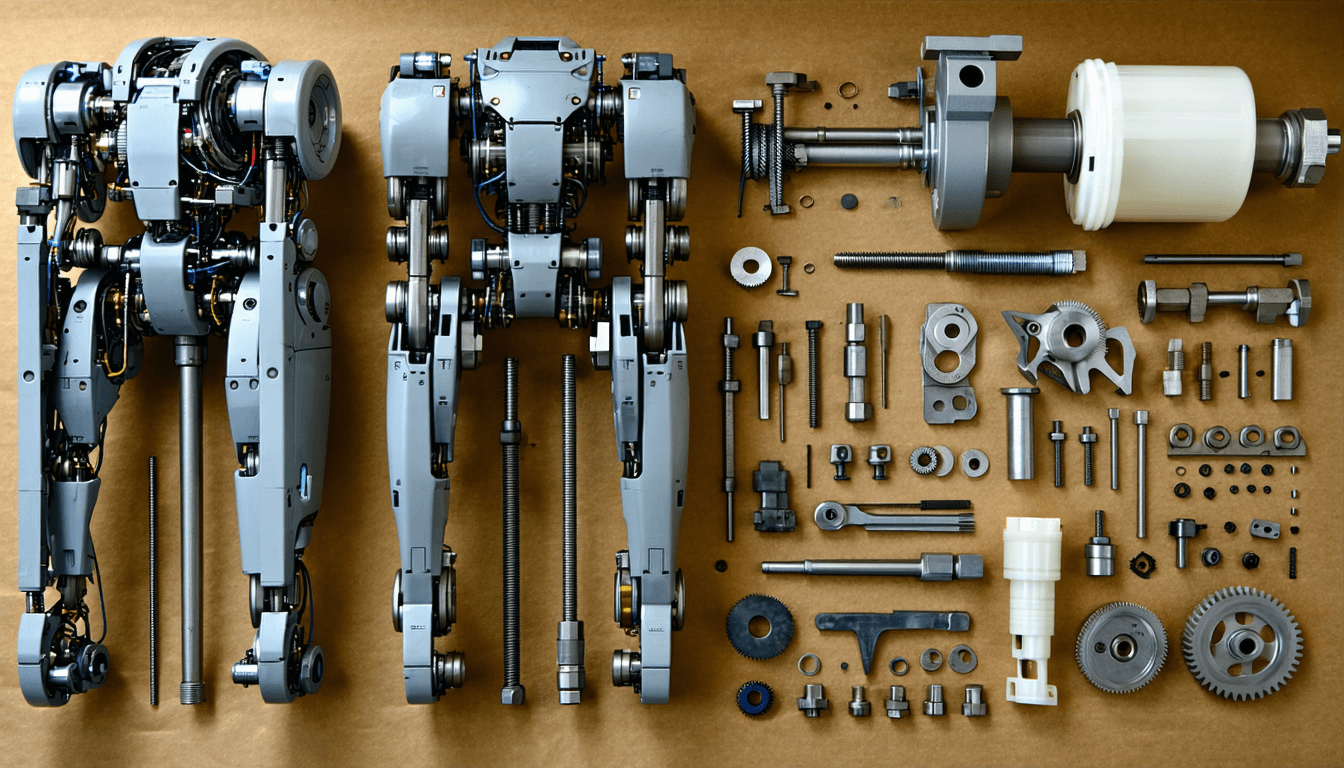
- U.S.-based Celanese Corporation and China-based Vigor Precision have partnered to develop lightweight plastic joint solutions for humanoid robots.
- The companies aim to reduce the weight of joint components by more than 30 percent compared with traditional metal designs.
- Under the agreement, Celanese will provide customized material solutions based on Vigor's technical requirements.
- The companies will focus on materials that combine high strength and rigidity with resistance to elevated temperatures and thermal degradation.
- Other stated priorities include precision transmission, self-lubricating performance, dimensional accuracy and extreme lightweighting.
Compiled by The Product DeskSomething wrong?How this is made
Why it matters
Celanese, the US engineered materials producer, and China-based Vigor Precision have agreed to co-develop plastic joint components for humanoid robots, aiming to cut joint weight by more than 30 percent against conventional metal designs [1][2]. The number matters less than what it implies about the constraint: the two companies describe the pressing problem as mass and mechanical endurance, driven by manufacturers trying to improve performance and operating time, not by any deficit in control software [14].
The requirement list is the tell. According to the announcement, humanoid joints must absorb rapid starts and stops, high-frequency reciprocating movement and complex loads while holding precise motion over extended periods [6]. Celanese will supply customised material solutions built against Vigor's technical requirements, with priorities stated as high strength and rigidity, resistance to elevated temperatures and thermal degradation, precision transmission, self-lubricating performance, dimensional accuracy and extreme lightweighting [3][4][5]. That is a durability brief written by someone who has taken a joint apart after a shift.
Heat is the awkward part. The companies say actuators and other components can generate significant heat during high-load or continuous operation, which makes thermal stability a design requirement rather than a nicety [11]. Dimensional accuracy under those conditions is described as critical for gears and other precision parts, where small variations affect movement and positioning [12]. Self-lubricating materials are pitched as a way to reduce friction and wear between moving components and limit the need for additional lubrication, which the source frames as a reliability and maintenance argument for robots running repetitive motion cycles [7].
The commercial framing is unusually plain about where such deals normally fail. Celanese said the work extends beyond material selection into targeted material commercialisation, lifecycle validation and consistent performance during mass production, integrated with Vigor's precision plastic moulding, gear design and manufacturing [10]. Todd Elliott, senior vice president of Celanese Engineered Materials, described the partnership as combining Celanese materials science and local technical capability with Vigor's precision gear design and manufacturing [8]. Vigor chief executive Hoi-sang Chan said the goal is precise formulation of high-performance materials for robotic joints, "thereby clearing the way for the large-scale deployment of humanoid robots" [9].
The claimed payoff, per the two companies, is better energy efficiency, dynamic response and overall mobility, supporting the industry's move toward higher-volume production [13]. Read carefully, that is a duty-cycle and unit-cost argument, not a capability one. Nobody here is promising a robot that can do more things. They are promising a robot that can keep doing the same thing for longer, and that can be moulded rather than machined.
What to watch: lifecycle validation data, since that is the stated deliverable that separates a materials announcement from a shipped part [10]. Watch whether dimensional accuracy holds across temperature swings in production volumes rather than in samples [12]. Watch the joint architecture question too, since Harvard researchers have separately produced a mathematical framework for optimising rolling contact joints, aimed at more capable grippers, personalised assistive devices and agile animal-like robots, which would change what a plastic part has to survive [15]. And note what the announcement does not contain: no financial terms, no timeline, and no production volumes [16].