Product1 publisher3 min readPublished
RoboParty pitches its RP1 biped at IROS as a humanoid that labs can modify end to end
RoboParty debuted RP1 at IROS 2026, calling it the first full-stack open-source bipedal humanoid, with joint torque peaking at 160 Nm. Labs weighing it against closed robots will need its license terms and published file list before counting on the right to change it.
The Product Desk · Product desk
Drafted by a language model from the sources cited here and checked against its claim ledger before publication. How we use AISend a correction
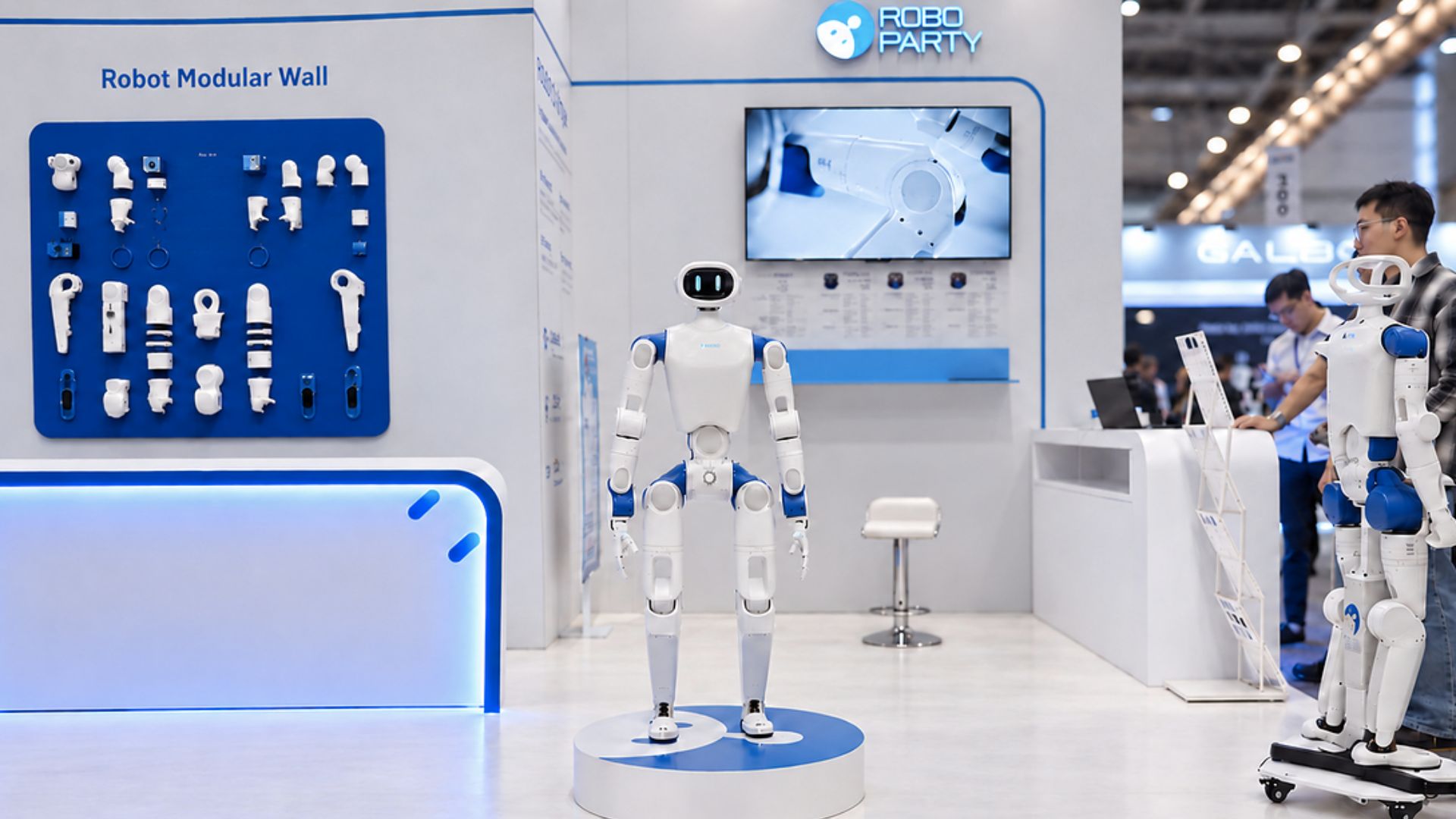
What happened
- Visitors at RoboParty's "Kick Me" booth pushed and kicked RP1, and the robot adjusted its posture and regained its balance.
- RoboParty says the demo ran on PartyOS, its open R&D foundation for humanoid robotics, which integrates the UFO framework.
- RP1's actuators are Romomo modules that RoboParty developed in-house, as are its mechanical structure and real-time motion-control system.
Compiled by The Product DeskSomething wrong?How this is made
Why it matters
- decision Choosing RP1 over a closed humanoid only pays off if the license permits modification, so labs have to see the terms and file list before a purchase request goes in.
- constraint A team that can rewrite PartyOS but cannot buy or build Romomo actuators elsewhere still depends on RoboParty whenever a joint needs replacing.
- capability If PartyOS and the control stack are published as described, embodied-AI teams could train and deploy their own models on a humanoid whose control code they can read and change.
Anyone who leaves the RoboParty booth wanting an RP1 now has to write a purchase request. The release, as reported by Interesting Engineering, does not include a price, a license, an availability date, or whether the Romomo actuator designs are published or sold on their own [13].
The company's pitch is about ownership. "Humanoid robots should not be closed systems that only a small number of teams can build while everyone else can do little more than watch," said Yi Huang, RoboParty's founder [4]. "We want RP1 to become an open foundation that developers can access, modify, train and continuously improve," Huang said [5].
The booth showed control. The kicks were unscripted, and RoboParty's press release contrasts them with demos built only on predefined motions [6]. I think that contrast is fair. An unscripted shove is harder to stage than a rehearsed walk. The company says RP1 also showed continuous motion and fall recovery, and it credits the coordination of body, actuator modules and motion-control system [7]. It calls the repeated high-intensity kicks a direct test of the body and of system-level robustness [8].
Kicks test hardware and controllers. Which files a buyer receives is a separate question. RoboParty names its intended users as researchers, educators, robotics developers and embodied-AI teams [3]. It lists the work as dynamic motion, model training, validation and deployment, data collection and continuous development [14]. Balance under load matters to all of them. The right to change the robot matters most to the embodied-AI teams, who would be training their own models on top of PartyOS [9]. For a lab that has to keep one robot running across a multi-year project, the in-house actuators are the part to ask about first [11].
RPO offers the best available check. RoboParty calls it a fully open-source biped and says its development and community adoption carried the company into actuators, bodies, motion control, dexterous manipulation and software [12]. A lab can compare what RoboParty actually released for RPO against those categories before trusting the same words on RP1.
For a locomotion or embodied-AI lab, I would ask RoboParty for the RP1 repository and license terms before asking for a quote. The tradeoff is that a good answer on software can still leave the lab with one supplier for its joints, even with every line of PartyOS in hand.
Two axes sort the outcome. The first is whether PartyOS, the control code and the design files ship under a license that allows modification. The second is whether actuators and structural parts can be bought from someone other than RoboParty or built from published files. Yes on both is the open foundation Huang described. Open software on vendor-only actuators is a capable research robot with a single source for its joints. Sourceable hardware with locked software is a kit. No on both is a closed robot with an open-source label, however well it took the kicks.
What to watch
- RoboParty publishing an RP1 repository and naming the licenses that cover its software and hardware design files.
- Whether Romomo actuator modules are sold separately or documented well enough for a third party to build or repair them.
- A published price and ship date for RP1.