Invest1 publisher3 min readPublished
Record diesel adds $13,740 to one Missouri combine's 30-day harvest
AAA had the U.S. diesel average at $6.05 a gallon on Friday, up about 60% from the $3.76 of late February, and a Missouri farmer burning 200 gallons a day for 30 days now faces roughly $36,300 in fuel for the combine alone.
The Investor · Invest desk
What happened
- Diesel set a U.S. record on Sept. 4 at an average of $5.85 a gallon, the first time the national average had reached that level, according to AAA.
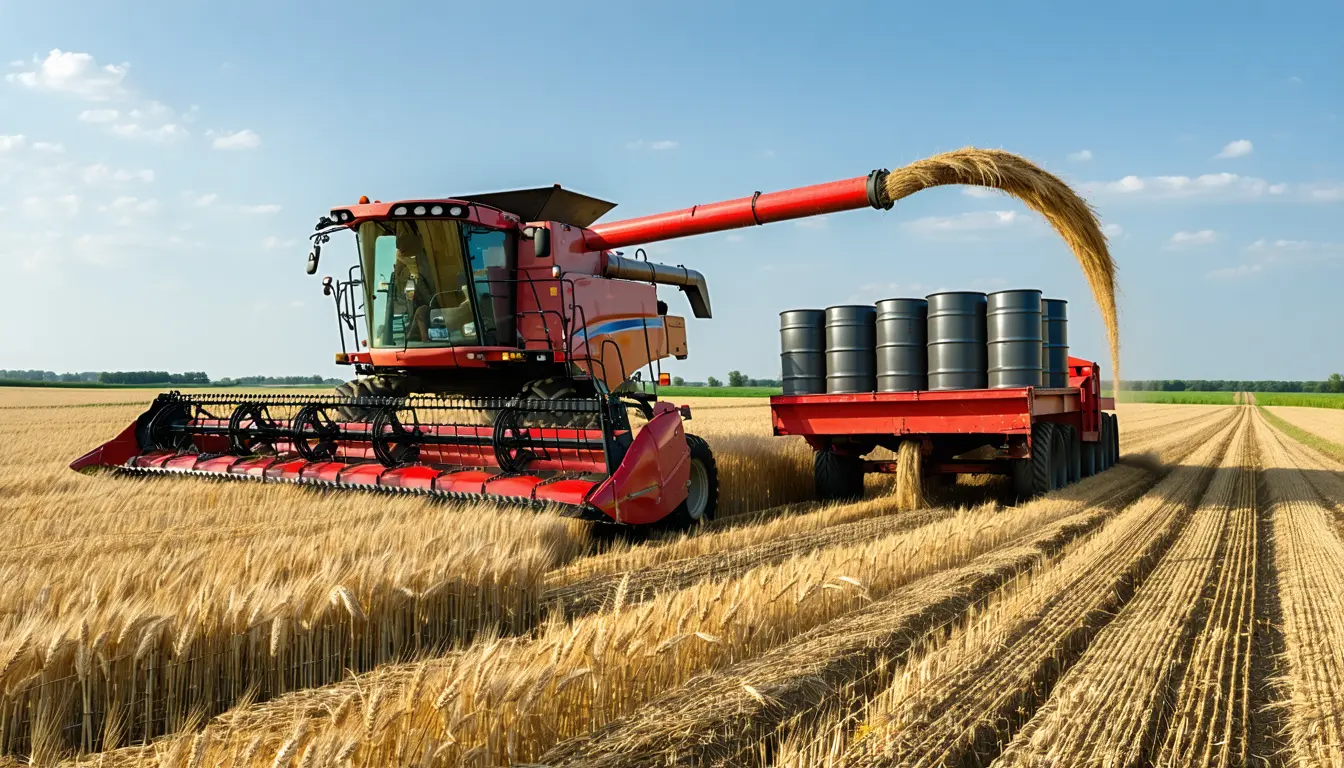
- Jason Kurtz, who farms corn and soybeans near Forest City, Missouri, runs a combine that burns 200 gallons of diesel a day and expected to run it for 30 days.
- Kurtz, a Trump voter, said he planned to postpone some farm work until later, hoping that diesel prices would come down.
Compiled by The InvestorSomething wrong?How this is made
Why it matters
- cost One combine over one harvest costs $13,740 more than at pre-war prices, and the grower pays it in September before a bushel is sold.
- constraint Because diesel prices the hauling as well as the cutting, the farms Mitchell calls cash strapped are choosing which other inputs to give up this autumn.
- contradiction AAA's series supports a 60.9% increase while Kurtz reports a doubling, so a 2026 fuel budget built off the national average may be roughly 39 points light for individual buyers.
- decision Postponing field work bets on the diesel price falling, and it only pays if the average comes down from $6.05.
Jason Kurtz's harvest is 6,000 gallons of diesel, on his own count: 200 gallons a day in the combine, 30 days of running [7][17]. At the $6.05 national average AAA published on Friday, that fuel costs about $36,300 [2][18]. At the roughly $3.76 the average sat at in late February, before the U.S. and Israel opened the war with Iran, the same 6,000 gallons would have cost $22,560 [3][19]. The difference is $13,740, which is $458 for every day the machine runs [20][21].
The combine is one machine of three. Kurtz also needs diesel for a tractor and for trucks [8]. Paul Mitchell, a professor of agricultural and applied economics at the University of Wisconsin-Madison, said the cost does not stop at the header: "And it's not just the harvesting. It's the hauling of everything, moving the grain or the silage from the field to the farm and then from the farm to wherever they're selling it." [10]
Run AAA's two prices against each other and the increase is 60.9% [22]. Kurtz said he was paying twice as much for diesel this year [6]. Those two figures are about 39 points apart [24]. The report does not say whether he means per gallon or in total, and it does not include the prices he will get for his corn and soybeans [25]. The 60% is a national retail average.
The bill lands on a year that was already expensive, with higher costs for fertilizer, seeds and equipment [16]. Kurtz, 49, said his finances were "already tight" after paying more for fertilizer and chemicals [9]. "We have to harvest," he said. "We have to run the machines. We have to use the diesel, so it cuts into our bottom line." [12]
His other response is to wait. Kurtz, who voted for President Trump, said he planned to hold off on some farm work until later, hoping diesel prices would fall [13]. "That's one good thing about farming," he said. "Tomorrow will be different." [14] Since the Sept. 4 record of $5.85, the average has added 20 cents, a 3.4% move against that plan [1][23].
If the Strait of Hormuz tanker disruption that pushed crude up unwinds, the $2.29 a gallon is a cost carried through one harvest and not a new base for 2026 budgets [4][21]. If it holds into spring, the same increase hits planting fuel, and the growers Mitchell describes get a second round of it: "Farms that are cash strapped, they're the ones that are most having to figure out what to cut to make this work," he said [11].
I think the waiting is a smaller option than it looks. The 6,000 gallons in the combine are committed the moment the crop is ready, so only the tractor and truck work can slide [7][8][13]. If AAA's average returns toward $3.76 before spring field work, the increase was a war premium [3].
What to watch
- Whether AAA's national average moves back toward the $3.76 of late February before spring field work begins.
- Whether the Strait of Hormuz tanker disruption that lifted crude eases, after the 20 cents added since the Sept. 4 record.
- Corn and soybean bids at the elevator, which decide whether the extra $13,740 of combine fuel is absorbed or borrowed.