Invest2 publishers3 min readPublished
Trump's data-center defense draws a muted crowd in battleground Ohio
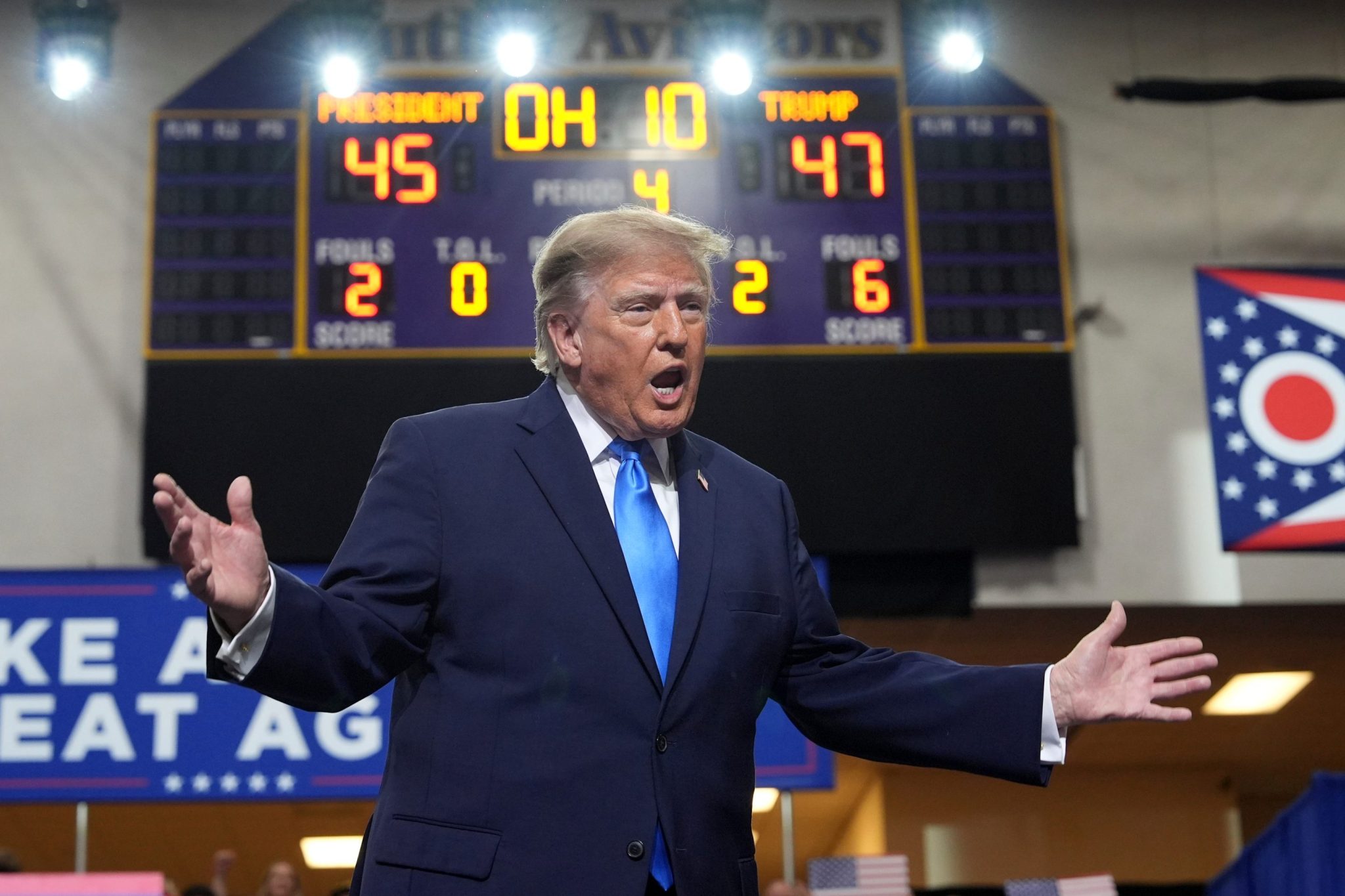
Donald Trump defended AI data centers to a muted Ohio rally crowd a month before a Nov. 3 Senate race Republicans call dead even. Both candidates are telling voters households should not pay the power bills, so data-center lenders face a tariff risk.
The Investor · Invest desk
Drafted by a language model from the sources cited here and checked against its claim ledger before publication. How we use AISend a correction
What happened
- Data centers have drawn opposition from both parties in races nationwide over electricity prices, farmland and water supplies.
- Sherrod Brown says Husted gave Big Tech billions in tax breaks to land data centers in Ohio and is now making Ohioans foot the bill.
- Crypto Briefing said prediction-market pricing pointed to a minor drop in the odds of a statewide Ohio data-center moratorium.
Compiled by The InvestorSomething wrong?How this is made
Why it matters
- cost If Husted's large-load pricing returns after Nov. 3, Ohio data-center operators would pay more for power to ease household bills, and project lenders would have to rerun their cost cases.
- contradiction Trump sells the buildout on money and China while his party's Senate campaign chief promises voters a community veto, so investors face two Republican positions on Ohio siting at once.
- exposure The state route to a moratorium through H.B. 646 does not depend on who wins the Senate seat, so siting risk for new Ohio projects survives either result.
"Look, there's so much money to be made for Ohio. You can't just turn them off. They'll go to China," Trump said [2]. In the same few minutes he said he wanted the sites to "benefit local communities" and praised Jon Husted for an ill-fated attempt to push legislation [3]. That legislation would ask utility regulators to effectively charge large power users more [6]. Tim Scott, chairman of the National Republican Senatorial Committee, describes Husted's support as conditional. "Sherrod Brown was for data centers, and Jon Husted is for data centers being responsible," Scott told reporters. "If a community doesn't want them, he doesn't want them either." [7]
Brown attacks from the same premise. "Senator Jon Husted gave billions in tax breaks to Big Tech to make sure they would build their data centers in Ohio," he wrote on X before the rally. "Now, he's making Ohioans foot the bill." [8]
Both candidates, in a race Democrats probably need to flip to win the Senate [16], are running on the idea that households should not carry data centers' power costs. For a lender or developer with Ohio exposure, that agreement matters more than the president's enthusiasm or the crowd's muted response [1]. The cost at risk is a large-load tariff, plus the local veto Scott endorsed [7]. Husted's pricing bill was blocked this past week by nearly all Democrats [6], so the law has not moved yet.
After the Nov. 3 vote [11], this goes one of three ways. A Husted win returns the sponsor of the large-power pricing bill to the Senate [6]. A Brown win seats a senator who spent the race attacking the tax breaks he says lured the campuses to Ohio [8]. The third route skips Congress: Crypto Briefing pointed to Ohio's H.B. 646 as the bill that could move the odds of a statewide moratorium [13].
On that route, Crypto Briefing reported in its write-up of the rally that market pricing pointed to a minor decrease in the likelihood of an Ohio moratorium [12]. It did not publish the probability, and neither source puts a figure on what a large-load surcharge would add to an operator's power bill.
I think the Ohio risk for data-center capital is a pricing risk: power costs pushed onto the biggest users, and a community veto the Senate GOP's campaign chief now endorses [7]. The counter-reading has evidence too. Trump is among the industry's most vocal proponents [14], the surcharge bill failed [6], and by Crypto Briefing's account the moratorium odds moved down [12]. If H.B. 646 stalls and no large-load pricing bill returns after the election, that reading is right. The crowd's quiet would then have been about the cost of living, a top issue around Dayton [17], where nearly 1,400 workers were laid off from a truck factory in nearby Springfield days before the rally [15].
What to watch
- Movement on Ohio's H.B. 646 and whether prediction-market odds of a statewide data-center moratorium keep falling.
- Whether Husted's bill asking regulators to charge large power users more is reintroduced after Nov. 3, and in what form.
- Statements on data-center policy from Ohio Governor Mike DeWine and findings from the Ohio EPA or Department of Natural Resources.