Science1 publisher2 min readPublished
Wisconsin engineers simulate a nanostructure that makes light nonlinear at a ten-millionth of the power
Qingyi Zhou and colleagues at UW-Madison optimized a nanostructure around a vacancy color center and report seven orders of magnitude less power for nonlinearity than conventional optical materials need. The work is simulation.
The Scientist · Science desk
What happened
- UW-Madison engineers published a quantum nanostructure design in Nature Communications on Aug. 27, led by Ph.D. students Qingyi Zhou, Jungmin Kim and Yutian Tao with professor Zongfu Yu.
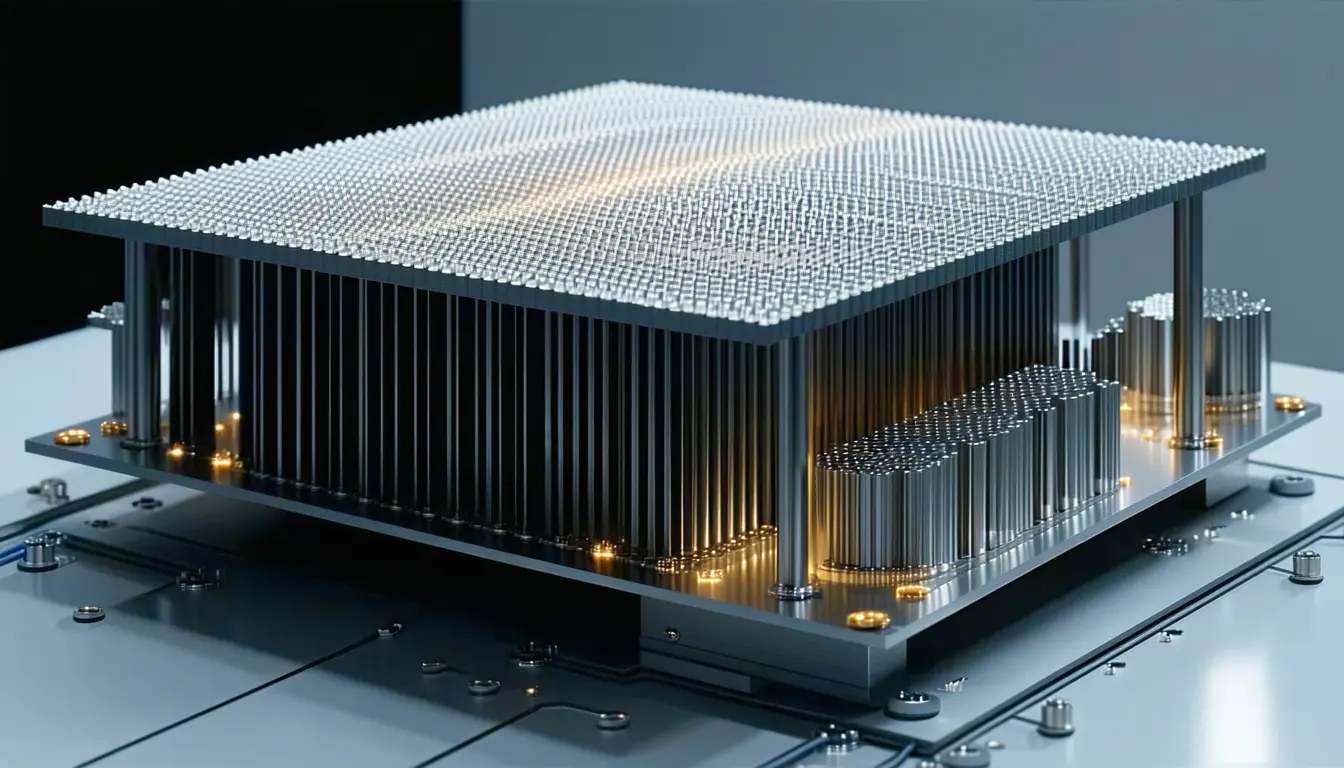
- Their design puts an optimized nanostructure around a quantum emitter, technically a vacancy color center, and the team evaluated it with a suite of simulation and computational tools.
- Simulations of a full network containing the devices produced strong nonlinearity at a modeled power consumption seven orders of magnitude below conventional optical materials.
Compiled by The ScientistSomething wrong?How this is made
Why it matters
- constraint The ten-millionfold figure is measured against other optics, so it cannot be set beside the electricity a GPU spends on an inference. That is the comparison a data center operator needs.
- capability A nonlinear step whose power draw is not the limiting term makes a complete optical network designable on paper; building one and measuring it is the work that follows.
- decision Anyone forecasting AI electricity demand is weighing measured silicon against a theoretical estimate, and that asymmetry does not yet support revising a build plan.
Photons barely interact with one another. Nonlinearity has been the hard part of computing with light. Linear operations are where optics is theoretically orders of magnitude more efficient than GPU electronics [4]. Few optical materials produce nonlinear functions at all [5], and the ones that do need so much laser energy that they cancel the savings [7].
Before designing anything, the group put a number on that. With conventional optical materials, the laser intensity needed to drive nonlinearity in a network came out impossible to realize, far past any realistic power budget [8]. "Basically, we asked ourselves, 'Why is this nonlinearity so important? Why do we need strong nonlinearity in the first place?'" Zhou said. "And, 'How should we overcome this bottleneck where we don't have lots of nonlinearity?' That's basically the starting point of the entire project." [9]
The alternative they reached for was a material class from a different field. "We asked, 'What if we used some not-so-conventional materials, like quantum emitters, which already show very, very strong optical nonlinearity?'" Zhou said. "If you construct a neural network including these materials, hopefully it would produce nonlinearity. That was our intuition; these materials have already demonstrated strong nonlinearity. They just haven't been used in the optical computing field." [10]
So they built, in software, a nanostructure surrounding a quantum emitter and optimized it to produce as much nonlinearity as possible [11]. Simulations of a full network containing those devices showed strong nonlinearity [12] at a power consumption seven orders of magnitude below conventional optical materials [13]. Seven orders of magnitude is a factor of ten million [15].
The denominator in that ratio is the same conventional-material figure the team had just called impossible to realize [8]. Whether a ten-millionfold cut lands inside a real power budget depends on the absolute number. The account of the work gives the improvement as a comparison with conventional optics. It does not give joules per operation [17].
The simulations show nonlinearity at the network level [12]. That claim is narrower than a trained optical network hitting an accuracy target, and it is the claim the decade-old case for optical neural networks was waiting on. Researchers proposed the approach because the energy cost of scaling electronic networks looked unsustainable [3]. Nonlinear operations are what let a network learn complex patterns; without them it rescales its inputs [6].
Zhou says the result is a theoretical estimate, and that the analysis already shows nonlinearity itself should no longer be the bottleneck for optical computing [14].
What to watch
- A fabricated emitter-plus-nanostructure device with its nonlinearity measured at the reported power.
- An absolute energy-per-operation figure. That number is what would let optical inference be compared with GPU silicon.
- An optical network trained to hit a task accuracy target.