Science1 publisher2 min readPublished
A single-arm fasting pilot in Huntington's disease reports a 13% drop in a nerve-damage marker
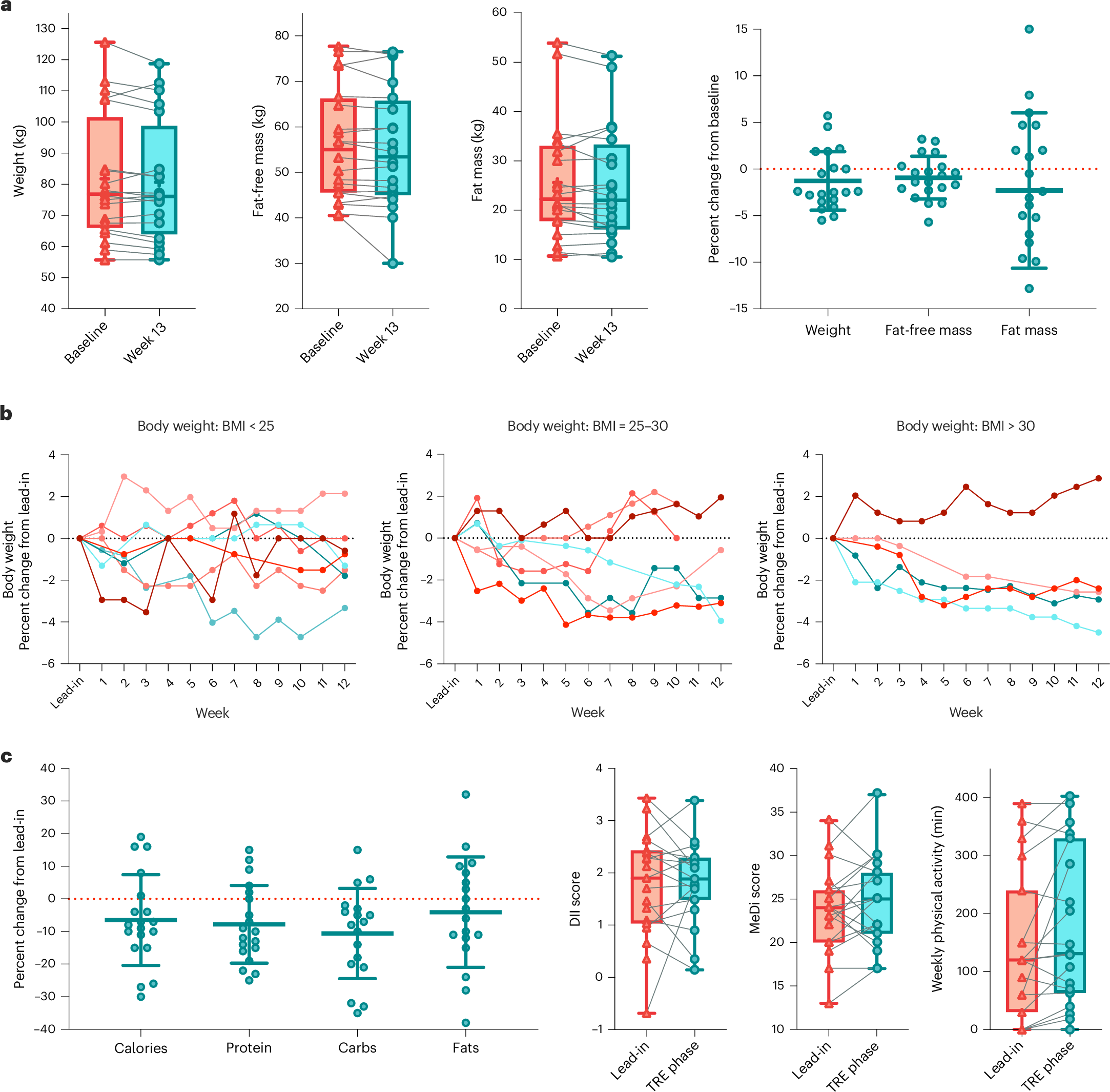
Twenty people with early-stage Huntington's disease ate inside a six-to-eight-hour daily window for 12 weeks. They kept their weight and lean mass, and gained half a point on a severity scale that normally falls. The pilot had no control arm.
The Scientist · Science desk
What happened
- A 12-week pilot study, the first formal test of time-restricted eating in people with Huntington's disease, had early-stage patients confine all food to a six-to-eight-hour window each day.
- The 20 participants kept the schedule on average more than five days a week, reported few side effects, and held on to both body weight and lean muscle mass.
- Scores on the composite Unified Huntington's Disease Rating Scale improved by an average of 0.5 points over the three months of the intervention.
Compiled by The ScientistSomething wrong?How this is made
Why it matters
- decision Funders now have to choose between treating an uncontrolled 20-person result as noise and paying for a randomized trial. The pilot hands them a measurable endpoint and a rough effect size to plan against.
- exposure A six-hour eating window needs no prescription, so patients and families can adopt it this week, in a disease where unintended weight loss is already a hazard.
- constraint The tolerability evidence covers early-stage patients who managed a daily app log, which is the easiest group to enrol and the least informative about whether the schedule is safe later in the disease.
- capability For a condition with no approved disease-slowing therapy, this puts a candidate intervention into testable form at close to zero manufacturing cost, with trial capacity as the limiting resource.
The 0.5-point figure gets its meaning from the comparison the authors supply. On the composite Unified Huntington's Disease Rating Scale, early-stage patients lose about one point a year [10]. Twelve weeks is a little under a quarter of a year, so the expected move across the study window was roughly 0.23 points down. Participants averaged half a point up, a gap of about 0.73 points [26]. That gap rests on 20 people with no comparison group [4][23].
Animal work had suggested intermittent fasting switches on cellular pathways that protect brain cells [21], but unintended weight loss is already a problem in Huntington's disease, so the researchers were unsure the schedule would be safe in people [22]. Participants picked their own window, usually late morning to early evening [4], and logged the day's first meal with a photo and a timestamp in a smartphone app [8]. On average they kept the schedule more than five days a week [6], which across 84 days is at least 60 days on plan [27]. Most settled in within the first week or two [7].
"When Russell first brought me the idea, I was skeptical," said Amie Hiller, professor of neurology at the OHSU School of Medicine [25]. "Weight loss is a major challenge for many people with Huntington's disease, so asking them to eat within a limited time window seemed counterintuitive" [16].
Neurofilament light, a protein released into blood when nerve cells are damaged, fell 13% on average [11]. In Huntington's disease it usually climbs as the disease advances [12]. "Neurofilament light typically rises as neurodegeneration continues, but after three months we observed a significant decrease," said Russell Wells, the OHSU medical student who led the work [24]. "For a pilot study, that was a remarkable finding" [14]. A single arm of 20 people over three months cannot separate that decrease from normal fluctuation in the marker or from the effects of being in a study. The authors say the result should not be read as proof that time-restricted eating slows the disease [23].
Several measures of mitochondrial activity improved, and they were made in participants' blood cells [13]. Blood cells are easy to sample. The disease kills neurons. "One theory is that fasting acts as a mild stressor that prompts cells to become more efficient," Wells said [18].
"These results suggest time-restricted eating deserves further study in a larger clinical trial," Wells said [15]. Such a trial is cheap to run against the alternative. The genetic cause of Huntington's disease has been known for decades, and no treatment has been approved that slows or stops it [19].
What to watch
- Whether a randomized, controlled trial gets registered and funded, and whether neurofilament light is set as its primary endpoint.
- Whether the schedule is tolerated by people with more advanced disease, where unintended weight loss is a bigger problem than in the early-stage group studied here.
- Whether another group reproduces a fall in neurofilament light over 12 weeks of time-restricted eating, in Huntington's disease or another neurodegenerative condition.