Loading today’s stories
Product1 distinct publisher3 min readUpdated
A gut metabolite that weakens the blood-brain barrier gives the Alzheimer's story a target
Researchers report in Nature Communications that imidazole propionate, made by gut bacteria from histidine, weakens the blood-brain barrier and worsens amyloid and tau. The human data is associative.
The Product Desk · Product desk
What happened
- Scientists have known for years that the gut microbiome of people with Alzheimer's differs from that of healthy people, but it remains unclear whether these differences are a consequence of the disease, contribute to it, or simply accompany it.
- In a study published in Nature Communications, researchers identified imidazole propionate (ImP), a compound produced by certain gut bacteria, as a possible link between the microbiome and Alzheimer's disease.
- Some gut bacteria use the amino acid histidine and, by metabolising it, produce ImP; some of this molecule can enter the bloodstream and circulate through the body.
- Experiments in the study indicate that ImP can weaken the blood-brain barrier.
- The blood-brain barrier protects the brain and controls what substances pass into it via blood; a less effective barrier can help the metabolite enter the brain, where researchers found it can interact directly with neurons.
Compiled by The Product DeskSomething wrong?How this is made
Why it matters
A team of researchers reporting in Nature Communications has named a specific molecule, imidazole propionate (ImP), as a candidate link between the gut microbiome and Alzheimer's disease [2]. That matters because the gut-Alzheimer's literature has spent years stuck on a correlation: the microbiomes of people with Alzheimer's differ from those of healthy people, with no settled answer on whether that is cause, consequence, or coincidence [1].
The proposed chain is mechanical rather than statistical. Certain gut bacteria metabolise the amino acid histidine to produce ImP, and some of it enters the bloodstream [3]. The study's experiments indicate ImP can weaken the blood-brain barrier, the filter that governs what crosses from blood into brain tissue; a weaker barrier makes it easier for the metabolite itself to get in and interact directly with neurons [4][5]. Once there, according to the authors, it promotes accumulation of amyloid beta plaques and increases tau phosphorylation [6] - the two changes that constitute the disease's principal biological hallmarks and track with neuronal deterioration [7].
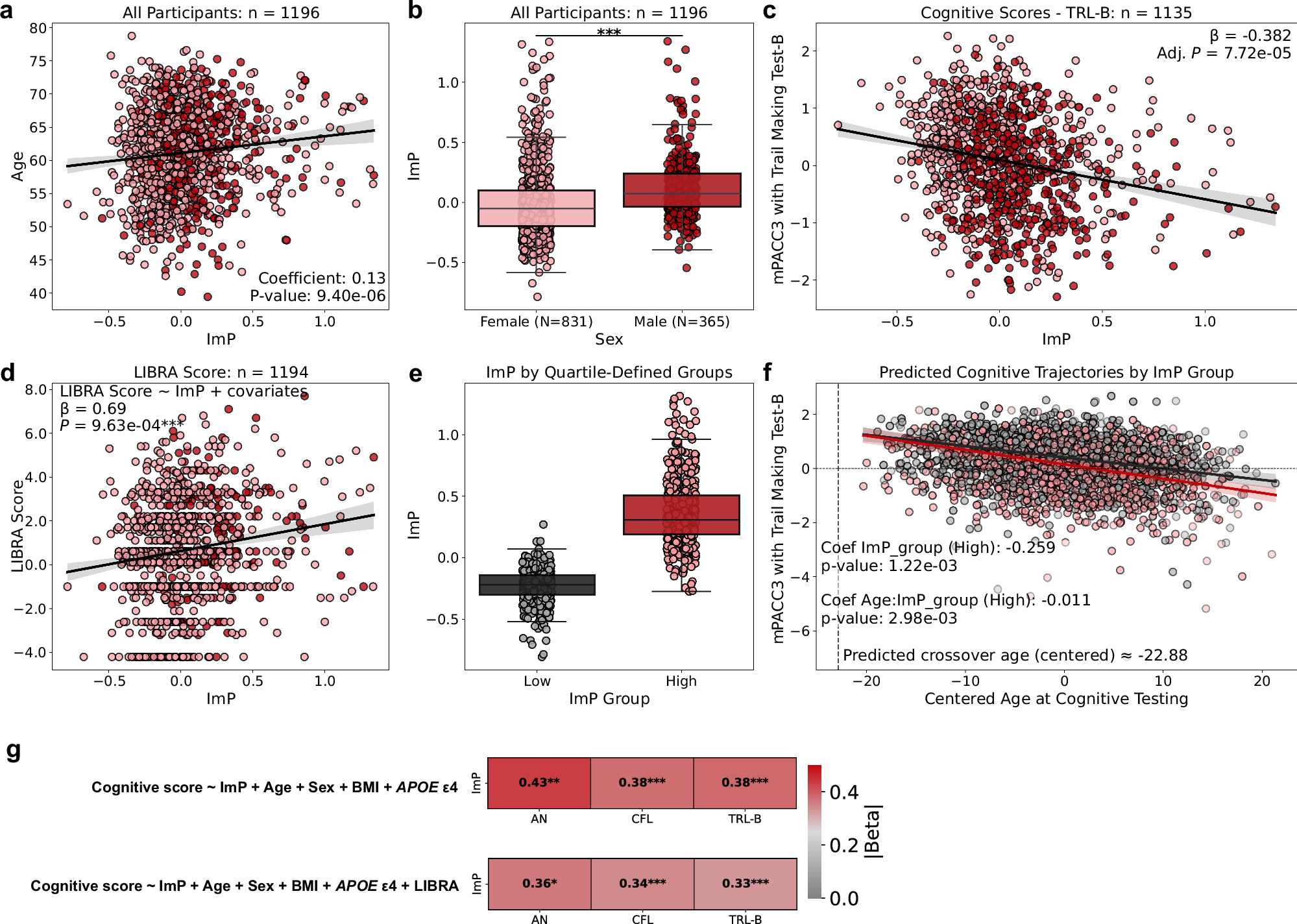
The human arm is a cohort, not an intervention. The researchers measured ImP in the blood of 1,196 cognitively healthy adults with a mean age of 61.2 years [8]. Higher ImP tracked with worse average cognitive test scores and with higher levels of pTau-217 and NfL [9], two blood-measurable markers - a modified tau used as an Alzheimer's biomarker, and a protein released when neurons are damaged - that can flag brain change before symptoms [10]. Over time, the highest-ImP group declined faster on cognition than the lowest [11].
Causation was tested elsewhere. ImP was administered for months to two groups of mice engineered to develop Alzheimer's features, and signs of disease worsened: amyloid plaques increased in some animals, while others showed worse tau abnormalities and astrocyte reactivity [12]. So the causal weight sits on mouse and cell work, and the human evidence remains an association [16]. That is the usual shape of this kind of result, and it is the part that decides whether anything is drugable.
What makes the pathway more tractable than "microbiome dysbiosis" is that it has named steps: a bacterial enzymatic conversion of a dietary amino acid, a circulating small molecule, a barrier effect, and downstream protein pathology [3][4][6]. Each is a distinct place to intervene, and none of them requires eliminating an organism. Which is convenient, because there is no villain species to eliminate. Several ImP-producing bacteria are found in healthy people [13]. "ImP-producing bacteria are present in a large fraction of people, but they're not very abundant in most people," coauthor Federico Rey, a professor of bacteriology at the University of Wisconsin, said in a statement. "But something we have learned over the years is that a microbe doesn't have to be abundant to have an impact on the host" [14]. Carrying the machinery does not mean accumulating the metabolite; how much reaches the blood appears to depend on a combination of factors, with differences related to age and sex [15].
Worth watching: whether ImP predicts conversion to clinical disease rather than just decline on tests in healthy adults [11], whether blocking the bacterial conversion or the barrier effect reverses anything in the mouse models [12], and whether the barrier finding replicates in human tissue rather than experimental systems [4]. Until then this is a coherent chain with one link measured in people and the rest measured in animals.
Loading topic controls
Loading related stories