ProductNot yet confirmed elsewhere1 publisher3 min readPublished
Sesame Solar, Target Arm and AG3 Labs package drones with the renewable grid that recharges them
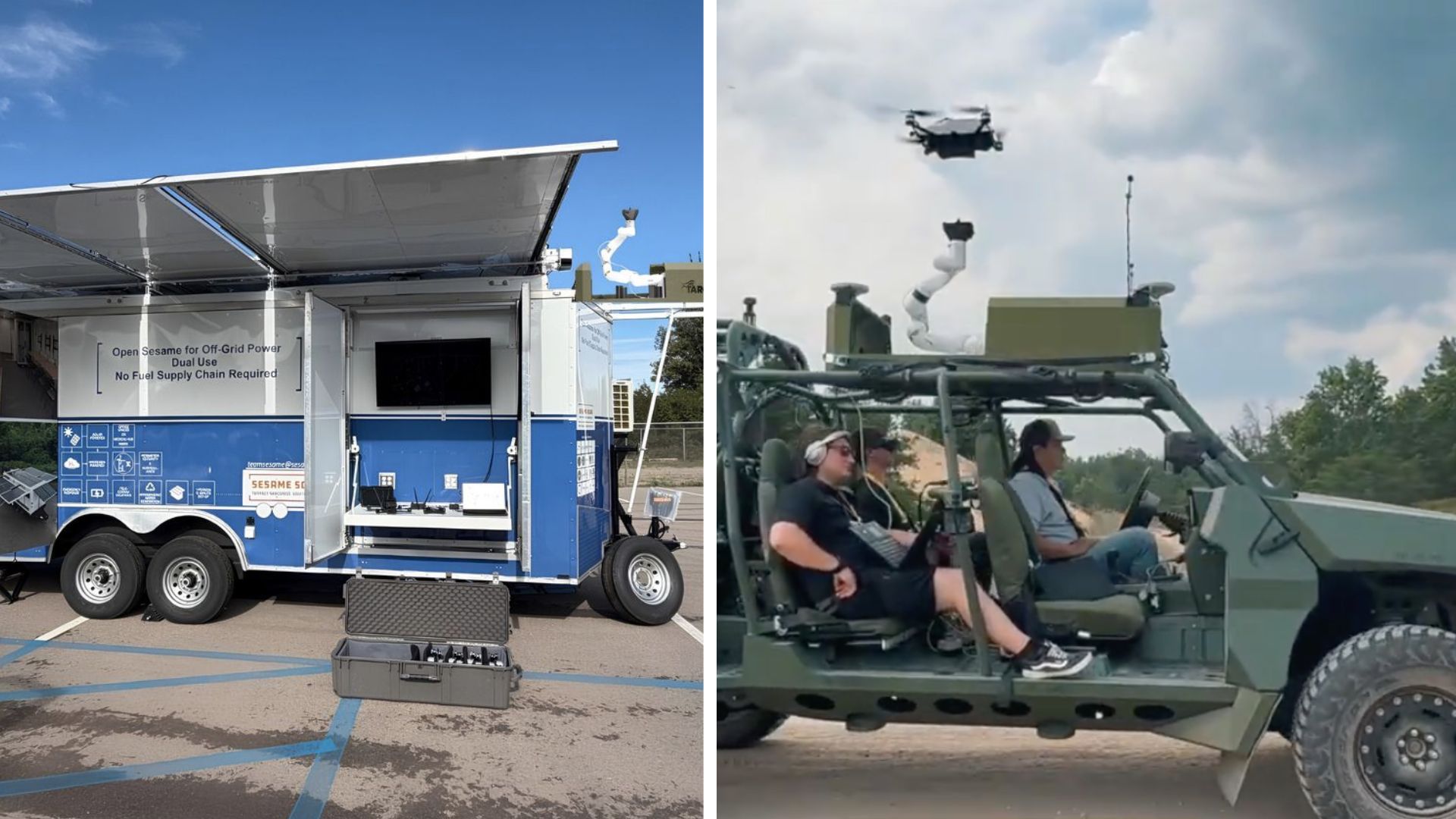
Sesame Solar, Target Arm and AG3 Labs launched a renewable-powered Nanogrid meant to keep drones flying at forward sites with no fuel resupply. For a forward unit, that puts the drones and the grid that keeps them flying into one purchase decision.
The Product Desk
What happened
- Target Arm's Ralar robotic arm launches, recovers, recharges and relaunches drones with no pilot on site, including from a moving vehicle or a boat.
- AG3 Labs supplies SPADE, a reconfigurable Group 1 drone for surveillance, communications relay and, for defense users, kinetic payloads, flown singly or as a swarm.
- The companies' release says the U.S. Army has documented that there is no standard procedure for getting backup power to a drone launch team.
- The companies say the domestically made system meets Executive Order 14307, which directs agencies to expand U.S. drone manufacturing and cut reliance on foreign-made drones.
Why it matters
- decision A unit buying these drones now sizes a power plant in the same decision, so the number of grids per site becomes a spec the drone buyer has to own.
- constraint Power, launch and airframe come from three vendors as one integrated kit, so in our view swapping in a different drone later means re-qualifying the whole system.
- precedent If domestic-sourcing rules reward U.S.-built bundles, we'd expect more drone makers to pair with power vendors and bid as a single system.
A drone is coming back to a forward site on a low battery, and someone has to recover it. Jeffrey A. McChesney, founder and chief executive of Target Arm, described that person as "someone standing in the open, waiting on an aircraft," and said launch and recovery are "two of the most exposed moments of a drone mission" [6]. The next battery has its own risk. "If a forward expeditionary team can't power its drones, or their batteries fail from heat or cold, warfighters lose one of their most valuable assets," said Lauren Flanagan, chief executive and co-founder of Sesame Solar [4].
The pitch is persistence. Target Arm's drone magazines cycle aircraft through deployment for what the companies call 24/7/365 coverage [8]. According to the companies' release, as reported by Interesting Engineering, the product is Sesame Solar's self-generating mobile power, Target Arm's arm and magazines, and AG3 Labs' attritable aircraft wired into one system for training and forward use [1]. Operators monitor the grid's energy performance remotely and control the arm and drones from a distance [2].
Flanagan also put electricity on the supply list. "Mobile electric power is a critical fifth supply requirement along with food, water, munitions, and fuel," she said [3]. We think she is right about where forward teams are short. If power is a supply line, a unit should test it as hard as it tests the airframes.
AG3 Labs co-founder Nick Smock described the payoff. "Put that on a system that launches, recovers and recharges itself, and you have persistent capability without adding a single person to the team," he said [13]. Forward units fly the sorties the mission demands, in whatever month and weather the site has. A grid that makes its own renewable power has to keep pace when generation drops. The companies' release does not include a generation rating, a storage capacity, a count of drones per magazine or a price.
The power side is sold by the unit, like the drones. A Nanogrid comes standalone or in a series of two to twelve, forming a turnkey MIL-STD mobile microgrid that can also charge man-portable batteries and other forward equipment [10].
In our view, a unit should judge the Nanogrid as a power purchase first and the drones second. The tradeoff is a slower decision on the airframes. A 2x2 sorts most units. One axis is why drones sit on the ground today: for want of charge, or for want of airframes and operators. The other is whether fuel reaches the site reliably or through a contested line. Grounded for charge on a contested line is the case the three companies built for. Grounded for charge with steady fuel puts the Nanogrid up against a generator. A unit short of airframes on a contested line would use the grid to charge man-portable batteries, and the drones become a separate buy. Short of airframes with steady fuel, there is little here for that unit.
For the first box, the number to get is sorties per day per Nanogrid in the site's worst month. Divide the mission's daily sortie need by that figure and you get the number of Nanogrids. A result above twelve means one array will not cover the site [10].
What to watch
- A published generation and storage rating per Nanogrid, and the number of SPADE sorties per day it supports at a cold-weather site.
- A first military contract or field trial of the combined system, with results reported by the unit using it.
- A price for a single Nanogrid and for a twelve-unit array.
Clarity's read
What the record supports and how the coverage leans. The claims behind it follow.
Reality
- Evidence22
- Adoption
- Insufficient
- Hype gap+60
- Incentives85
- Confidence30
Claim ledger
Ranked by verification strength, evidence, and original report placement.
- [1]
Sesame Solar, Target Arm and AG3 Labs are launching the Persistent Drone Operations Nanogrid, which combines Sesame Solar's self-generating mobile power, Target Arm's robotic arm and drone magazines for autonomous drone launch and recovery, and AG3 Labs' attritable unmanned aircraft into a single system for training and forward expeditionary use.
- [2]
Operators can remotely monitor the Nanogrid's energy performance and control the robotic arm and drones.
- [3]
"Mobile electric power is a critical fifth supply requirement along with food, water, munitions, and fuel."
- [4]
"If a forward expeditionary team can't power its drones, or their batteries fail from heat or cold, warfighters lose one of their most valuable assets."
- [5]
Executive Order 14307 directs agencies to expand U.S. UAS manufacturing and reduce reliance on foreign-made drones; the companies say the domestically manufactured Nanogrid meets these requirements.
- [6]
McChesney said launch and recovery are "two of the most exposed moments of a drone mission" with "someone standing in the open, waiting on an aircraft."
- [7]
Target Arm's Ralar is an autonomous robotic arm launch and recovery system that lets drones deploy, recover, recharge and relaunch with no pilot on site and while moving, including from a moving vehicle or a boat.
- [8]
Target Arm's drone magazines work with Ralar to autonomously cycle drones through deployment for persistent 24/7/365 coverage.
- [9]
AG3 Labs' SPADE is a Group 1 UAS that reconfigures for the mission, supporting ISR, communications relay and, for defense users, kinetic payloads; it can be flown one-to-one or controlled one-to-many as an autonomous swarm.
- [10]
The Nanogrid is available as a standalone solution or in a series of two to twelve Nanogrids, creating a turnkey MIL-STD mobile microgrid that can also charge man-portable batteries and other forward expeditionary equipment.
- [11]
The companies say the system integrates renewable energy, autonomous robotics and unmanned aircraft and will enable continuous drone operations with no fuel resupply.
ReportedInsufficientSource: Companies' release as reported by Interesting EngineeringView cited source - [12]
The U.S. Army has documented that there is no standard procedure to get backup power out to a drone launch team.
- [13]
"Put that on a system that launches, recovers and recharges itself, and you have persistent capability without adding a single person to the team."
Sources
1 independent publisher whose own reporting we read for this story.
Topics and entities
Follow any of these and your For You feed starts watching them — no settings page required.
Topics
- Tactical microgridsFollow
- Drone launch and recoveryFollow
- Military DronesFollow