Product1 distinct publisher3 min readPublished
The chore a robot mower leaves behind, trimming the edges by hand, got solved at IFA this year. The FCC's ban on advanced robotic devices is why American buyers are not getting the fix any time soon.
The Product Desk · Product desk

Follow any of these and your For You feed starts watching them — no settings page required.
product
LiDAR frees the robot mower from the sky. At $3,200 it is still priced for the biggest lawns1 distinct publisher
product
An $800 Roborock outperformed machines twice its price in Gizmodo's testing1 distinct publisher
build
The FCC read HOVERAir's Versa by what it was built to do, not how it was boxed2 distinct publishers
product
Eufy bolts a trimming arm onto the one mowing job robots hand back to you1 distinct publisher
Compiled by The Product DeskSomething wrong?How this is made
What owners actually do with a robot mower is let it cut the middle of the lawn and then hand-trim the rest, because the machine cannot get at grass growing against a wall or flopping over a sidewalk [1]. The most advanced answer a US buyer can order is a deck that slides sideways, as on the Segway Navimow X4, and it still hands you the weed whacker afterward [2].
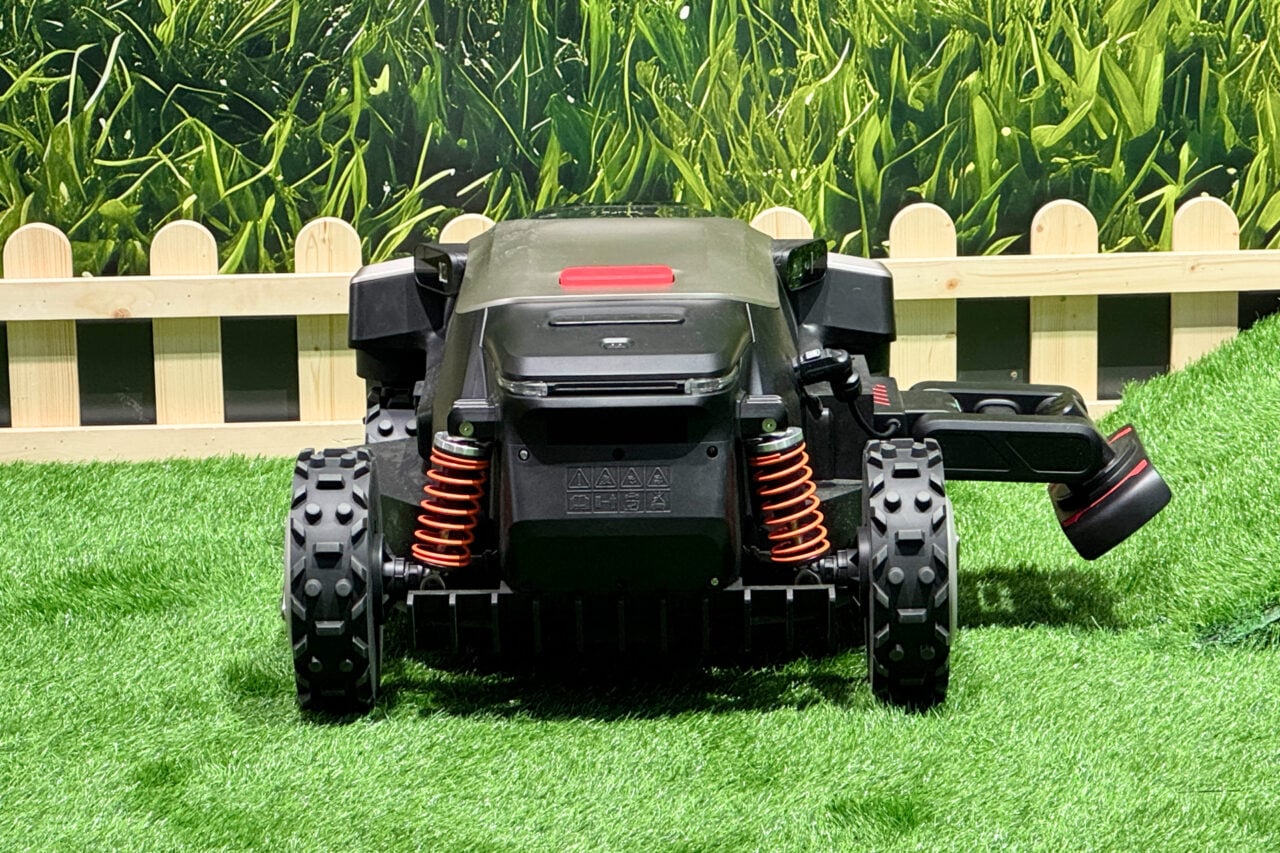
The implementations of the new reach differ in ways a buyer would care about. Segway's Navimow H5 Pro opens a side panel and pushes its own mowing blades out [4]. The Dreame A4 AWD Pro and the Eufy Lawn Mower S2 Max swing a string trimmer instead, and the Eufy arm turns vertical to edge a sidewalk [5][7]. Mammotion sells its version as an accessory that bolts to the back of the Yuba 4 AWD [6]. Three of the four build the reach in rather than charge for it separately [2], which is what a feature looks like once it has stopped being an experiment.
The wall in front of all of it is written as capability, not as a product list. The FCC FAQ describes the ban on "advanced robotic devices" as protection against "unacceptable risks to the national security of the United States" and reaches devices "capable of locomotion, obstacle avoidance, navigation, or movement on the ground" [8]. Gizmodo reads that as covering mowers, alongside the foreign-made robot vacuums already caught by it [9]. A definition that broad leaves the classification call to the importer, and what Gizmodo got back at IFA is the answer a compliance team gives when it cannot price a shipment: we are working to understand current U.S. regulations [10].
The grandfathering is what shapes the shelf. Devices already approved for sale in the US can keep being imported and sold, and current owners keep what they own [11]. American lawns therefore get extra years out of the models that cleared first, and any competitor who wants that shelf space has to bring a fresh approval with it, because an articulating arm is new hardware that needs its own clearance, not something a firmware update can add. Clearance date becomes the moat.
That also leaves the stated rationale doing odd work. The vulnerability Gizmodo cites is a hacker taking over a Yarbo automower and driving it across Verge reporter Sean Hollister [13], a machine already inside the country and untouched by a rule that operates on imports [12].
For anyone spending money this season, two things settle the decision. Is the specific model cleared, given that approval as Gizmodo describes it attaches to devices already through the door rather than to brands [11]. And is the arm the actual reason for the purchase, because if it is, the honest plan is to keep the trimmer and revisit after the November midterms rather than wait on a launch date no vendor will name. Gizmodo's list of escape routes is short: a change of heart from President Trump, individual exemptions, or a Democrat-controlled Congress, and otherwise years [15]. A Roborock representative was pinning hope on the late-September summit between Trump and Xi Jinping [14]. Nothing domestic fills the gap in the meantime, since there is no idle American home robotics industry waiting to build these [16].
Ranked by verification strength, evidence, and original report placement.
Robot mowers still cannot get up to the edges of buildings and sidewalks, leaving grass growing against a house or flopping over concrete for a human with a weed whacker.
The Segway Navimow X4 slides its mowing deck over to get closer to edges, but still leaves the owner the task of trimming vegetation against structures and edging sidewalks.
At IFA 2026 Gizmodo saw a sudden trend of robot mowers with robotic arms that stick out to the side to cut grass away from the body of the mower.
On the Segway Navimow H5 Pro, a panel on the side of the device opens up to bring the robot's mowing blades out.
The Dreame A4 AWD Pro uses a string trimming arm to reach grass beside the mower.
The Mammotion Yuba 4 AWD offers an optional accessory that bolts onto the back of the mower.
Distinct publishers with included, body-backed reporting in this cluster.
1 article · September 5, 2026
Evidence-backed comparisons of source perspectives and observed adoption signals. Read the methodology
Which Builder, Operator, and Investor concerns the observed source mix emphasized—not a truth score.
Evidence, demonstrated adoption, hype gap, incentives, and confidence are assessed independently, each on its own current evidence. How these are measured.
Firsthand hardware, secondhand rulebook
Two halves of unequal quality sit in the same piece. The mowers were seen and handled, and each mechanism is described concretely enough to be checked by anyone else who walked the hall. The ban, which supplies the headline, comes from a quoted FAQ with no rule number, effective date or agency comment, and the step from "devices capable of locomotion" to "your lawn mower" is the reporter's own inference.
Trade-show hardware, no shelf
Everything counted here happened inside a convention centre. Four machines were shown, one of them offering the arm as a bolt-on accessory, and not a single representative would name a US date. Against that, the installed base of already-approved mowers keeps selling, so the adoption picture is a new capability with no channel behind it in the market the story is about.
Scope read wider than the paperwork shown
The observable claim, that arm-equipped mowers debuted at IFA and their makers cannot say when Americans can buy them, holds up. The stronger claim in the headline depends on a definition Gizmodo interprets and on a multi-year delay projected from three hypotheticals: a presidential change of heart, individual exemptions, or a midterm result. Nothing in the reporting rules that reading out, and nothing in it confirms the reading either.
Every voice here sells mowers
The people quoted on US policy are the people who cannot currently sell into the US, including the Roborock representative hoping a summit clears the way and the unnamed reps offering the same line about studying the rules. A regulatory obstacle is a comfortable explanation for a missing launch date. The FCC does not speak in this story, and no American competitor is asked whether the gap is fillable.
Trust the mowers, verify the ban
We would repeat the hardware findings without hesitation and the regulatory ones with a caveat attached. A single reporter, a single outlet, and the load of the argument resting on an FAQ paraphrase keeps this in directional territory until someone produces the rule text or an agency answer about ground-based lawn equipment.