Invest1 publisher2 min readPublished
Washington's $967 million ban on Canadian goods falls mostly on liquor already under 50% tariffs
Washington banned an estimated $967 million of Canadian imports on Tuesday, 87% of it alcohol, a sliver of $880 billion in yearly two-way trade. The listed goods already faced Trump's 50% tariffs, so the risk to price sits in Canada's reply and the USMCA renewal.
The Investor · Invest desk
What happened
- This summer Trump used a Great Depression-era law to put 50% tariffs on about $20 billion of Canadian goods, saying Canada discriminates against U.S. dairy, auto and alcohol producers.
- Canada hit back with tariffs of 15%, 25% or 50% on U.S. goods, matching the American measures dollar for dollar.
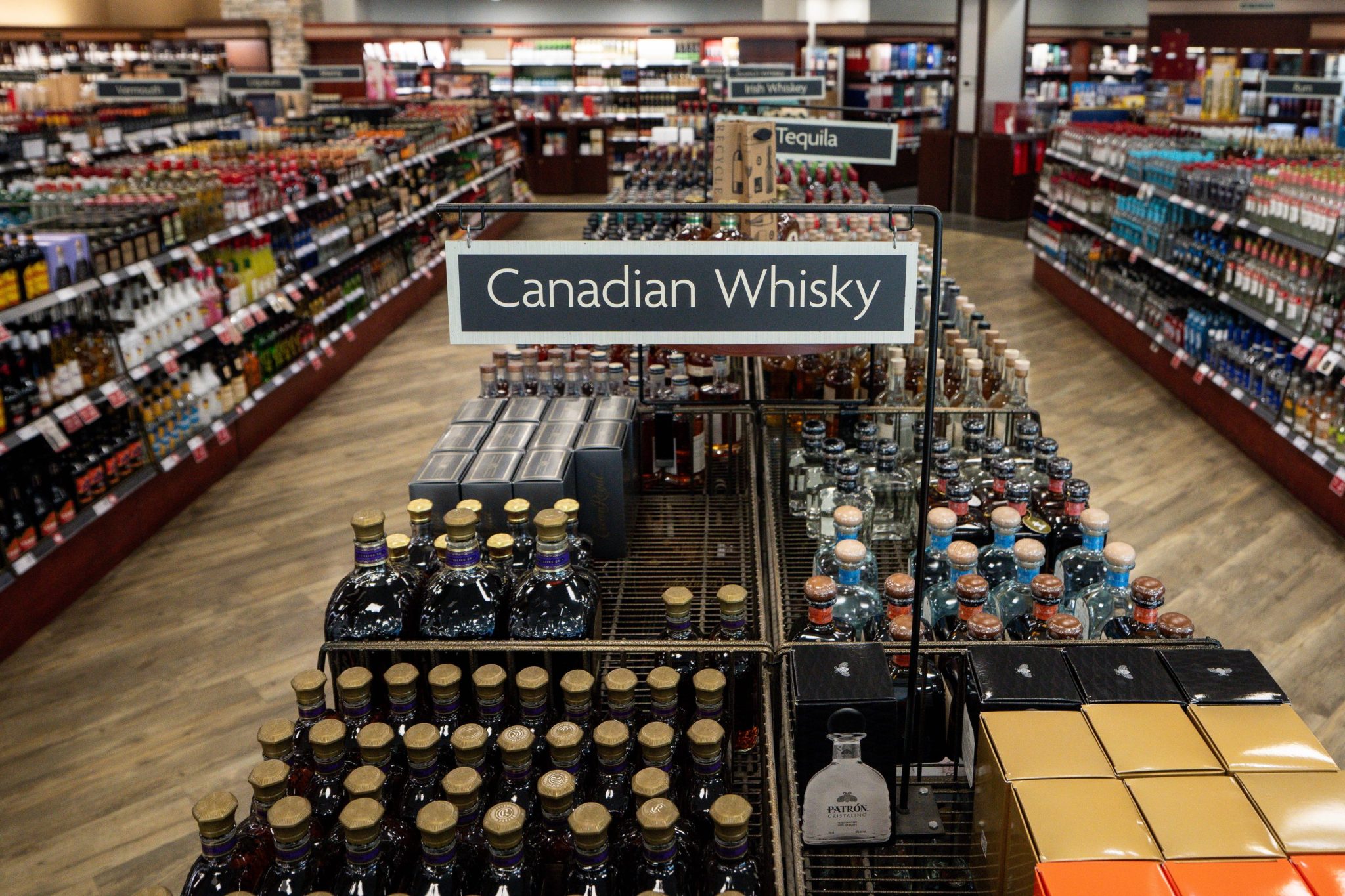
- Alcohol leads the ban list because some Canadian provinces pulled U.S. liquor from store shelves in response to Trump's tariffs.
- Prime Minister Mark Carney wants Canada to double its trade with countries other than the U.S. over the next decade.
Compiled by The InvestorSomething wrong?How this is made
Why it matters
- constraint A U.S. buyer still paying the 50% duty to keep a Canadian spirits or whey supplier now has no rate at which that trade can clear.
- exposure U.S. exporters selling into Canada carry the exposure if Ottawa answers prohibition with prohibition instead of another round of tariffs.
- decision Operators sourcing across the border have to price the USMCA renewal when sizing Canadian supply, because the $967 million list understates what is at stake.
Jacob Jensen's $967 million, counted on 2025 trade [3], is about 0.11% of the $880 billion that crosses the border in both directions each year [2][1]. It is also about 4.8% of the roughly $20 billion of Canadian goods already under 50% tariffs [5][2]. Alcohol makes up roughly $841 million of the list [4][3]. That leaves about $126 million for whey and other dairy and for motorcycles [11][4].
The products on the list were already facing those tariffs, trade attorney Patrick Childress noted [9]. A 2025 base, taken before the 50% duties arrived this summer, is therefore a high count of what the ban removes from this year's trade. Childress, a Holland & Knight partner and former U.S. trade official, said: "For a lot of these goods, the 50% was already acting as a de facto ban by making importation from Canada into the United States uneconomical" [8].
Motorcycles show the timing. Bombardier Recreational Products in Quebec confirmed that its three-wheel Can-Am Spyder and Canyon models "will be excluded from importation into the U.S." [12]. It said the impact likely won't be felt until next year, because it has completed most production and shipments for the current season [12].
The White House imposed the ban to punish Canada for its counter-tariffs [7]. Jensen sees it cutting two ways. "This marks yet another escalation in the trade war that may result in further retaliation on the Canadian side," he said [13]. He also expects exporters and importers caught by the list to be "highly motivated" to press officials on both sides for a "resolution of this whole ordeal" [14]. Fortune reports the impasse also imperils renewal of the USMCA, the pact under which most goods crossed North American borders duty free [17][18].
I think the ban moves little cash by itself, and that the risk to reprice sits in Ottawa's reply and in the pact. The counter-case is Jensen's first path: a Canadian answer in kind would make this list the first entry in a two-way exchange of bans. The view is wrong if a follow-on U.S. list reaches goods that were still clearing the 50% duty, or if Canada bans U.S. goods outside its current tariff list.
Ottawa's effort is pointed elsewhere. The U.S. took more than 70% of Canadian exports last year [15]. "There is now a price to be paid for access to the United States market," Carney said earlier this month [19]. He has embraced the prospect of Canada becoming the European Union's first associate member [20], and his government is aiming to conclude trade talks with India by the G20 summit [21].
What to watch
- Any move by Canadian provinces to widen their shelf bans on U.S. liquor, the measure that put alcohol at the top of the U.S. list.
- Whether the dairy quota dispute, including whey, is taken up inside the USMCA renewal talks.
- Whether Canada's trade with non-U.S. partners grows fast enough to track Carney's goal of doubling it within a decade.