Leadership1 distinct publisher3 min readPublished
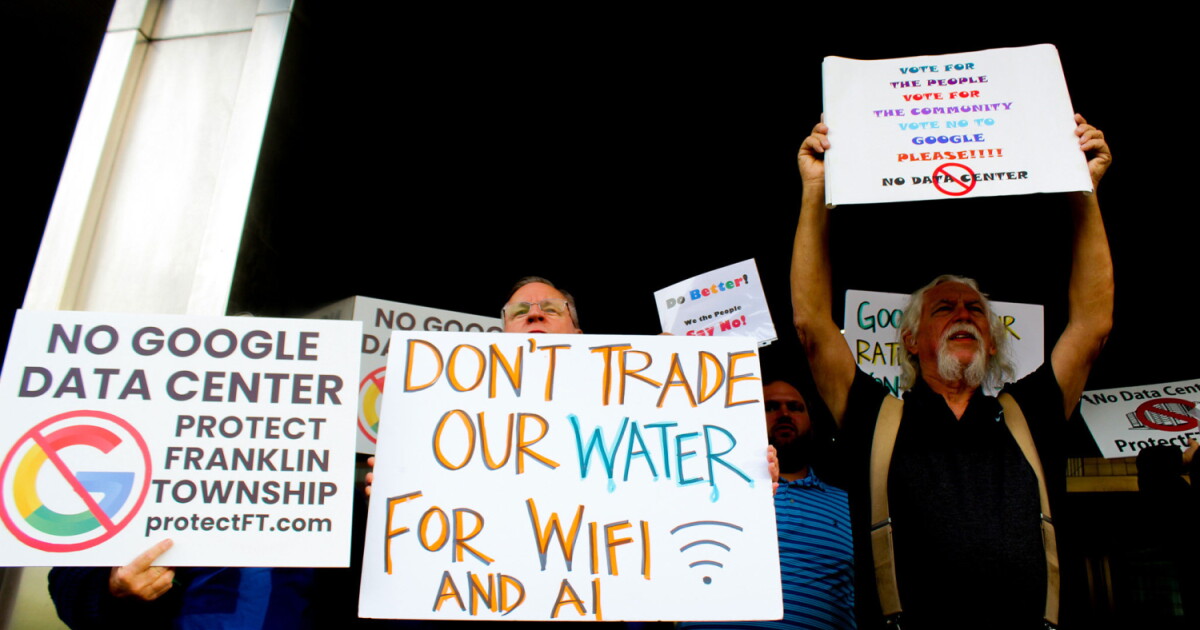
Opposition to compute buildouts now polls at three-quarters of Americans and has become the central charge in Senate races contested by both parties, which makes permitting, rather than megawatts or capital, the variable that moves a capacity schedule.
The Board Room · Leadership desk

Compiled by The Board RoomSomething wrong?How this is made
The mechanism that should interest anyone holding a multi-year capacity plan is sequencing. A campus spends real money long before it draws a watt: land options, rezoning applications, interconnection queue positions, long-lead transformers and turbines. A county ban does not remove the demand, it relocates it, and relocation restarts every part of the schedule that was site-specific while leaving the equipment orders and the customer commitments where they were. Opposition is therefore a lead-time problem first and a reputation problem second.
The polling deserves a careful read. If three-quarters oppose local development after a swing of more than 30 points in a year [1], the implied starting point is somewhere at or below 45 percent [12], which puts most of the movement inside a single planning cycle. The Guardian's 30 August account [11] does not identify the pollster, the sample or the question wording [13], so the direction is the usable finding and the exact level is not. The author's own frame is explicitly political: the piece argues the movement is the best chance in generations to redirect public anger toward billionaires [15], which is a reason to weigh the counts separately from the thesis they are enlisted to support.
A skeptic on a siting team would say that five hundred jurisdictions voting no is mostly noise, because hyperscale load goes where transmission, water and gas already sit, and most of those counties were never candidates. That was defensible while the losses were confined to city councillors [14]. It is harder now that Bernie Sanders and Alexandria Ocasio-Cortez have called for a national moratorium [3] and Utah's senate president was voted out over his support for hyperscale proposals [4]. When the officeholders paying the price hold statewide authority, the cheap site is bought at the level that writes the rules for every site.
The Indiana detail is the one worth holding. In Monrovia, a town of 1,600, the proposal is a 550-acre Google project [8]; a Citizens Action Coalition organiser told the Guardian that of about 50 people he spoke to at a local festival, none wanted it, and at least six volunteered that they had voted for Trump and asked what he was doing supporting these projects [9]. That is one canvasser's account and should be read as such. But it describes an opposition with no partisan flank to route around, which is what removes the usual option of picking a friendlier state and waiting out one election.
The board-deck version says the binding constraints are power and cost of capital, and it is incomplete for a simple reason: a power contract can be renegotiated, and a county that has already passed an ordinance cannot. The trade-off is between speed and durability of consent. Quiet land assembly and non-disclosure agreements with commissioners compress the front of the schedule and are also the reliable input to a moratorium eighteen months later; water commitments, ratepayer protections and a public rate case add cost and months at the start. Priced against a relocation, the front-loaded version is usually the cheaper of the two, and this quarter's siting decisions are the ones that will be litigated during next year's campaigns.
Ranked by verification strength, evidence, and original report placement.
Senator Bernie Sanders and Congresswoman Alexandria Ocasio-Cortez began calling for a national moratorium on datacenters.
Utah's senate president was tossed out of office for supporting hyperscale datacenter proposals.
In the Ohio US Senate race, populist Democrat Sherrod Brown has made Republican senator Jon Husted's support of datacenters the centerpiece of his campaign, prompting the National Republican senatorial committee to warn that "datacenters are the anchor hanging around Husted's neck".
Texas governor Greg Abbott once touted the state as the "epicenter of AI development"; last week he said datacenters had "dug their own grave".
In Michigan, days after The Lever revealed that GOP Senate candidate Mike Rogers held millions in AI-related investments, he announced his support for a one-year moratorium on datacenter construction in the state.
A proposed 550-acre (222-hectare) Google project is planned in Monrovia, Indiana, a rural town of 1,600 people.
Distinct publishers with included, body-backed reporting in this cluster.
Follow any of these and your For You feed starts watching them — no settings page required.
invest
The NRSC just told AI firms their data centers are a losing issue1 distinct publisher
invest
The data-center backlash is now a permitting variable, not a PR problem1 distinct publisher
invest
Canada tariff fight becomes a midterm liability, with the biggest hike dated for after the vote1 distinct publisher
invest
Brin's $102m Doesn't Fight Prop 40. It Funds Two Measures That Would Void It1 distinct publisher
Evidence-backed comparisons of source perspectives and observed adoption signals. Read the methodology
Which Builder, Operator, and Investor concerns the observed source mix emphasized—not a truth score.
Evidence, demonstrated adoption, hype gap, incentives, and confidence are assessed independently, each on its own current evidence. How these are measured.
Quotes solid, counts unsourced
Split the piece in two and it grades very differently. The on-the-record material is checkable and specific: Abbott's two contradictory lines, the Republican senatorial committee's 'anchor' warning, a named organizer describing 50 conversations at a Monrovia festival, an acreage and a town population. The aggregates are not: three-quarters opposition, a 30-point swing, more than 500 jurisdictions, dozens of dead projects — four numbers carrying the argument, none of them attributed to a survey, a registry or a filing, and none corroborated by a second publisher anywhere in our coverage.
Restriction is the thing scaling
What is spreading here is prohibition, and the piece shows it moving up the ladder rather than just sideways: local ordinances, then a federal moratorium call from Sanders and Ocasio-Cortez, then a state senate president out of office, then a statewide moratorium endorsed by a Republican Senate candidate. That escalation is legible. The magnitude is not — 500-plus jurisdictions is a number with no list, and the only concrete project named, Google's Monrovia parcel, is still merely proposed, so nothing in this reporting ties a single lost megawatt to a single ordinance.
Argument outruns the arithmetic
The gap is not in the anecdotes, it is in the leap from them. A Guardian columnist gets from festival conversations and county ordinances to 'the best opportunity we've had in generations to truly shake up American politics' on the strength of two numbers nobody can check and a political-science framework applied after the fact. Note also what the piece never claims: it does not say any buildout was delayed. Our own framing at the top of this story, treating permitting as the binding constraint on capacity, pushes the reporting further than the reporting goes.
A strategy memo in article form
This piece wants an outcome and says so: redirect partisan anger at billionaires. Its living sources are a lead organizer and a program director at one Indiana advocacy group and a Sunrise Movement co-founder running for Congress on the issue — people whose campaigns benefit from the backlash reading as a national movement rather than scattered zoning disputes. The Michigan disclosure is credited to The Lever and deployed as political ammunition. None of that is concealed, and the counter-incentive is equally visible in the material: Abbott and the Republican senatorial committee are hostile witnesses whose own words cut the same way.
Single voice, sharp direction
One publisher, one piece, published 30 August 2026, with an explicit thesis and no second account to test it against. We are fairly confident the direction is real — hostile quotes from Abbott and the Republican senatorial committee are hard to explain if datacenter siting were still routine local business. We have little confidence in any specific magnitude in this story, and none in the year-earlier baseline it implies.