ScienceNot yet confirmed elsewhere1 publisher2 min readPublished
Kyoto researchers' female-baited traps catch more stag beetles toward forest interiors
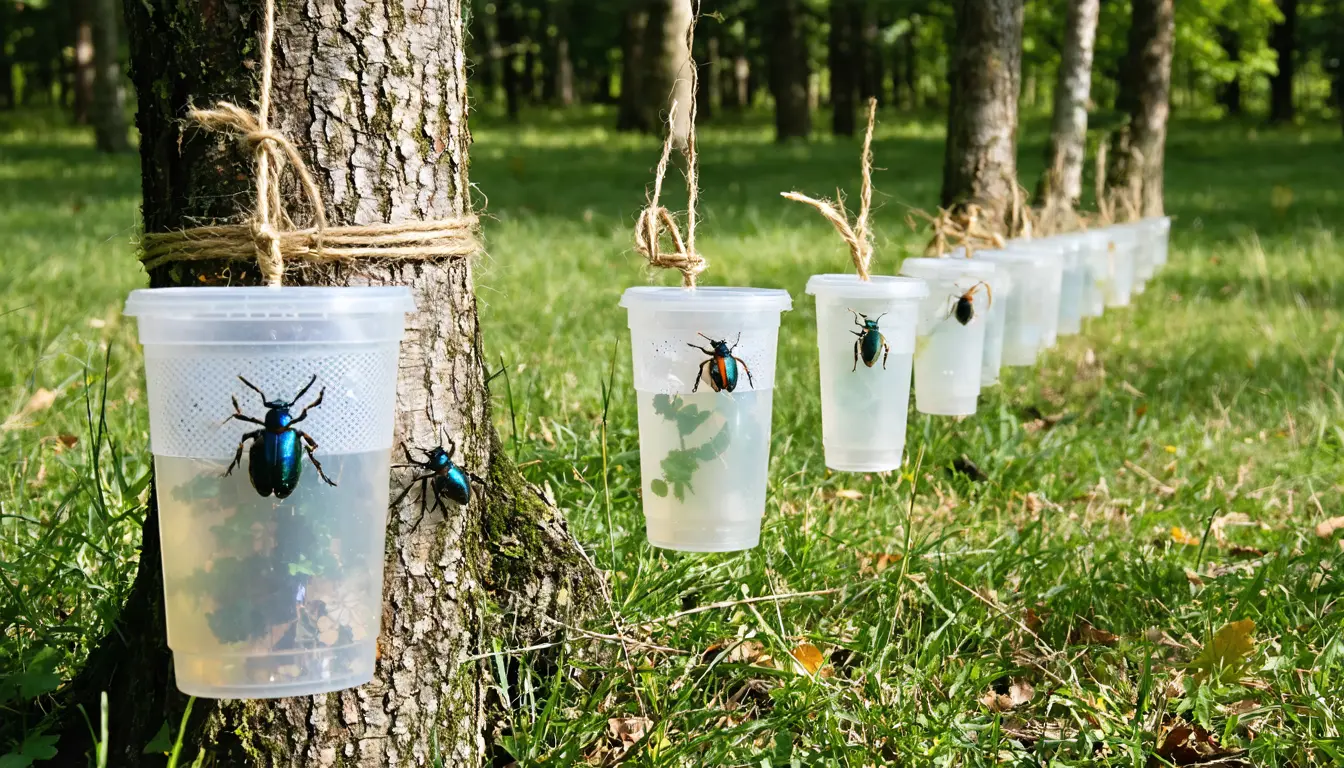
Kyoto University traps baited with female Platycerus stag beetles caught more males toward forest interiors and fewer toward open areas in Hida, Japan. That gradient makes a leaf-bud-eating beetle a candidate habitat gauge for working broadleaf forests, though the pattern has yet to be checked across years and other forests.
The Scientist · Science desk
What happened
- The trap, called F-FIT, is a recent design meant to replace Platycerus surveys that depend on observer skill and can damage the beetles' breeding sites.
- The catch was males of Platycerus takakuwai, a stag beetle species typical of Japan.
- Catches were modelled against weather, elevation, forest structure and forest-edge position, with several statistical models compared.
- The paper, in Forest Ecology and Management, is the first use of F-FIT for habitat assessment in operational broadleaf forestry.
Why it matters
- capability A count that does not hinge on the surveyor's skill can be compared between sites and survey crews, which is the basic requirement for an indicator used in routine forestry.
- constraint One season's catch in one forest cannot yet serve as a baseline for measuring a harvest's effect, because the team says the pattern still has to be checked across forests, years and survey dates.
- precedent Copying the approach elsewhere means finding a local species, since P. takakuwai is found in Japan, and the team says it aims to build such local indicators for other regions.
Forest monitoring already has a dependable insect for the ground. According to the Kyoto University team, ground-dwelling beetles describe conditions on the forest floor, while indicators for the canopy have been harder to find, and the team proposed Platycerus for that job [6]. The genus lives in broadleaf forest. Its larvae eat dead wood and its adults eat new leaf buds [7], so an adult's food is up in the trees.
What the paper shows is a habitat gradient. Males were caught more often toward forest interiors [3], and forest structure was among the variables the models tested [5]. That fits an animal tied to closed tree cover. I think it is enough to justify the trap as a habitat measure in working broadleaf forest. It stops short of a canopy indicator. The published summary does not give the number of traps or beetles, the size of the interior effect, or any direct canopy measurement set against the catches. Without those figures, a reader cannot tell a large effect across many traps from a modest one in a small sample.
The second finding is the more useful one statistically. The link between tree density and catches changed from place to place across the surveyed forest [4]. In modelling terms, a single forest-wide slope for tree density would fit some stands and miss others. The team says this shows the value of looking beyond forest-wide averages when judging habitat [4].
First author Minori Tokito came to the beetles from the management side [11]. "I'm interested in how forest resources can be used while maintaining habitats for wildlife," Tokito said [11]. Tokito also said: "It was rewarding to see F-FIT develop from a quantitative survey method into a source of information for considering how forests are used and managed" [12].
What to watch
- Results from the larger-scale surveys the Kyoto team has underway, and whether they show the same interior-to-edge gradient.
- A study setting F-FIT catches against measured canopy cover, the direct test of whether the trap tracks the canopy itself.
Clarity's read
What the record supports and how the coverage leans. The claims behind it follow.
Reality
- Evidence38
- Adoption
- Insufficient
- Hype gap+15
- Incentives
- Insufficient
- Confidence42
Claim ledger
Ranked by verification strength, evidence, and original report placement.
- [1]
Kyoto University researchers surveyed forests in Hida, Japan, using a female-attracted flight interception trap (F-FIT) that uses female Platycerus stag beetles to attract males.
- [2]
The survey recorded captures of male Platycerus takakuwai, a species typical of Japan.
- [3]
Beetle capture counts increased toward forest interiors and declined toward open areas.
- [4]
The relationship between tree density and capture counts varies across locations instead of being uniform across the forest, which the researchers say highlights the value of looking beyond forest-wide averages when assessing habitat conditions.
- [5]
The scientists analyzed capture counts in relation to location data and environmental variables including weather, elevation, forest structure and forest-edge position, and compared multiple statistical models.
- [6]
Ground-dwelling beetles help scientists understand forest-floor conditions, but indicators reflecting canopy conditions have been more elusive; the Kyoto University team thought Platycerus might fit this role and complement ground-dwelling beetles in monitoring broadleaf forests.
- [7]
Platycerus stag beetles inhabit broadleaf forests; larvae feed on dead wood and adults feed on new leaf buds.
- [8]
F-FIT was introduced recently to address limitations of conventional Platycerus surveys, which depend on an observer's skill and risk damaging breeding sites.
- [9]
The study is the first application of F-FIT to habitat assessment in operational broadleaf forestry.
- [10]
The paper, by Minori Tokito et al., is published in Forest Ecology and Management (2026).
- [11]
"I'm interested in how forest resources can be used while maintaining habitats for wildlife," said first author Minori Tokito.
- [12]
"It was rewarding to see F-FIT develop from a quantitative survey method into a source of information for considering how forests are used and managed." (Minori Tokito)
- [13]
The team has larger-scale surveys underway, and future work will need to examine whether similar spatial patterns are observed across forests, years and survey dates.
- [14]
Because Platycerus takakuwai is found in Japan, the scientists aim to develop locally useful indicators to support forest management balancing timber use and biodiversity conservation in other regions.
Sources
1 independent publisher whose own reporting we read for this story.
- phys.orgA honey trap: Female-baited beetle traps reveal habitat variation in Japanese forests
1 article · October 7, 2026
Topics and entities
Follow any of these and your For You feed starts watching them — no settings page required.