Leadership3 publishers2 min readPublished
SpaceX flies Starship to orbit despite an early upper-stage engine shutdown
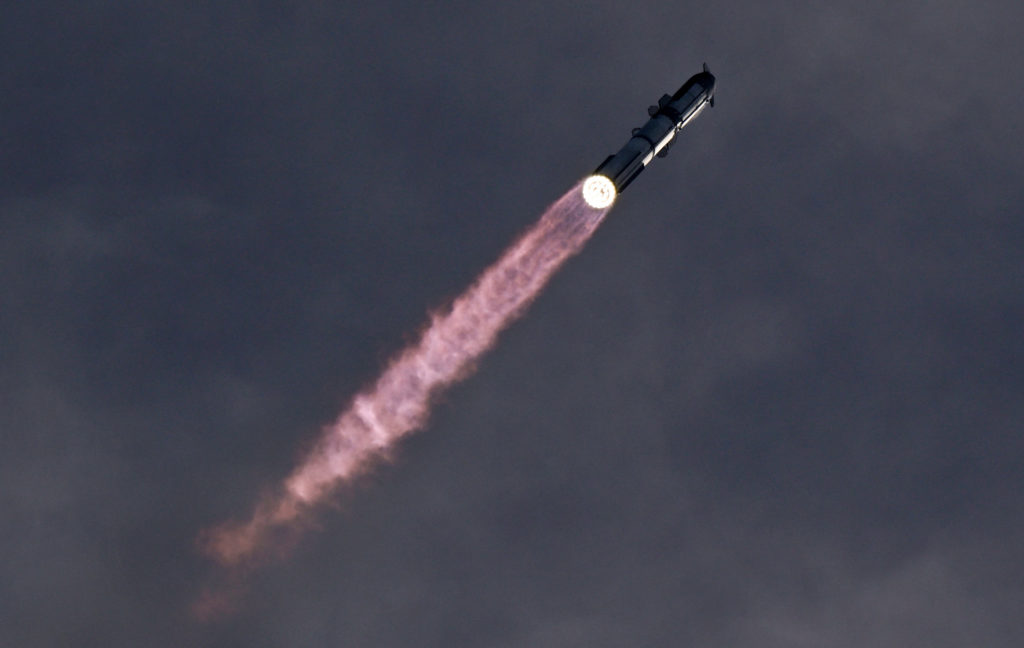
SpaceX put Starship into orbit on its first orbital flight even after one of the upper stage's six Raptor engines shut down early. It sets up the orbital refuelling tests NASA's 2028 moon landing depends on, though those tests and an upper-stage catch are still ahead.
The Board Room · Leadership desk
What happened
- Flight controllers reviewed telemetry, judged the ship otherwise healthy and cleared a second firing, on a single Raptor, that completed the climb to orbit.
- The Super Heavy booster lost one of its 33 engines on ascent and apparently another during boost-back, then made a seemingly normal splashdown a few miles offshore.
- Eight and a half minutes after the orbit-insertion burn, Starship began releasing 26 third-generation Starlink satellites from a dispenser in its nose.
- The planned moon landing uses a Starship variant that must be fuelled by multiple tanker flights before it meets an Orion capsule in lunar orbit.
Compiled by The Board RoomSomething wrong?How this is made
Why it matters
- decision Teams planning around NASA's 2028 landing can now count orbit as shown, while orbital refuelling still has to be carried in their plans as an untested step with its own schedule risk.
- constraint Until an upper stage is caught at the pad, customers have no flight evidence on which to price in cheaper heavy lift from Starship.
- exposure Engine reliability now sits on the path of a landing campaign that needs several tanker launches to go right in sequence, and the rate behind it is unmeasured.
SpaceX planned the flight so that the decision to go to orbit came after the first burn [3][4]. That burn aimed for a suborbital path like earlier test flights. If SpaceX lost control of the vehicle, that path would still end in a safe splashdown [4]. The upper stage finished the burn on five of its six Raptors [2], and the orbital burn went ahead only after the flight team's health check [3].
Counted across both stages, three engines shut down early on one flight [1]. The booster is designed to reach space despite losing engines [6]. The previous test flight went worse. Three engines had problems, only eight of 13 fired for the landing burn, and the booster hit the water hard [8]. SpaceX made upgrades and software changes before Monday's launch [8].
The board-deck version is short: orbit reached, 2028 on track. It leaves out the part of the flight that had not happened when CBS filed. CBS ties confidence in the 2028 mission to getting Starship into orbit and back [13]. At that point the ship still had six orbits to fly before a single-engine de-orbit burn 8 hours and 52 minutes after launch, with a tail-first splashdown planned off Chile [16]. After the return comes autonomous orbital refuelling, which has never been attempted at the scale Artemis landings require. Reaching orbit sets the stage for the test flights meant to demonstrate it [15].
A skeptic would ask what happens when the flight is repeated. A landing that needs several tanker launches [14] gives an engine problem several chances to cost a flight. Monday gives a partial answer. Both stages kept flying after losing an engine, and the upper stage still reached a 180-mile orbit [5][6]. One flight cannot show how often engines quit across a run of launches, and we do not know that rate yet.
Most of the supply-chain case for heavy lift is about cost, and the CBS account does not include launch prices. The capacity figures are on the record. The booster generates some 16 million pounds of thrust, twice that of NASA's Space Launch System [12]. Both stages are designed to be caught at the launch site [9][10]. I think any fall in launch cost depends on those catches becoming routine, and I would not read one from this flight. SpaceX has caught the booster with the tower's mechanical arms four times but is sticking with ocean splashdowns until upgrades are tested [9]. The upper stage has not yet attempted a catch [10].
What to watch
- Whether Starship completes its single-engine de-orbit burn and tail-first splashdown off Chile, the return half CBS links to confidence in the 2028 schedule.
- The follow-on flights meant to demonstrate autonomous orbital refuelling at the scale Artemis landings require.
- A return to tower catches for Super Heavy and a first attempt to catch the upper stage at the pad.