Science1 publisher3 min readPublished Updated
Europe's bid for its own launches starts from 12 percent of last year's space investment
EU and French leaders used a Paris summit on 10 September to call for sovereign launch and crew capability. The parts actually under construction are a 348-satellite constellation, German defence budgets and a first orbital launch from Norwegian soil.
The Scientist · Science desk
What happened
- At the inaugural International Space Summit in Paris on 10 September, European Commission president Ursula von der Leyen told delegates that Europe's security on Earth increasingly depends on its security in space.
- Isar Aerospace flew the first orbital rocket to take off from European soil on 5 September, from the Andoya spaceport in Norway.
- The European Union is building IRIS2, a 348-satellite constellation due to begin launching in 2029 to serve civilians, businesses, emergency services and the military.
Compiled by The ScientistSomething wrong?How this is made
Why it matters
- constraint Durham University's Bleddyn Bowen sets the bar at enough essential infrastructure, not parity, so European operators planning around sovereignty should size for sufficient capacity.
- exposure Envision's science team now carries US policy risk in its payload manifest, and a 2031 launch date leaves a finite window to fund and qualify a substitute instrument.
- contradiction The summit rhetoric reaches human spaceflight while the funded hardware stops at cargo and satellites, so suppliers hoping for crewed-programme contracts have no vehicle to bid into, only a statement of intent.
- cost The fastest-moving European space money is defence money from Germany's 35-billion-euro plan. Vendors chasing sovereignty budgets will be selling to defence ministries and pricing to their procurement rules.
Twelve percent of $13.5 billion is $1.62 billion. Sixty-eight percent is $9.18 billion. European space companies took in roughly $7.6 billion less than US ones out of last year's global investment in the sector, a ratio of about 5.7 to one [6][7]. The figure tracks money going into companies. State budgets sit outside it, and the largest new European number is a state one: Germany plans to spend 35 billion euros by 2030 on spy satellites, space planes and other military equipment [19].
Nature gives that plan as around $40 billion, close to 25 times what European space companies raised privately across last year [19][21].
The dependency Europe is trying to shed also works item by item. NASA said last week that it will no longer supply an instrument for Envision, a European Space Agency mission to Venus set to launch in 2031 [12]. The Nature report does not name a replacement [22].
On crews, the hardware lags the speeches. "Europe must fly with its own crews," Macron said at the summit [9]. The nearest hardware in the story is Nyx, a spacecraft from The Exploration Company in Gauting, Germany, which announced $450 million in funding on 8 September, one of the largest raises in European space history, to carry cargo and eventually humans [20].
The summit itself supplied the political prompt. The White House was reported by Politico and others to have discouraged US companies including SpaceX and Blue Origin from attending [8]. Eva Berneke, previously chief executive of the French satellite company Eutelsat, told Nature that the last-minute cancellation by "the big Americans" was a "wake-up call" [10]. "Europe needs to step up," she said [11].
Bleddyn Bowen, an astropolitics researcher at Durham University, does not expect Europe's launch industry to match those of the United States or China, and sets the test instead as whether Europe "has enough essential infrastructure in space" with its own rockets [16]. That matters for buyers. Enough launch capacity for Europe's own satellites is a different thing from a commercial alternative to SpaceX, whose Starlink network is now the leading provider of internet from space [5].
The EU's answer on connectivity is IRIS2, 348 satellites due to begin launching in 2029, serving civilians, businesses, emergency services and the military [17]. "IRIS2 has been talked about for many, many years," Bowen said. "Now, things are actually getting built" [18].
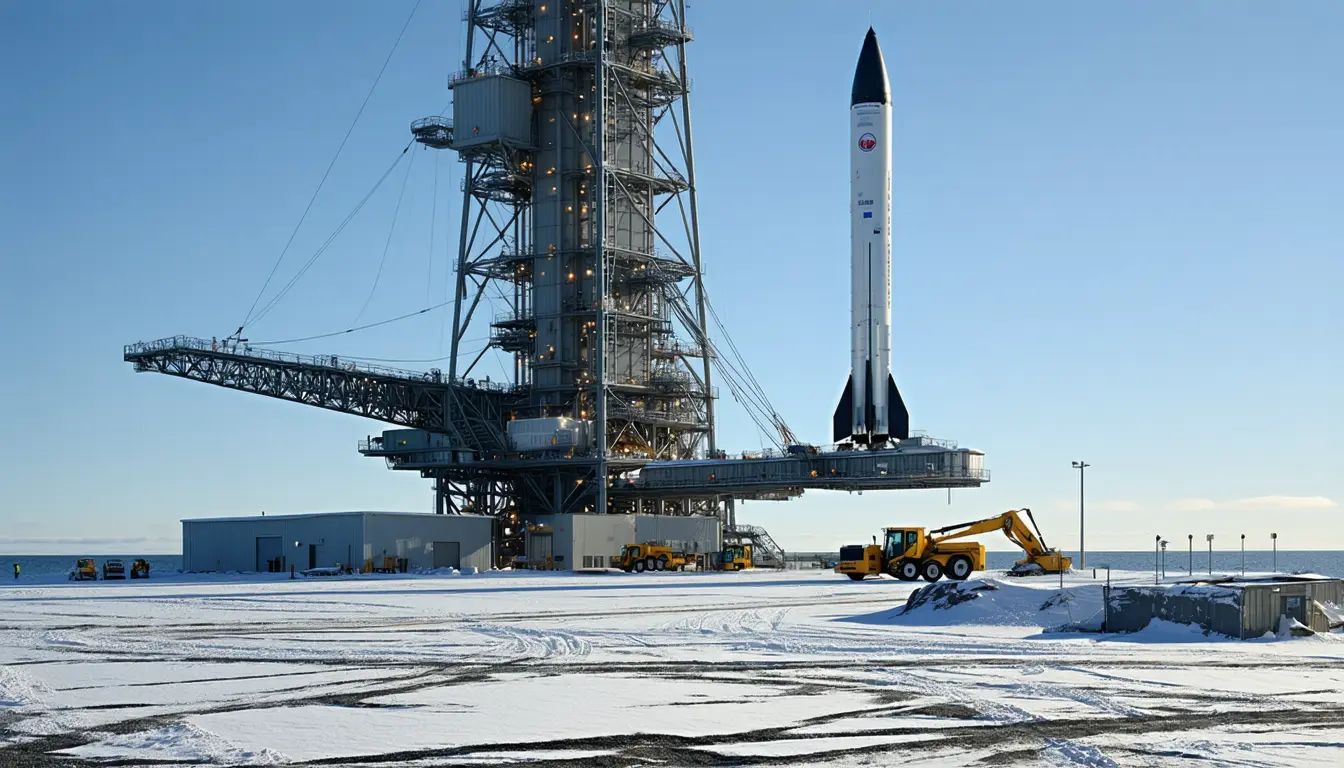
Launch is where the change shows most. It is also the least mature. Ariane and Vega fly from French Guiana, and Europe has no private rocket sector on the scale of those in the United States or China [13]. On 5 September the German company Isar Aerospace flew the first orbital rocket to take off from European soil, from the Andoya spaceport in Norway [14]. Several European firms are working on reusable rockets and heavy-lift launchers [15].
What to watch
- Whether ESA funds or sources a replacement for the NASA instrument in time for Envision's 2031 launch date.
- Whether IRIS2 holds its 2029 start for launching 348 satellites, and which launch providers are contracted to fly them.
- Whether The Exploration Company's Nyx moves from cargo to crew with a named date and a paying customer.