Invest1 publisher3 min readPublished
Psyonic plans to pay amputees in Pakistan and India to record grip data for robots
Psyonic plans to give bionic hands to thousands of amputees in Pakistan and India and pay them for the grip data the hands record. Chief executive Aadeel Akhtar hopes the resulting revenue will subsidize the hands for the people who wear them.
The Investor · Invest desk
Drafted by a language model from the sources cited here and checked against its claim ledger before publication. How we use AISend a correction
What happened
- Each Psyonic hand logs the forces, torques and finger positions of every grip, synced to video from a wearable camera.
- Psyonic plans to sell robotics companies models trained on the recordings, not the raw data itself.
- London-based Koalaa will help fit the hands with a soft fabric sleeve, replacing a custom socket that usually takes several clinician visits.
Compiled by The InvestorSomething wrong?How this is made
Why it matters
- cost The fabric sleeve removes clinician visits that would otherwise be paid again for each of the thousands of hands Psyonic wants to place.
- decision Selling models puts Psyonic up against Google DeepMind, whose models run on other companies' robots, so the hand subsidy depends on Psyonic's model winning buyers against a large lab's.
- exposure The wearers' pay and their subsidized hands would both depend on Psyonic finding paying customers for its models.
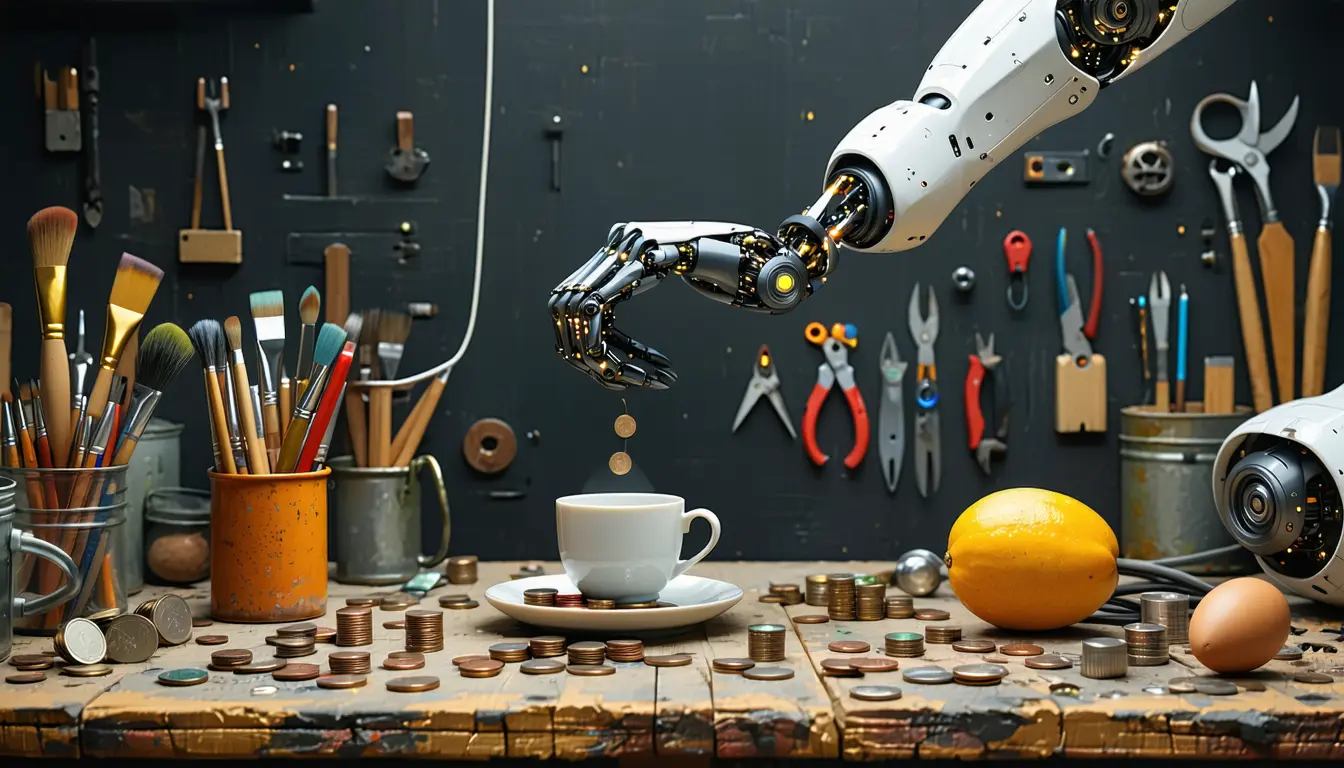
In this plan, the sensor and the product are the same hand. In recent years robotics developers approached Psyonic about putting its hands on robots [3]. Worn by amputees, those same hands would record every grip [2][4]. "Robotics has a data problem," Akhtar told Semafor, especially around hands [18]. According to Semafor, other companies looking for training data offer free home cleanings in exchange for filming the work, or strap head-mounted cameras on factory workers in India [6]. Those methods record what a task looks like. Psyonic's also records how hard each finger pressed [4].
Touch is where the field is stuck [10]. Rich tactile manipulation remains "generally unsolved," said Kanishka Rao, a research director on Google DeepMind's robotics team [10]. A hand has to be skilled at "grabbing a raspberry without crushing it, but also lifting a 100-pound kettlebell and swinging it," Akhtar said [19]. The hardware also falls short: at about 22 degrees of freedom against 27, the best robot hands have roughly four-fifths of the independent motions of a human hand [9][1]. Barclays researcher Zornitsa Todorova said hands are often the biggest single cost in building a humanoid [11]. "It's loaded with motors and rare earths and actuators," she said [12].
The deal has three parties. Psyonic supplies the hand and pays the wearer [2]. A robotics company pays for a trained model [5]. Akhtar hopes the model revenue will then subsidize the hand [8]. The report does not say what Psyonic will pay wearers, what a hand costs to build, or what a model would sell for. Because it sells models, Psyonic will compete in the same business as Google DeepMind, whose models are built to run on other companies' robot hardware [14]. Akhtar also presents the program as a livelihood for people who are unemployed because they are missing limbs [20]. Millions of people worldwide have upper-limb amputations, most of them in developing countries [17].
So the supply of wearers is large, and the open question is whether enough robot makers will pay. Three outcomes are plausible. In the first, humanoid makers buy models trained on human grip, and the revenue covers hands and wages across the thousands of units Psyonic wants to place [2]. In the second, a July review by German researchers turns out to be right that "in-hand manipulation does not benefit from anthropomorphic hand design, as simpler mechanisms are sufficient" [13]. Buyers would then follow the hospital robots from Cobot and Diligent Robotics, which move on wheels with simple grippers [15]. In the third, the large labs get dexterity from other data. DeepMind showed a humanoid tying a trash bag when it rolled out Gemini Robotics 2 in July [16].
I think the force-and-torque log is the part of the plan that camera-based collectors cannot record [4][6], and it gives Psyonic a better chance at the first outcome than a video-only operation would have. The view is wrong if Psyonic's first model customers put the model on grippers instead of five-fingered hands, or if model sales cannot pay for one hand per wearer.
What to watch
- Whether Psyonic discloses what it pays wearers and what a subsidized hand costs in Pakistan or India.
- The first robotics company to buy a Psyonic-trained model, and whether it runs the model on a five-fingered hand or a gripper.
- Whether Google DeepMind's Gemini Robotics models start taking force or tactile inputs, which would put them in direct competition with Psyonic's data.