Science1 publisher2 min readPublished
Snakes that look alike draw similar fear and disgust in a 377-person photo study
Aveiro and Brasilia researchers found that 377 people rating 92 snake photos gave similar-looking snakes similar fear, disgust and liking scores. Their lab treats spotting a snake and fearing it as separate steps, and this study measured only the second.
The Scientist · Science desk
What happened
- Participants took part online from Brazil and Portugal, were aged 18 to 74, and viewed the snake photos on their own devices.
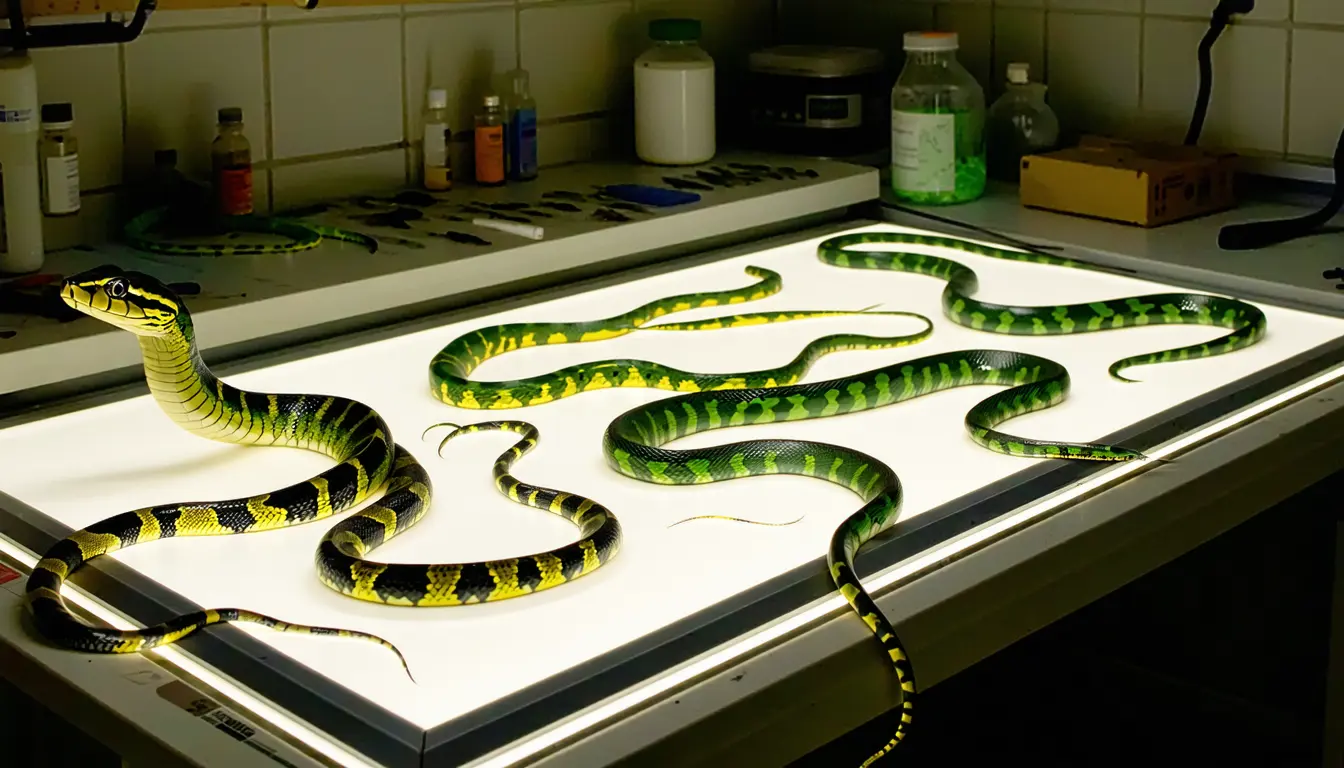
- The images came from the Reptiles of Ecuador project and were chosen to cover a wide range of snake body forms and visual traits.
- The researchers did not pre-rate any image; they grouped participants' ratings first, then tested whether each group shared morphological traits.
- Three clear response groups emerged from that sorting, according to senior author Sandra C. Soares.
Compiled by The ScientistSomething wrong?How this is made
Why it matters
- capability The few snake-like non-snakes in the set give the team a test of whether people react to an animal's identity or its appearance; a snakes-only set could not separate the two.
- constraint Because the photos show real animals whose head shape, girth and colour vary together, a trait linked to a response group is an association; showing that one feature causes fear would need images that change one feature at a time.
- constraint The profiles come from adults in two countries rating Ecuadorian species on a screen, so whether the same traits drive the same reactions face to face with a live animal, or among people living with different snakes, is untested.
Sorting the ratings first and explaining them afterwards keeps the experimenters' own guesses about which snakes look dangerous out of the groups [6]. Each image was rated on six scales: fear, disgust, beauty, emotional valence, arousal and perceived size [5]. Those ratings were reduced to three profiles [1]. The team then examined "whether these different profiles were associated with the animals' visual and morphological characteristics, as well as with participants' individual experience and attitudes," Soares said [16].
The photo set had a neat control built into it. "We also included a small number of elongated, limbless reptiles that look remarkably snake-like but are not actually snakes, which helped us explore whether people were responding to the animal's biological identity or to its visual characteristics," said Luiz Biondi, the paper's first author [4][14].
Soares's lab came to this question from work on how quickly primates detect snakes [9]. Earlier studies suggest that humans, as well as monkeys and apes, tend to notice snakes in their surroundings fast [9]. "Fast visual detection of something as a snake is not necessarily the same as being afraid of it," Soares told Phys.org [8]. The next question, she said, was "what makes some snakes appear more threatening than others once we actually look at them?" [15] A 2025 review by her group examined evidence that different visual features of snakes can become important at different stages of perception [13].
Her reasoning starts from ecology. In her words, "a slender colubrid, a broad-headed viper and a large constrictor may all be snakes, but they provide very different visual information" [10]. Participants also reported their general fear of snakes, previous encounters with them and exposure to natural environments [5]. That let the study ask how responses "interact with individual experience and ecological or cultural context" [11]. Phys.org's account does not list the traits behind each profile, or say where the non-snakes landed.
With participants from only Brazil and Portugal [2], the cultural comparison has two points. The study extends work by Daniel Frynta and colleagues suggesting that people respond differently to different snake species [12].
What to watch
- Where the snake-like non-snakes fall among the three response profiles in the full paper: sitting beside similar-shaped snakes would favour appearance over identity.
- Which morphological traits define each profile, and how strongly they predict the fear and disgust ratings.
- A study that times detection and collects fear ratings for the same images in the same participants.