Science1 publisher2 min readPublished
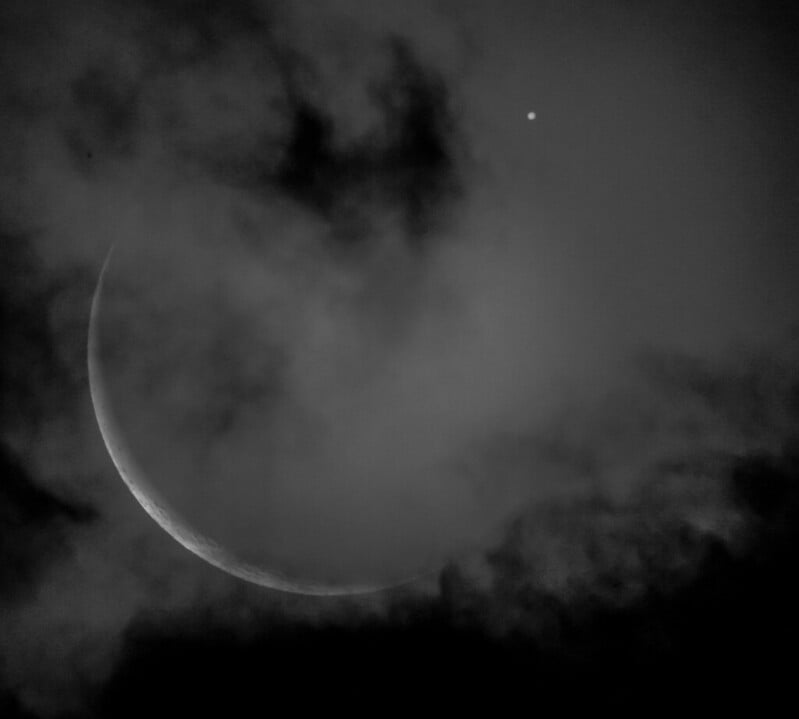
Moon occults Jupiter before dawn on Oct. 6 for eastern North America
Jupiter slips behind a crescent moon near 10:16 UT on Oct. 6, before dawn for the eastern US and Canada, in the last good view from the lower 48 until 2034. Saturn reaches opposition two days earlier, brightening by about 0.3 magnitudes, a change skywatchers can test against Capella and Rigel.
The Scientist · Science desk
What happened
- Jupiter, at magnitude -1.9 and 34 arcseconds across, will take a full minute to disappear behind the moon and another full minute to reappear.
- The 20%-lit waning crescent leads with its sunlit edge, so Jupiter vanishes at the bright limb and comes back out at the dark one.
- Because Saturn's opposition falls near September's equinox, the planet strays just into a corner of Cetus, a constellation outside the zodiac.
- Saturn's rings are tilted 12 degrees in late 2026, opening from edge-on in 2025 toward their widest tilt in 2031.
Compiled by The ScientistSomething wrong?How this is made
Why it matters
- capability A minute-long fade at each edge of the moon is slow enough to watch and record on video, so the event suits camera owners as well as observers at the eyepiece.
- decision Anyone planning to record it needs their own site's ingress and egress times from IOTA's list, since contact times move with location away from the event's center time.
- constraint The 0.3-magnitude surge depends on how far the rings are open, so this year's figure will not hold for the oppositions to come as the rings widen toward 2031.
The one-minute fade follows from two other figures in the phys.org account. The moon covers its own apparent diameter, half a degree, in about an hour [4]. Half a degree is 1,800 arcseconds, so the lunar edge sweeps about 30 arcseconds a minute, and a 34-arcsecond disk takes roughly 68 seconds to go under [1]. That matches the article's full minute for both the disappearance and the return [5].
For the East Coast the center of the event falls at 6:16 a.m. EDT [1]. Last month's occultation of Jupiter happened in daylight. This one is in darkness before sunrise across the eastern contiguous US and Canada [3]. Phys.org calls it one of the best-placed and top sky events of 2026 [17]. The moon's unlit side should show faintly in earthshine [7], and Jupiter's own moons are in their mutual transit season at the same time [8].
I think the better experiment of the week is Saturn's, because it comes with controls. At opposition the planet shows a fully lit face to Earth, and a retroreflective brightening called the Seeliger effect, or opposition surge, sets in [13]. The rings make Saturn's version especially prominent, at about 0.3 magnitudes [14]. The article gives its own conversion: six times brighter is about two magnitudes. By that ratio, 0.3 magnitudes is about 30 percent brighter [4].
The lunar example in the same piece needs a denominator. A moon near full can be up to six times as bright as a quarter moon [15], but the quarter moon is only 50% lit. Doubling the lit fraction accounts for a factor of two. The remaining factor of about three is what the article credits to the small shadows that vanish at full phase [5].
The controls are Capella and Rigel, both zero magnitude, against Saturn at +0.3 [16]. Saturn therefore sits 0.3 magnitudes fainter than its comparison stars, a gap the same size as the surge [6]. The thing this doesn't tell you is whether the +0.3 figure already includes the surge. An observer can still follow the change against the same two stars over the next few weeks as the surge fades [16].
What to watch
- Cloud cover over the eastern US and Canada in the hours before dawn on Oct. 6, since the event is a single predawn window.
- Amateur video of ingress and egress, which would show whether the fade runs close to the 68 seconds the moon's half-degree-per-hour motion predicts.
- Whether ring spokes show up as Saturn comes off its 2025 equinox season; phys.org says they are thought to come from meteoroid impacts.