Science1 publisher2 min readPublished
Vanadium bonds reorganize through three phases of Li0.5VS2 while it stays metallic
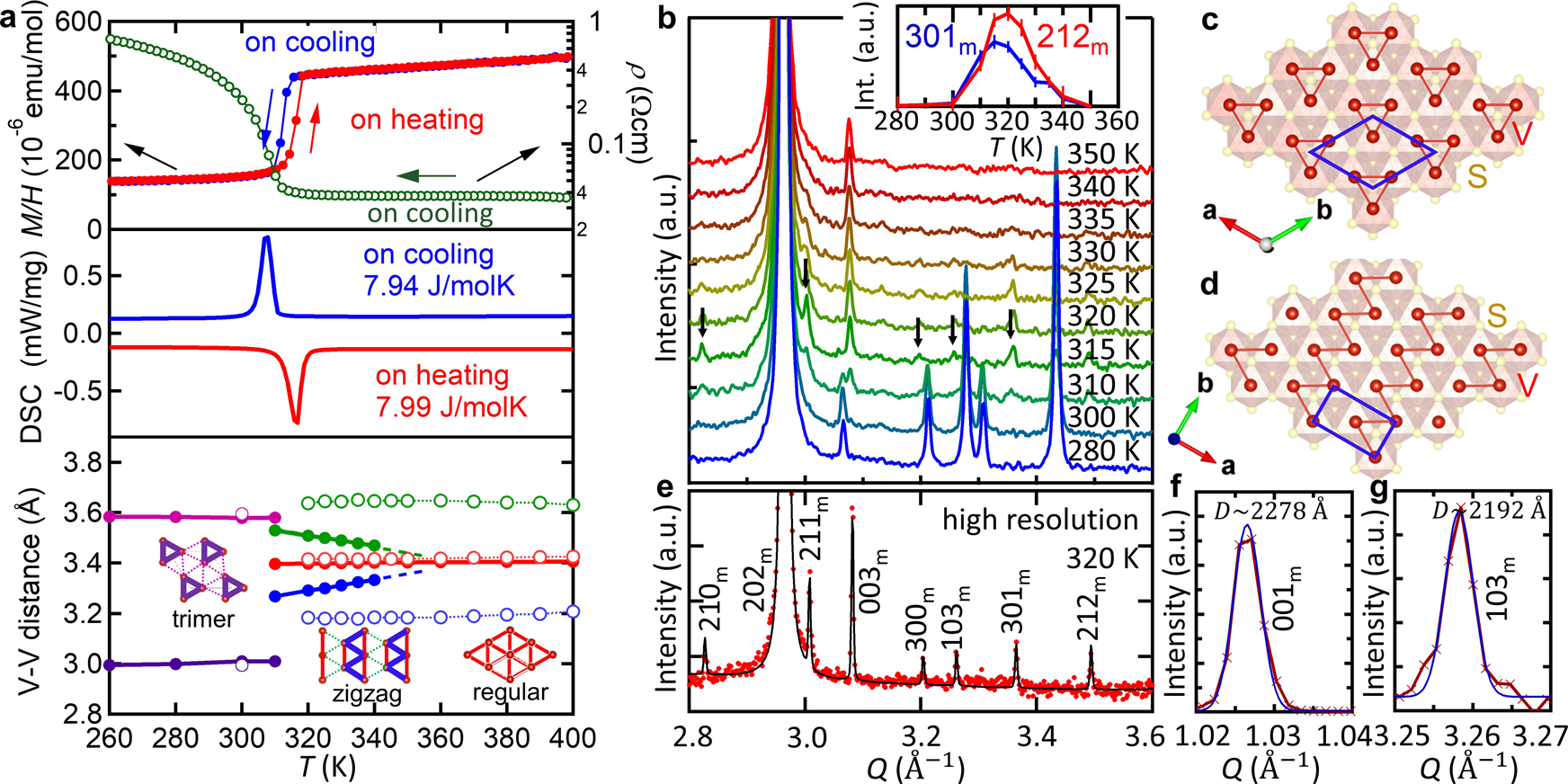
Okayama University researchers report that the two magnetic transitions of Li0.5VS2 track vanadium-vanadium bonds that form zigzag chains near 345 K and pairs near 140 K, with resistivity metallic in all three phases.
The Scientist · Science desk
What happened
- Keita Kojima and Naoyuki Katayama at Okayama University report in Chemistry of Materials that bonding between vanadium atoms in Li0.5VS2 reorganizes as the material passes through successive structural changes.
- The team identified two successive magnetic phase transitions in the compound, one near 345 K and one near 140 K.
- Vanadium sits in a triangular arrangement at high temperature, draws into zigzag chains between the transitions, and breaks into localized V-V pairs at low temperature.
- Electrical resistivity measurements showed the compound remains metallic through all three phases, including the intermediate phase whose magnetic response is more localized.
- In the zigzag phase the V-V distances shorten by about 0.2 Angstrom, and calculations indicate the resulting sigma bonds are only partially occupied for lack of electrons.
Compiled by The ScientistSomething wrong?How this is made
Why it matters
- capability A single compound with several distinct electrical and magnetic settings would be a new kind of component, and Kojima ties that prospect to controlling the bonding states and transition temperatures by composition, substitution or pressure.
- decision Anyone who wants the dimer state has to cool to 140 K to get it, since a sample at ambient temperature is already sitting in the middle phase.
- constraint The bonding design principle currently rests on one composition of one compound, with neighbouring lithium contents showing only a single transition, so it stands as a hypothesis about electron count.
The odd part sits between the two transitions. Vanadium draws into zigzag chains, the magnetic response becomes more localized, and current still flows [8][11]. Calculations put the sigma bonds along those chains at partial occupancy, because there are not enough electrons to fill them [13]. That, the authors say, is what lets V-V bonds form while the compound keeps conducting [14].
Below the lower transition the chains break into V-V pairs, and the localized moments present at intermediate temperatures are almost completely suppressed [15]. Resistivity does not follow the magnetism down. Some electrons keep moving through vanadium orbitals that do not fully participate in the dimer bonds [16]. In the calculations, electron-electron interactions stabilize the dimers, while Hund's coupling contributes the intermediate phase's magnetic response [17].
Symmetry and bonding move together in this material. The vanadium atoms shift at the lower transition and their bonds reorganize with them [9], so the temperature sweep on its own cannot separate the rearrangement from the bonding. The case for bonding as the cause of the transitions rests on the calculations that assign the two low-symmetry phases different stabilizing interactions [17]. The account reports the 0.2 Angstrom contraction and describes the magnetic changes by direction; it does not give absolute V-V distances or measured moments [12].
The choice of composition came from older work. Donald W. Murphy and co-workers found that Li0.5VS2 was the only composition showing two distinct magnetic phase transitions, with a single transition at x values of 0, 0.33 and 1 [4]. So Kojima looked at the electronic and structural changes behind them [5].
The two transitions are about 205 K apart [1]. The upper one, near 345 K, is roughly 72 C; the lower, near 140 K, is roughly minus 133 C [2]. Room temperature, near 295 K, falls inside the zigzag window, so a sample on a bench sits in the intermediate phase [3].
Kojima's own framing of the payoff is conditional. "In the longer term, if the bonding states and transition temperatures can be controlled by chemical composition, elemental substitution, or pressure, the underlying mechanism could provide a basis for materials whose electrical and magnetic properties can be switched in multiple steps," he said [18]. "Such materials may be relevant to future sensors, switching devices, and other responsive functional materials," Kojima said [19]. The report frames the result as a new design principle in which chemical bonding itself is used to control electronic and magnetic properties [20].
What to watch
- Whether elemental substitution or applied pressure moves the 345 K and 140 K transitions, which is the condition Kojima attached to any switching application.
- Whether a direct spectroscopic measurement confirms the partial occupancy of the V-V sigma bonds that the calculations infer.
- Whether any other LixVS2 composition can be pushed into an intermediate zigzag-chain phase, which would test the bonding picture outside x = 0.5.