Product1 distinct publisher3 min readPublished
The passport shape buys smaller letterbox bars and a fainter crease with a cover screen your thumb cannot cross and web pages that render off-frame. That is a trade-off frontier, not a finished product.
The Product Desk · Product desk

Compiled by The Product DeskSomething wrong?How this is made
Read the last three cover screens as a ledger and the pattern looks like arithmetic rather than progress. Until the Fold7, the outer display ran narrower than an ordinary phone, which made it easy to work one-handed and, by reviewers' account, awkward to look at [8]. Drew Blackard, Samsung Electronics America's senior vice president of mobile product management, describes the feedback as annual and unvarying: "Every year until probably last year, we were told, 'Too slim, too slim, too slim'" [9]. Widening it settled that complaint and pushed the inner panel towards square, which made the unfolded device more awkward to hold and put thick black bars around video [10]. The new shape answers that in turn, and the bill arrives as a thumb that struggles to cross the cover screen, with the alternative grip balanced under the fingers and feeling precarious [6], plus portrait reading where the camera cutout now sits along the side of the page instead of the top [12].
None of those moves is wrong on its own. Together they describe a boundary: the closed shape, the open shape and the crease all draw on one account, and each generation has paid down one complaint by opening another [18].
The deletion is the tell. Partial folding went because the hinge that supports it leaves a more noticeable crease [15], and Avi Greengart, founder and lead analyst at Techsponential, calls that a fair price if video is the priority, since a widescreen shape wants as little crease as possible [16]. On the reviewer's account the crease is now barely noticeable [2], so the trade bought something real. It bought it by cutting a feature from exactly one model in the line while leaving it on the two either side of it [17]. Blackard puts video and games at 60% of what people do with these phones [14], which is the argument for the shape and also the argument against losing the kickstand.
The other half of the split is priced upward. The near-square panel survives on the pricier Fold8 Ultra, now sold as a productivity device that runs two full-sized phone apps side by side [13]. What faces a fleet buyer, then, is a pick between two geometries with different failure modes rather than between a cheap version and a good one [20].
The quiet exposure is the layout one. Hint text on a puzzle site rendering just out of frame is trivial in itself, and the reviewer first read it as a bug before realising the messages were sitting outside the visible area [7]. Nothing errors and nothing logs; the content is simply not on the screen. Any internal page built on the same assumption about a tall, narrow viewport breaks the same way and reports nothing. The hardware compromise here was chosen on purpose and documented by the people who chose it. The software one was not chosen by anybody, which is why it will be found by users.
Ranked by verification strength, evidence, and original report placement.
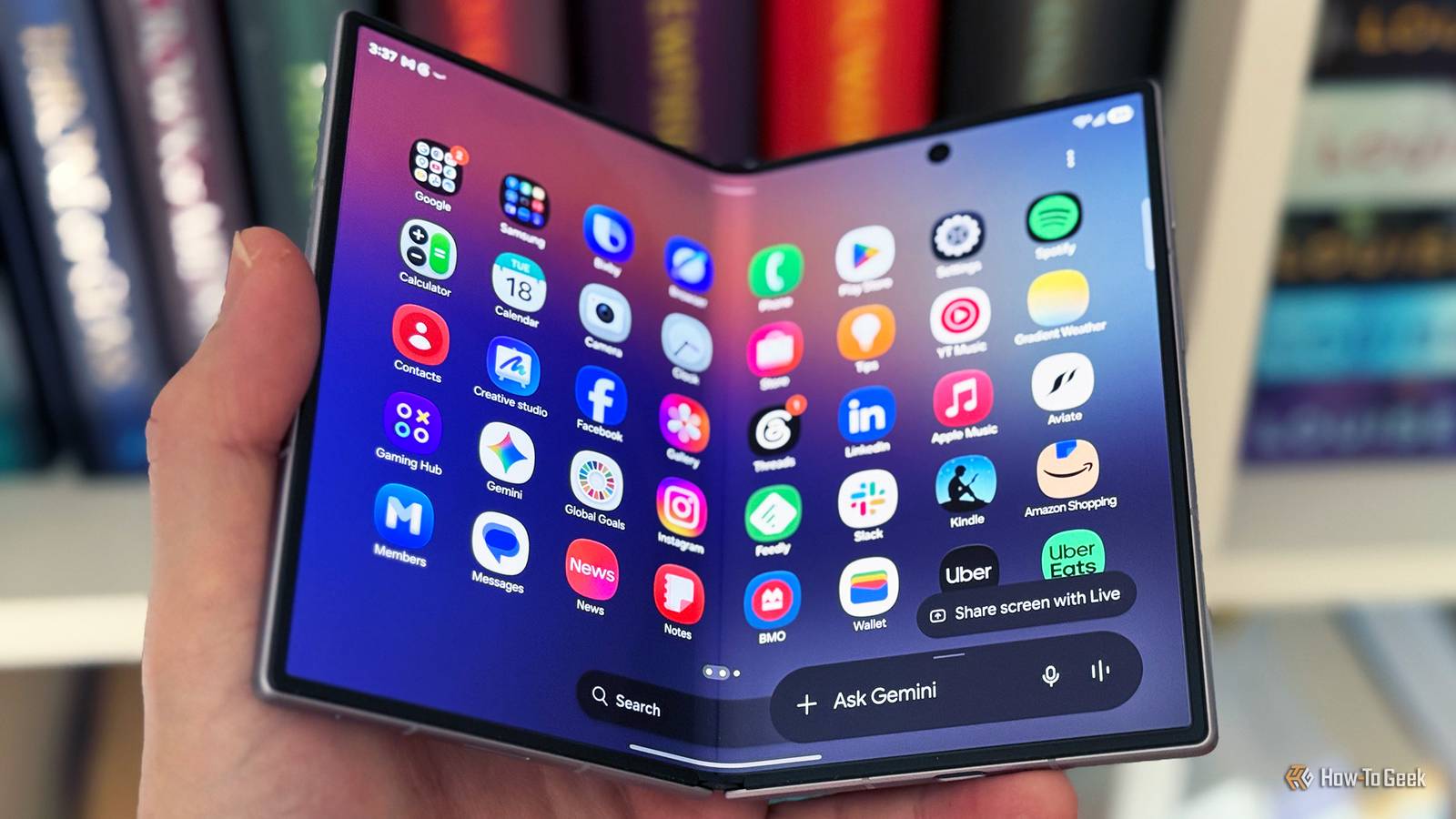
Samsung's Galaxy Z Fold8 launched in early August for $1,900, with a passport-like shape that is more pocketable than previous versions while unfolding into a small tablet.
On the reviewer's account, the crease on the Fold8's inner screen is barely noticeable.
Samsung says it is targeting people who consume video on their phones with the Fold8; the Fold8 caters to the mainstream use of watching videos and playing games.
The Fold8's outer screen uses a 16:10 aspect ratio, the same as Samsung's 2011 Galaxy Note, making it shorter and wider than any other modern flagship phone.
The main challenge with the Fold8's cover screen is one-handed use: reaching across the screen with a thumb while gripping the phone in the palm is a struggle, and balancing the phone under the fingers is easier but feels precarious.
Some apps and websites are not ready for squatter displays: the reviewer nearly lost a Connections streak because the Fold8 cut off the site's "One Away" messages, which he first took for a bug before realising they were appearing just out of frame.
Follow any of these and your For You feed starts watching them — no settings page required.
Evidence-backed comparisons of source perspectives and observed adoption signals. Read the methodology
Which Builder, Operator, and Investor concerns the observed source mix emphasized—not a truth score.
Evidence, demonstrated adoption, hype gap, incentives, and confidence are assessed independently, each on its own current evidence. How these are measured.
One hands-on review with named vendor and analyst sourcing, no independent measurement
Claims rest on a single publisher's multi-week hands-on use plus on-record quotes from a Samsung SVP, a Techsponential analyst and a Google product manager. Design facts (aspect ratios, hinge omission, product segmentation) are checkable and internally consistent, but the load-bearing quality judgments (faint crease, precarious grip) are subjective, the 60% usage figure is vendor-supplied without methodology, and the Apple comparison is rumour aggregation.
Product is shipping and priced, but no demand or developer-adaptation data
There is hard evidence of availability: the Fold8 launched in early August at $1,900 and the Fold8 Ultra continues with the older panel and hinge, so the segmentation is real and in market. Beyond shipment, the cluster offers no units sold, share, sell-through or attach data, and no measure of how many apps or sites handle the squatter cover screen - only one anecdote where a site's UI rendered off-frame.
Roughly aligned; vendor framing runs slightly ahead of the evidence
The article's own thesis - that the passport shape relocates rather than removes foldable compromises - is well supported by its reporting and is deliberately deflationary. The residual gap is vendor-side: Samsung's framing of the Fold8 as wiping away remaining compromises for broader appeal, and the 60% consumption statistic, are unaudited, while the model pitched for video consumption is also the one that cannot be propped open hands-free. Rumoured Apple validation adds unearned momentum to the shape narrative.
Vendor and analyst sources with clear commercial stakes; reviewer access dependency
The primary interviewee is Samsung's own SVP of mobile product management promoting a shipping $1,900 product and its pricier sibling; a second source is an industry analyst whose firm covers these vendors; a third is a Google product manager defending a competing design choice. The reviewer depends on vendor device access, and the Apple angle is sourced to a rumour aggregator with traffic incentives. The publisher partially offsets this by printing disagreement, including a Samsung executive preferring a different model.
Moderate-low: facts are plausible and specific but wholly single-source
Hardware and segmentation facts are specific, attributable and unlikely to be wrong, which supports moderate confidence. But every claim traces to one publisher, the experiential judgments are unverifiable, no third party has measured crease, durability or layout compatibility, and the forward-looking Apple element is explicitly rumour. Confidence is capped well below high.
product
Samsung fixed the crease. The Fold8 and Fold8 Ultra now sit $200 and one zoom lens apart.2 distinct publishers
product
Eight smartwatches reach their support cutoffs in one four-month window, and the hardware is fine1 distinct publisher
invest
Apple's foldable enters a 1.6% market at $2,000-plus, minus telephoto and Face ID1 distinct publisher
product
Apple splits the iPhone 18 launch, and autumn 2026 becomes a Pro-only quarter1 distinct publisher
Distinct publishers with included, body-backed reporting in this cluster.
1 article · August 25, 2026