Science1 publisher2 min readPublished
Nearly complete Gobi skeleton places zhelestid mammals among shrew-like zalambdalestoids
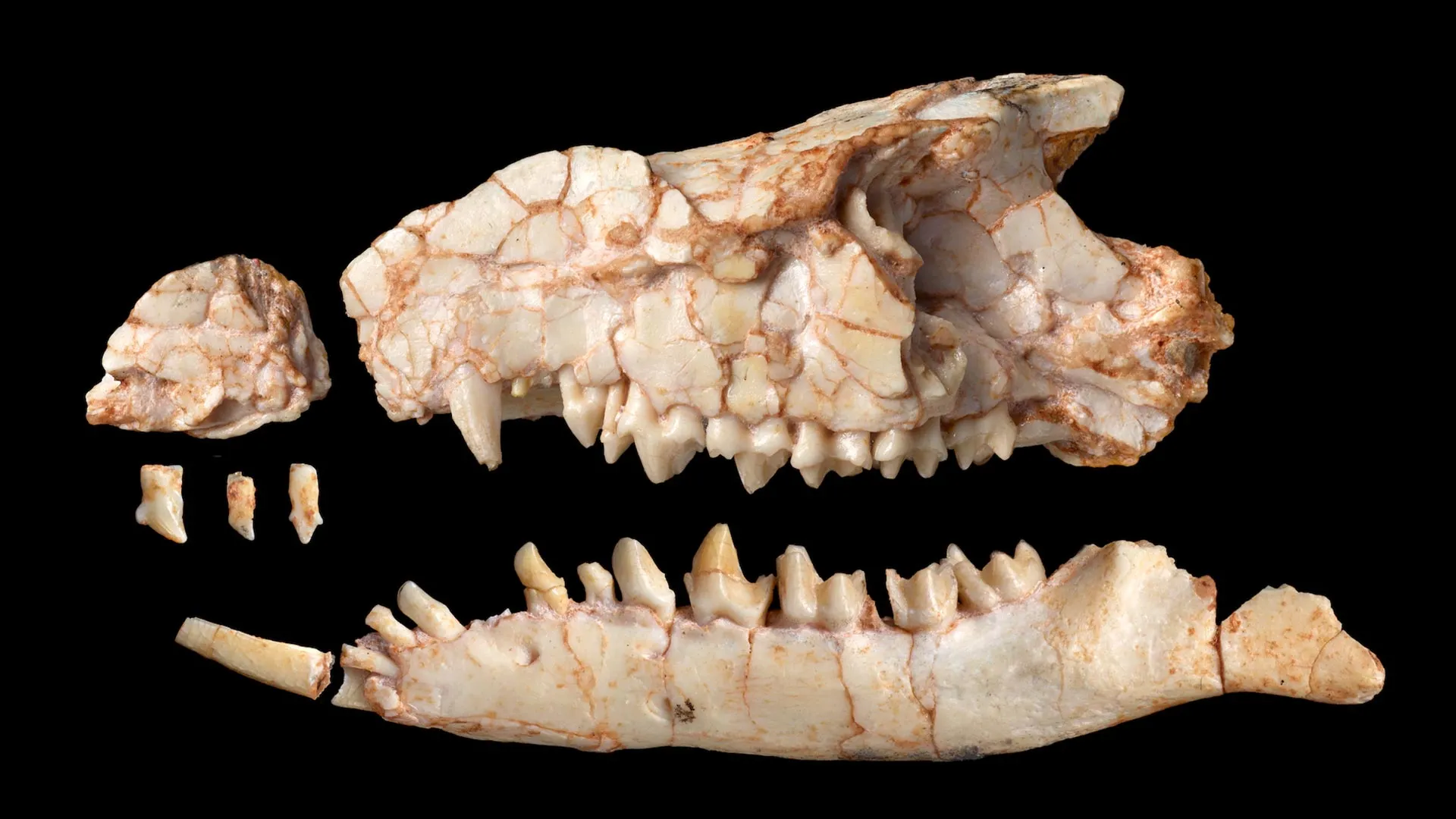
Researchers describing Tamirkhan balcarceli in Nature place zhelestids, long argued to be early placental relatives, among shrew-like zalambdalestoids. The Gobi skeleton suggests teeth alone misled the group's classification for nearly 40 years.
The Scientist · Science desk
What happened
- Lead author Andres Giallombardo found the specimen in the eastern Gobi as a graduate student on a 2004 American Museum of Natural History expedition.
- Earlier zhelestid finds were mostly isolated teeth or incomplete remains, and Tamirkhan is the most complete specimen of the group found so far.
- Those teeth were unusually suited to eating plants for a Cretaceous mammal, at a time when sharper insect-eating teeth were common.
- Beside its low, rounded zhelestid teeth, Tamirkhan has long, continuously growing incisors and skull features seen in zalambdalestoids, small shrew-like insectivores.
Compiled by The ScientistSomething wrong?How this is made
Why it matters
- constraint Anyone building a fossil case for placental mammals deep in the Cretaceous, as molecular clocks predict, now has to look for it outside the zhelestids.
- exposure Other Cretaceous mammals placed mainly on isolated teeth are open to the same convergence error that kept zhelestids misclassified for nearly 40 years.
- capability A near-complete zhelestid lets anatomists compare the group bone by bone with its relatives, where before they had to infer the body from teeth.
A skeleton lets paleontologists test a classification built on teeth against the rest of the animal. In Tamirkhan, the skull and the hind limbs both point away from placental mammals [8]. "Tamirkhan's hind legs are long and slender with distinctive ankles, traits that are unmistakably zalambdalestoid," said Shawn Zack, a paleontologist at the University of Arizona and an author of the study [9]. On the combined evidence, the team concluded that zhelestids were neither placental mammals nor especially similar to them, and that they belong within the zalambdalestoid group [2].
The placental hypothesis had rivals [7]. Some paleontologists proposed that zhelestids were an unknown group of hoofed mammals [7]. Others debated whether they were placentals living in the Cretaceous, part of the group that today includes humans and most living mammal species, or a separate lineage that evolved similar traits on its own [7]. Tamirkhan comes down on the side of the separate lineage [2].
That leaves the teeth to explain. The authors put their resemblance to the teeth of many plant-eating mammals down to probable convergent evolution, in which unrelated animals develop similar traits as they adapt to comparable ways of life [10]. They also suggest that Cretaceous mammals may not have been as anatomically varied as their teeth alone implied [11].
Molecular clock studies have supported placental mammals originating well before the end of the Cretaceous, and the museum presents the fossil as physical evidence pointing in another direction [12]. "Molecular models based on living animals can predict the past, but fossils provide the evidence needed to test those predictions," said Paul Velazco, a comparative biologist at Arcadia University and a coauthor [13]. The thing this fossil doesn't tell you is when placentals arose. In my view it weakens the fossil case for an early origin without refuting the molecular dates. What it shows is narrower: one group proposed as Cretaceous placentals was something else [2].
The sample is one specimen [4], and its verdict is being extended to a whole group [2]. Its incisors, skull and hind limbs agree with one another [8][9]. The museum's summary of the Nature study does not report statistical support for the placement [1].
Giallombardo's description came about 22 years after he found the specimen [1]. "This discovery illustrates why fieldwork remains indispensable to understanding life's history," he said [14].
What to watch
- Whether other teams rerunning the analysis with the new skeleton recover the same zalambdalestoid placement, and how strongly the Nature paper's data support it.
- New zhelestid skeletons from the Gobi that show whether Tamirkhan's incisors, skull and ankles are typical of the whole group.