Product1 publisher2 min readPublished
BASE trucked 92 antiprotons 7.5 km out of CERN to escape the facility's magnetic noise
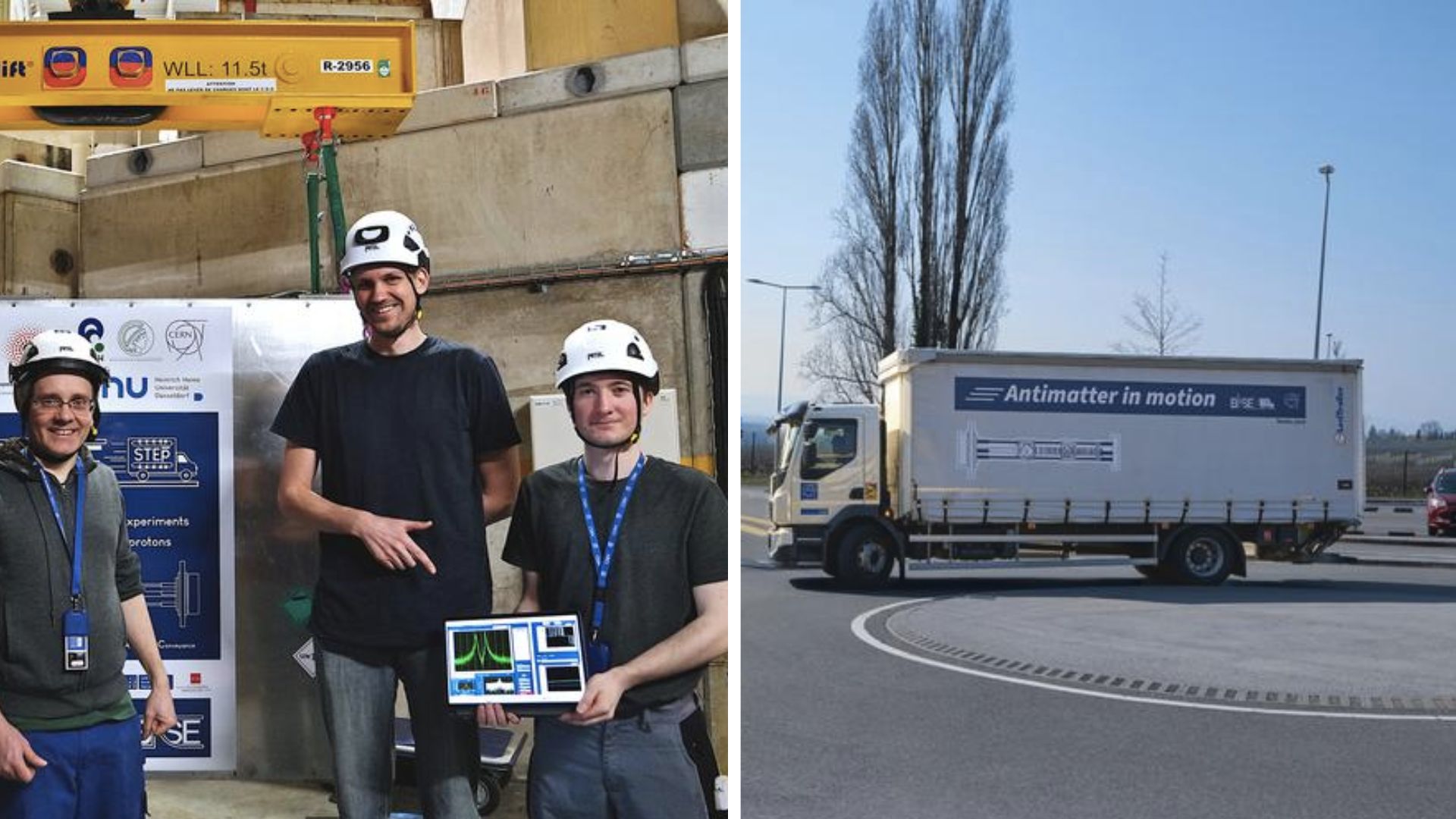
The trap lost no particles on the road run and has held antiprotons for more than a month, and the collaboration's stated reason for moving them is that running the facility itself shakes the magnetic field its instruments depend on.
The Product Desk · Product desk
What happened
- Ninety-two trapped antiprotons rode 7.5 km outside CERN's Antimatter Factory in a purpose-built trap on a truck, with no particle loss and no measurable degradation of the trap vacuum.
- The BASE collaboration also reports holding antiprotons in a mobile transport vessel for more than a month, which it says had never been done before.
- The Antimatter Factory remains the only facility in the world where low-energy antiprotons can be produced, stored and studied, according to a press release.
- BASE compares protons and antiprotons to look for a difference in mass or magnetic moment that could point to the origin of the matter-antimatter asymmetry seen in the cosmos.
- It is the first road transport of antiprotons, carried out in a trap built for the purpose and loaded onto a vehicle.
Compiled by The Product DeskSomething wrong?How this is made
Why it matters
- capability Precision antiproton work can now be sited where the magnetic environment is quietest, because the particles travel to the instrument; HHU is building a laboratory on that assumption.
- constraint Production stays at CERN, so any offline laboratory runs on deliveries from Geneva with a shelf life bounded by how long the trap holds its particles.
- decision Groups planning antiproton instrumentation now have to weigh shielding and scheduling around beam operations against building a trap that can be driven away from them.
The machinery that makes low-energy antiprotons and the equipment that measures them share one facility, and operating the first disturbs the second. "We cannot improve the level of measurement accuracy any further at the AMF as facility operation causes magnetic-field fluctuations, which affect our measuring equipment," said Dr Christian Smorra, the BASE-STEP principal investigator and corresponding author of the study [8][10].
So the team moved the sample. The trap had to hold its particles through the drive and hold them for the duration. Those were tested separately. Ten hours of driving, the Geneva-to-Düsseldorf run Smorra names as the next target, is about 1.4 percent of the month the trap has already held antiprotons [3]. "We completed a successful dress rehearsal with the transport in March and were able to demonstrate that our idea works. Our next target is to make the trap sufficiently autonomous to allow a ten-hour transport from Geneva to Düsseldorf," Smorra said [12].
"In recent years, we have already achieved precision measurements of the intrinsic magnetic moment of both types of particles with an accuracy of 0.3 ppb for protons and 1.6 ppb for antiprotons," said Professor Stefan Ulmer, BASE's founder and spokesperson and a co-author of the Nature study [6][7]. The antiproton figure is about five times coarser than the proton one, so the antiproton side limits the comparison [1]. Smorra's stated aim for an offline site: "We can only find better conditions outside CERN. And so the idea of the mobile open BASE-STEP trap was born: We will transport the antiprotons to another location with a high-precision laboratory in order to achieve an at least 100-fold improvement in precision," he said [9]. Applied to 1.6 ppb, a factor of 100 works out at 0.016 ppb [2]. The quote does not tie the factor to a particular measurement.
One destination is the high-precision laboratory Ulmer's team is establishing at HHU, built for comparison measurements of protons and antiprotons [11]. Ultra-high-vacuum Penning traps are what make those measurements possible in the first place, and BASE-STEP is a mobile one [14][4].
For anyone whose measurement is capped by the room it happens in, the first question is whether the ceiling comes from the instrument or from the site; Smorra's account puts it in the site [8]. The second is whether the payload survives relocation, which a trap can answer by counting particles at both ends and reading the vacuum gauge [3]. BASE has that answer for 7.5 kilometres. The ten-hour version has not been run yet, because trap autonomy is still the next target [4].
What to watch
- Whether the trap can hold particles and vacuum unattended for the full ten hours Smorra sets as the condition for the Geneva-to-Düsseldorf run.
- Whether the HHU high-precision laboratory, once operating, delivers the at least 100-fold improvement Smorra states as the aim.
- Whether a measurement taken on transported antiprotons shows the offline site is in fact magnetically quieter than the AMF.